Chapter 13: Faiths and traditions · Part 6
Judaism
Five movements. Every synagogue requires the Ark (aron kodesh) on its front wall, a Bimah, and a Torah scroll (bought, not placed: $30,000), and expects a ner tamid, a yahrzeit board (for the weekly yahrzeit, the rite every synagogue keeps), a social hall for the kiddush, and the building facing east. Each keeps Shabbat from candle-lighting to nightfall and the Hebrew year, and buries promptly; the four movements with a union send it dues, and sell seats for the High Holy Days.
Reform Judaism its page →
America's largest Jewish movement: a Friday evening service, often the week's best attended, and a Shabbat morning service of Torah and haftarah, men and women sitting and leading together, and no counted minyan. Festivals are kept one day. Members pay dues and the High Holy Days sell seats, so membership is the budget; outsiders who come for Rosh Hashanah and Yom Kippur are your best prospects to join. The kitchen keeps no pork or shellfish without being kosher. A Torah reader is welcome but optional.
- Required: Ark (aron kodesh), Bimah, Torah scroll.
- Expected: a ner tamid, a yahrzeit board, a social hall, and the building facing east. The Hammond organ is discouraged.
- Fits best: the ark, bimah, ner tamid, and yahrzeit board (+0.5); pews, stained glass, and every formal item (+0.33); the pipe organ +0.17. The Hammond organ and handbells −1; chairs, the projection screen, drums, and the sound system 0.
The board of trustees calls the rabbi from the movement's placement list, with an interim between; the members vote on renovations and new building. URJ dues (3% of income, an estimate) are required, and the Union's regard rides on them; it can expel a temple, but has no other power over it. Women and men are rabbis alike, and the movement is affirming. Leaving takes a majority and costs nothing. Build the ark on the east wall and a bimah, and buy a Torah scroll, before anything else.
Conservative Judaism its page →
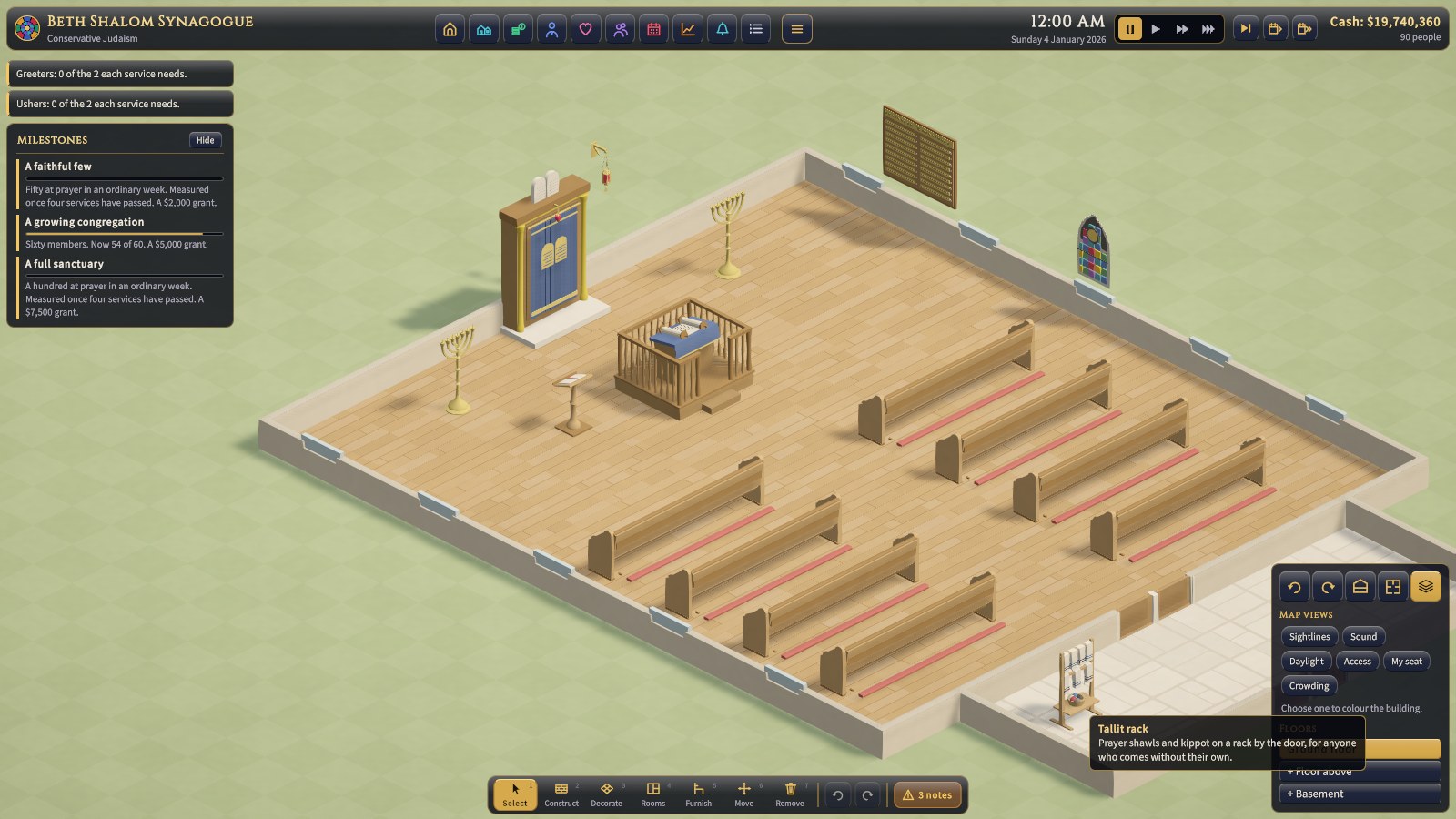
Traditional prayer, mostly in Hebrew, egalitarian in most congregations: Shabbat morning with the Torah service and Musaf, Kabbalat Shabbat at candle-lighting, and weekday minyanim morning and evening that need ten adults. Festivals are kept two days; a Torah reader is expected. The Traditional variant counts only men for the minyan, and only men lead. Keep the daily minyan alive: it's the core of the congregation, and the High Holy Days its biggest crowds.
- Required: Ark (aron kodesh), Bimah, Torah scroll.
- Expected: a ner tamid, a yahrzeit board, a social hall, and the building facing east. The pipe organ and the Hammond organ are discouraged.
- Fits best: pews, stained glass, pillars, and every formal item (+1); the ark, bimah, ner tamid, and yahrzeit board (+0.5). Drums and the sound system −0.5; chairs, the projection screen, the electronic and Hammond organs, and handbells −1.
The board of directors calls the rabbi from the movement's list, with an interim between, and the rabbi's view sways the members, who vote on renovations and new building. USCJ dues (3% of income, an estimate) are required, and the United Synagogue's regard rides on them. The kitchen is kosher: hire a mashgiach to bring meals down to 1.2×. Dues and seats pay for it. The congregation decides whether it's affirming. Leaving takes a majority and costs nothing.
Modern Orthodox Judaism its page →
The shul of an observant community that lives within walking distance: Shabbat morning, weekday minyanim of ten men morning and evening, Kabbalat Shabbat, and a strict Shabbat from candle-lighting to nightfall, with no instruments. Men and women pray apart behind a mechitza, or, in the Women's gallery variant, upstairs. Only men lead prayer, and a ba'al koreh, to read the Torah, is required at every service. Without ten men there's no minyan: grow the regulars before the building.
- Required: Ark (aron kodesh), Bimah, a Mechitza (unless the women pray in a gallery), Torah scroll.
- Expected: a ner tamid, a yahrzeit board, a beit midrash, a social hall, and the building facing east.
- Forbidden: organs, pianos, drums, and handbells. Discouraged: banners.
- Fits best: pews, stained glass, pillars, and every formal item (+1); the ark, bimah, mechitza, ner tamid, and yahrzeit board (+0.5). Chairs, instruments, the sound system, the screen, and banners −1.
The board of directors calls the rabbi, a man, from an open search, with no interim; his view sways the members, who vote on renovations and new building. Whether women sit on the board is the congregation's to decide. The OU's membership dues ($1,500 a year) are required. A kosher kitchen with its mashgiach, dues, seats, and tithing taught. It isn't affirming. Leaving takes a majority and costs nothing.
Reconstructionist Judaism its page →
Small, egalitarian, and lay-involved: Shabbat morning and Friday evening, a minyan of ten adults, two service leaders from the members expected at each service, a dairy-vegetarian kitchen, and pledges rather than dues. Festivals are kept one day. The Havurah variant is a small fellowship in rented space, its members preaching, its part-time rabbi chosen by consensus. Seats still sell for the High Holy Days.
- Required: Ark (aron kodesh), Bimah, Torah scroll.
- Expected: a ner tamid, a yahrzeit board, a social hall, and the building facing east. The pipe and Hammond organs and the national flag are discouraged.
- Fits best: the ark, bimah, ner tamid, and yahrzeit board (+0.5); chairs and the projection screen (+0.33), drums and the sound system (+0.17). Pews, stained glass, and formal items −0.33, the pipe organ −0.67, the electronic and Hammond organs, handbells, and the flag −1.
The members decide everything, calling the rabbi included; the rabbi teaches and facilitates, but doesn't govern, and its rabbis serve shorter terms than the other movements'. The affiliation dues (1.5% of income) are required, and falling behind on them costs the congregation its voice. Reconstructing Judaism lends from its Aviv Revolving Loan Fund, and can't expel a congregation. The movement is affirming. Leaving takes a majority and costs nothing.
Chabad-Lubavitch its page →
A center founded and run by its shluchim, a rabbi and his wife sent by the movement, who stay for life and are succeeded by their family. There are no dues, no seats, and no membership: everyone is welcome, and the center lives on gifts and grants, so keep people content and giving. Shabbat morning, Kabbalat Shabbat, and weekday minyanim of ten men; a ba'al koreh is expected; a strictly kosher kitchen and a full table for Shabbat meals.
- Required: Ark (aron kodesh), Bimah, a Mechitza, Torah scroll.
- Expected: a ner tamid, a yahrzeit board, a beit midrash, a social hall and a kitchen, and the building facing east.
- Forbidden: organs, pianos, drums, and handbells.
- Fits best: the ark, bimah, mechitza, ner tamid, and yahrzeit board (+0.5); chairs and the projection screen (+0.33). Stained glass, pillars, formal items, drums, and the sound system −0.33, choir stalls and the pipe organ −0.67, pianos, the electronic and Hammond organs, and handbells −1. Its worship is informal and warm, whatever its Orthodox rules.
The rabbi decides everything himself, new building after hearing the advisory board, and the movement's region sends the next rabbi. Nothing is owed upward. Donors such as the Rohr Family Foundation give grants to a center in need, and the movement holds its rabbis' standing. It can't vote to leave.