Chapter 3
Growing the congregation
Growth is a funnel. New households walk in; some are welcomed well enough to come back; a few of those become regulars; regulars become members. Each stage has its own levers, and a congregation grows when it does well at every stage at once.
Stage 1: newcomers walk in
There are two ways in. Most traditions gather their people at a main service (Jumu'ah, Shabbat, the Sunday diwan or puja or sabha, a Sunday service), and newcomers come to it. Traditions that keep open hours (a Hindu temple's darshan, a gurdwara's open doors, a Jain center's puja, a Chinese temple's incense, a Shinto shrine's visits, Konko's mediation) also receive visitors every day they're open, and a few of those find their way back. A shrine and a folk temple hold no main service at all, so their open hours are their only way in.
At the main service
Each week, new households visit the main services at a rate of:
(0.3 + 0.004 × active people) × visibility × feasts × ministries and standing × lot × scenario
- Size helps itself. 100 active people draw about 0.7 new households a week; 300 draw about 1.5.
- Visibility. What stands over the building or on the grounds draws the eye: a great dome, a Gopuram, or a Steeple and bells +25%; a pagoda, a Shikhara, or a Vimana +22%; a Minaret +20%; a plain spire +15%; a small dome or a gurdwara's gilded dome +12%; a Stupa or a Buddhist temple bell in its belfry +10%; a shrine's Honden +3%; and a Torii, a Paifang, a Nishan Sahib, or a Hindu temple's Dhvajastambha +2%. Visibility is capped at +50% in all.
- Feasts. A tradition's great days bring newcomers by how many they draw, from two to five times the usual new households: the High Holy Days four or five times, the Eid al-Fitr prayer, Diwali, and Vaisakhi four, Samvatsari and the folk temple's New Year five, Vesak, Obon, and Tết three, Christmas and Easter three, and Christmas Eve four. Lesser feasts' pull on newcomers is capped (see Worship and the year). Be ready for the great days, with seats and greeters, and in a church or a synagogue the season's decor.
- Ministries. Each adds newcomers, and each faith has its own: a preschool +15% (any faith), a Daoist temple's tai chi classes +15%, SGI's discussion meetings and ISKCON's harinama +12%, meditation for beginners at a Buddhist temple and Preksha meditation at Jain Vishva Bharati +10%, yoga for the neighbourhood at a Hindu temple, a folk temple's welcome desk for new arrivals, and a food pantry +8%, a new Muslims' circle and a lion dance troupe +6%, an open mosque, a youth chapter, or a youth group +5%, Sikh youth +4%, a church choir +3% (see The congregation in its community). The congregation's standing in the community above 0.3 adds more: 0.5 brings a fifth more. See The congregation in its community.
- Outreach. A mailing to 300 homes ($225) usually brings 3 to 6 households over the next few weeks, on top of the usual newcomers.
- Your own faith. About half of newcomers come from another congregation, and nearly always one of your own faith: a synagogue's from other synagogues, a gurdwara's from other gurdwaras, a church's from other churches. One in twenty of those comes from any faith.
- The lot. A city lot brings 1.3 times the walk-ins of a suburb; a country lot 0.7 times.
- A change of practice draws people looking for just that, for a year (see Faiths and traditions).
At open hours
Where a tradition keeps open hours, each day's window brings visitors who don't belong, as well as its own people:
- How many. Each day's window draws a share of a week's newcomers to the main services, as the tradition sets it: a fraction a day at most temples, as many at a Hindu temple's weekend and half as many again at a BAPS stone mandir, nearly as many at a folk temple, and two and a half times as many at a shrine, nearly all passing through. A feast day draws many more: a shrine's New Year (nine times the usual visitors) brings thousands.
- Who comes back. Most visitors are counted, give (about $2 in the box, and $4 more at an amulet counter), and go. A quarter of them, never more than three a stretch however great the crowd, might come back, and become newcomers like any others.
- How they settle. A newcomer who comes only at open hours settles in after six visits, twice a main service's three. Where the week has no main service (a shrine, a folk temple), the open hours are its gathering: a newcomer comes back as often in a week as to a Sunday service, spread over the days it's open, and settles in after three.
- What a visit is worth. Each visit counts a quarter of a main service: the building and its worship room, and whether anyone welcomed them (How people feel works one through). The size of the congregation, visibility, the lot, ministries, standing, and curb appeal raise open hours' visitors as they raise the main service's newcomers, and bad weather thins them.
See Worship and the year for how open hours run.
Stage 2: the first impression
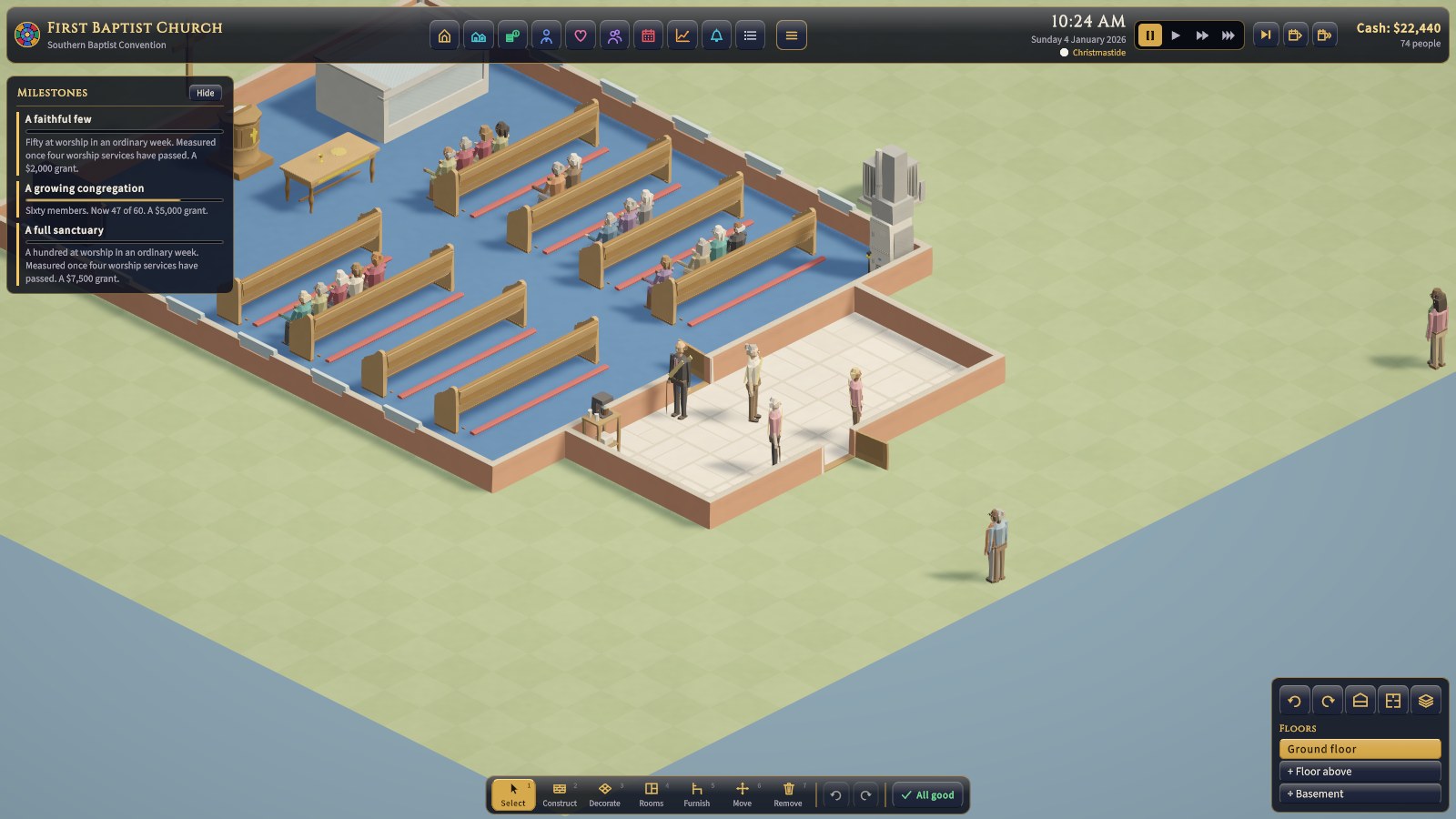
A visitor's satisfaction moves 60% of the way to their first service's target, so the first visit is everything. The biggest single factor is being welcomed: +0.15 if greeted, −0.1 if not, a swing of 0.25. The chance of being greeted is:
| Source | Adds to the chance |
|---|---|
| Base | 0.2 |
| An entrance hall (the narthex in a Christian tradition: an enclosed room with the outside door) | +0.45 |
| A crowd around (up to) | +0.15 |
| Two greeters on duty (at a service: open hours keep no rota, so none are on duty there) | +0.25 |
A building with an entrance hall and two greeters welcomes nearly everyone (up to 95%). One where visitors walk straight into the worship room with nobody at the door welcomes one in five. Ushers showing them to a seat add another +0.03. The entrance hall is the same room in every faith, by its own name (the narthex in a Christian tradition, the lobby at a synagogue or mosque, the Latter-day Saints' foyer, and the entrance hall elsewhere): where a mosque's, a temple's, or a gurdwara's visitors take off their shoes, and where a gurdwara keeps the head scarves a visitor can borrow (+0.02, or −0.03 if there are none).
An entrance hall and two greeters on duty at every main service are the single best investment in growth. Greeters cost nothing.
Everything else a visitor feels counts too, and counts hard: a seat (+0.05) or standing (−0.15), a restroom when they need one, a nursery for their baby, the sermon (or khutbah, katha, dharma talk, or pravachan), and the building.
Stage 3: coming back
A visiting household comes back each week with a chance of (satisfaction − 0.5) × 1.5, capped at 50%.
| Visitor's satisfaction | Chance of returning each week |
|---|---|
| 0.5 or less | never |
| 0.6 | 15% |
| 0.7 | 30% |
| 0.83 or more | 50% |
After three visits at 0.55 or more, a household becomes regular (six, if it comes only at open hours where there's a main service too). A visiting household that hasn't been back in four weeks is gone.
Stage 4: belonging
A regular becomes a member the way their tradition receives people. In most traditions of every faith, a content regular (0.5 or more) of the tradition's age joins after the tradition's wait; in Christian traditions that baptize, it depends on whether they've been baptized, and where. Members come more often (+0.1 to their chance of attending) and give far more readily, by pledge or by dues (see Money). Each tradition's own page in Every tradition: services and what they need gives its ages and waits.
| Faith | How a content regular is received, and the wait |
|---|---|
| Judaism | Joins as a member household: after six weeks at a Reform or Conservative synagogue, four at a Modern Orthodox or Reconstructionist one. Chabad has no formal membership: a regular of three months belongs. |
| Islam | Joins as a voting member after six months at a Sunni or Shia center, three at the W. Deen Mohammed community or an Ahmadi chapter (from 15); the Nation of Islam registers its members after eight weeks. |
| Buddhism | A month at a Buddhist Churches of America temple, eight weeks at a Zen or Tibetan center or a Chinese Buddhist temple (where those who join have taken refuge), twelve at an SGI center. A Theravada or Vietnamese temple has no formal membership: a regular of three months belongs. |
| Hinduism | A month at a Hindu temple, an Indo-Caribbean mandir, the Arya Samaj, a Chinmaya center (by enrolment), or a Sathya Sai center; eight weeks at BAPS or an ISSO temple (by the vows, kanthi and vartman, from 12 at BAPS) or SRF (by the Lessons); six months at ISKCON (by initiation) or a Vedanta Society. A Hindu temple's voting members are its life members, who pay $1,001 once. |
| Sikhism | Joins the gurdwara's General Body, with a vote, after three months, from 18. |
| Jainism | Eight weeks at a Jain center or Jain Vishva Bharati; a Jain center's life members pay $301 once. |
| Shinto | A month to join a shrine's supporters' association (the sukeikai) or a Tenrikyo church. A Konko church has no formal membership: a believer of three months belongs. |
| Chinese religion | Six months to join a folk temple's association, eight weeks at a Daoist temple, twelve at Yiguandao, where many are initiated at once (qiudao) and fewer go on to be cultivators. |
| Christianity | By baptism and reception, as below; where there's no baptism, after the tradition's wait. |
- Baptized in a church yours recognizes (Christian traditions) (a Catholic parish recognizes any baptism in the Trinity's name; a Baptist church only a believer's; the Latter-day Saints only their own): content (0.5 or more), they ask to join after a short wait (a week from another church of your tradition, two to twelve weeks from others), and are received at the next service they come to. In a tradition that confirms, they're confirmed (or chrismated) with it.
- Not baptized, or baptized where yours doesn't recognize it: they become a candidate, prepare for the tradition's months (none for a Baptist church, about two for the Latter-day Saints, nine for the Orthodox, a year for a Catholic catechumen), and are baptized and received at the same service. A Catholic parish receives the unbaptized only at Easter, the Orthodox at Pascha, and the Witnesses baptize at their assembly. Preparation needs its class to meet: a classroom or an office, and the pastor or a teacher from the school. Without one, the months don't count, and the building check says so.
- No baptism (Friends, the Salvation Army, Christian Science, Unitarians, as in every other faith): a content regular is received after the tradition's wait (six months for Friends and Christian Science).
Across the faiths, the ways in take several shapes: a wait and a welcome (most synagogues, mosques, and temples); vows (BAPS's kanthi and vartman); initiation (Yiguandao's qiudao, many initiated at once; ISKCON's harinama); enrolment (Chinmaya Mission's family membership, SRF's Lessons); a life membership with a fee, paid once (a Hindu temple's, a Jain center's), without which a household doesn't vote (Money); baptism (most churches); or no formal membership at all (Chabad, a Theravada or Vietnamese temple, a Konko church, Calvary Chapel), where a content regular of three months belongs, without a vote. The school (Hebrew school, a weekend Islamic school, Dharma School, Bal Vihar, a Punjabi school, pathshala, Sunday school) and small groups halve the waits and double the chance each month.
The church's own children. In Christian traditions where believers are baptized, they're baptized at about the tradition's age (8 for the Latter-day Saints, 9 for Southern Baptists, 12 for Adventists and Churches of Christ, 15 for Mennonites), mostly within a year or two of it, and are members from then (or when old enough). Where infants are baptized, babies are, and in most such traditions they're baptized members, without a vote. At the age, a confirmation class prepares them (2 years in the ELCA and the Missouri Synod, 9 months for Methodists and the UCC, 6 for Presbyterians and Episcopalians), and the yearly rite (Pentecost for confirmation) confirms those who come full members. The rite is held only when there are candidates. Other faiths mark a child's birth and coming of age with rites of their own (a bar or bat mitzvah, consecration on Simchat Torah, and a Reform confirmation at Shavuot; the aqiqah for a newborn; a Hindu naming or the sacred thread; a Sikh naam karan; a Shin temple's Hatsumairi; a shrine's Shichi-Go-San), which are kept as rites (see Worship and the year and Money) rather than as a way into membership.
What it means. Being received (or baptized, or confirmed) is worth +0.1 to the person, +0.05 to their family there, and +0.03 to everyone else at the service. It roots them: a household with someone rooted here drifts away only 0.6 times as often, and if it falls away (unhappy, over a change, or the congregation's beliefs) it has a 25% chance of coming home at the year's great days, for ten years, as visitors who settle back in at their next visit: at the tradition's own great days (the High Holy Days, the Eids, Vesak, Diwali, Vaisakhi, a shrine's New Year, the Witnesses' Memorial), or each Christmas Eve and each Easter where the tradition keeps the church year, at most once a month.
The People screen's membership class, once a quarter, prepares regulars of three months at once: they're received at their next service, and in a Christian tradition that baptizes, those not baptized where it recognizes are baptized and received together.
Friendships form by themselves between people who sit together, and they hold households in place. Each friend at the same service adds +0.03 (up to +0.1), and each friend in the congregation makes drifting away 15% less likely. Grudges form the same way and cost −0.05 when someone they resent is at the same service.
Why congregations shrink
- Households drift away below 0.45 satisfaction.
- 3% of households move away each year, whatever you do.
- People die, and older congregations lose more.
- Grown children leave home at a fifth a year: half stay in the church with a household of their own, half move away.
- Conflicts and changes of practice drive some away (Projects, approvals and conflict, Faiths and traditions).
A congregation that welcomes poorly loses visitors faster than it gains them, and natural losses do the rest. That's the "dying congregation": not a disaster, just a slow leak.
The People screen
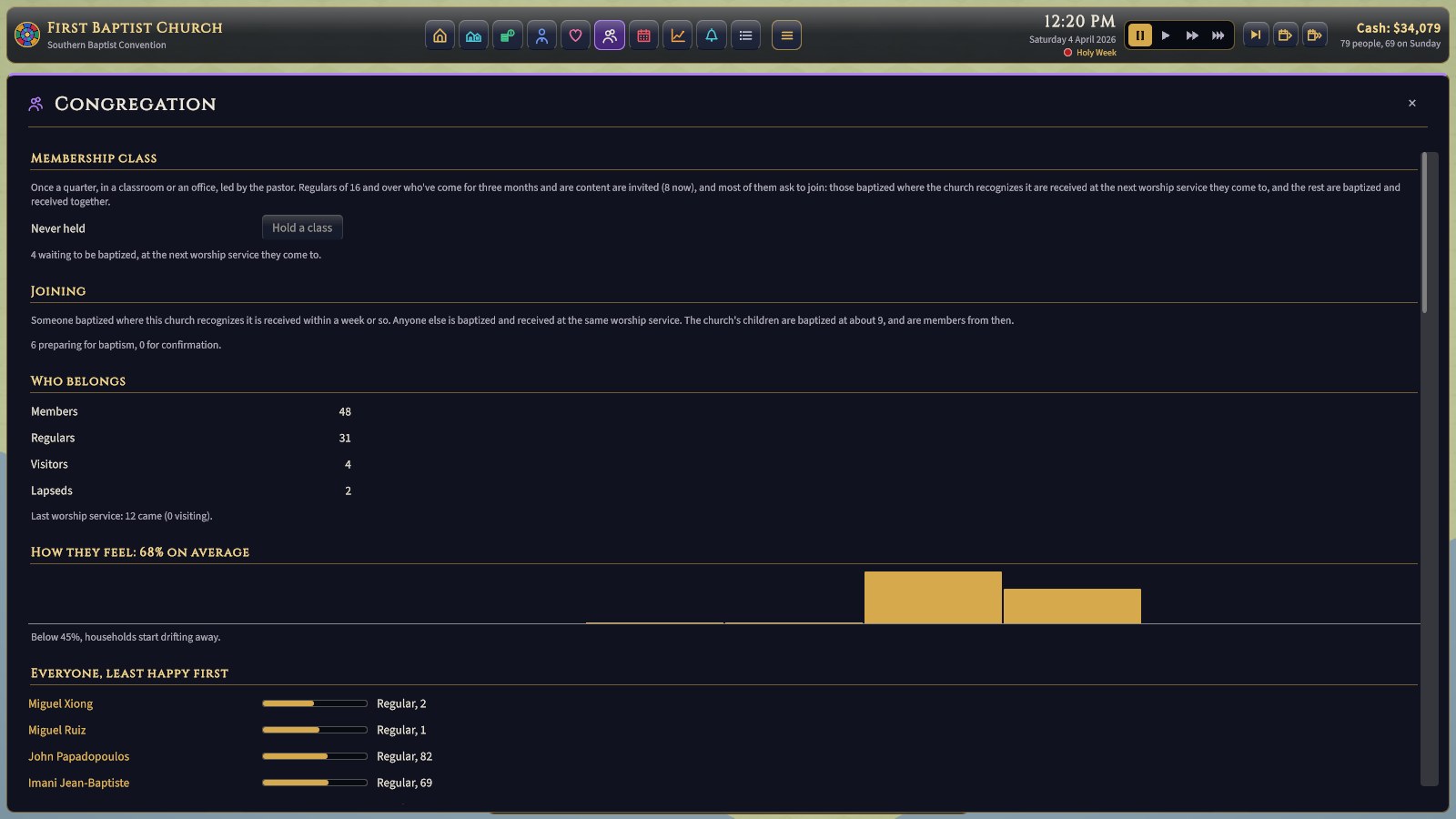
People has two tabs. People counts who belongs and charts their satisfaction, with a line at 45% where households start to drift. Below that, everyone is listed least happy first with their status and years attending. Click a name to open their inspector and bring them into view. Work down from the top of the list: the least happy are the ones about to leave.
Services
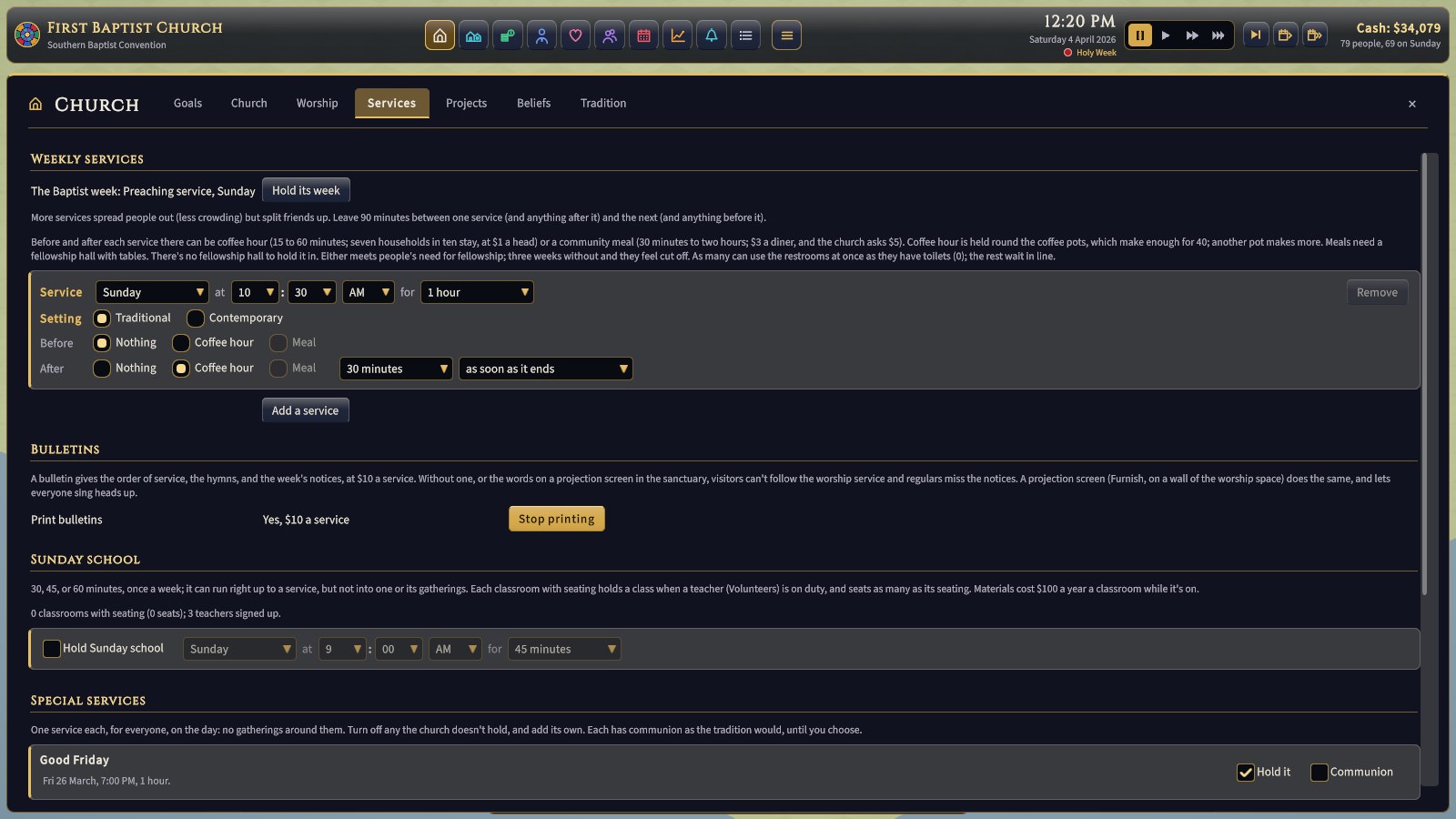
A congregation can hold up to eight main services a week, and up to 42 short daily ones (a mosque's daily prayers, a minyan, a temple's aratis, a gurdwara's dawn and evening prayers, a morning sitting) with any open hours beside them, which the Services tab shows together under Daily services, a row for each with a chip for every day. Each household keeps to one of the main services; the daily ones people come to one by one. More main services spread people out, so there's less crowding and fewer people standing, but they split friends up. Leave 90 minutes before a main service (15 before a daily one). A service timed by the sun (Jumu'ah after midday, Maghrib at sunset) moves through the year, and the game checks the gap for every week of it. Remember that every extra service needs its own greeters, ushers, and nursery workers on duty (see Staff and volunteers).
A growth plan that works
- Welcome: an entrance hall with an outside door, two greeters and two ushers at every service.
- Seat everyone: seats for your busiest service and for its great days (the High Holy Days, the Eids, Diwali, Vaisakhi, Samvatsari, Christmas and Easter), or add a service.
- Meet needs: a restroom with plumbing, and a nursery with a nursery worker on duty.
- Fix what the tradition requires, then what it expects.
- Reach out: a classroom for a preschool, a hall for a food pantry, your own faith's ministries that draw newcomers (an open mosque, yoga for the neighbourhood, meditation for beginners, tai chi, a lion dance troupe, Sikh youth), and a mailing every month or two. Where the tradition keeps open hours, keep them open and the welcome warm: they bring visitors every day.
- Keep people: watch the bottom of the People list, and fix what their last-service factors show.