Chapter 10
Staff and volunteers
Staff cost more than anything else a congregation buys, and the right ones are worth it: a great preacher or teacher (a pastor's sermon, a rabbi's d'var Torah, an imam's khutbah, a granthi's katha, a swami's discourse) lifts everyone every week. How your clergy come, how long they stay, and who pays them is your tradition's to say, and this chapter shows each way. Volunteers cost nothing at all, and are among the best value in the game, as long as you don't wear them out.
Staff
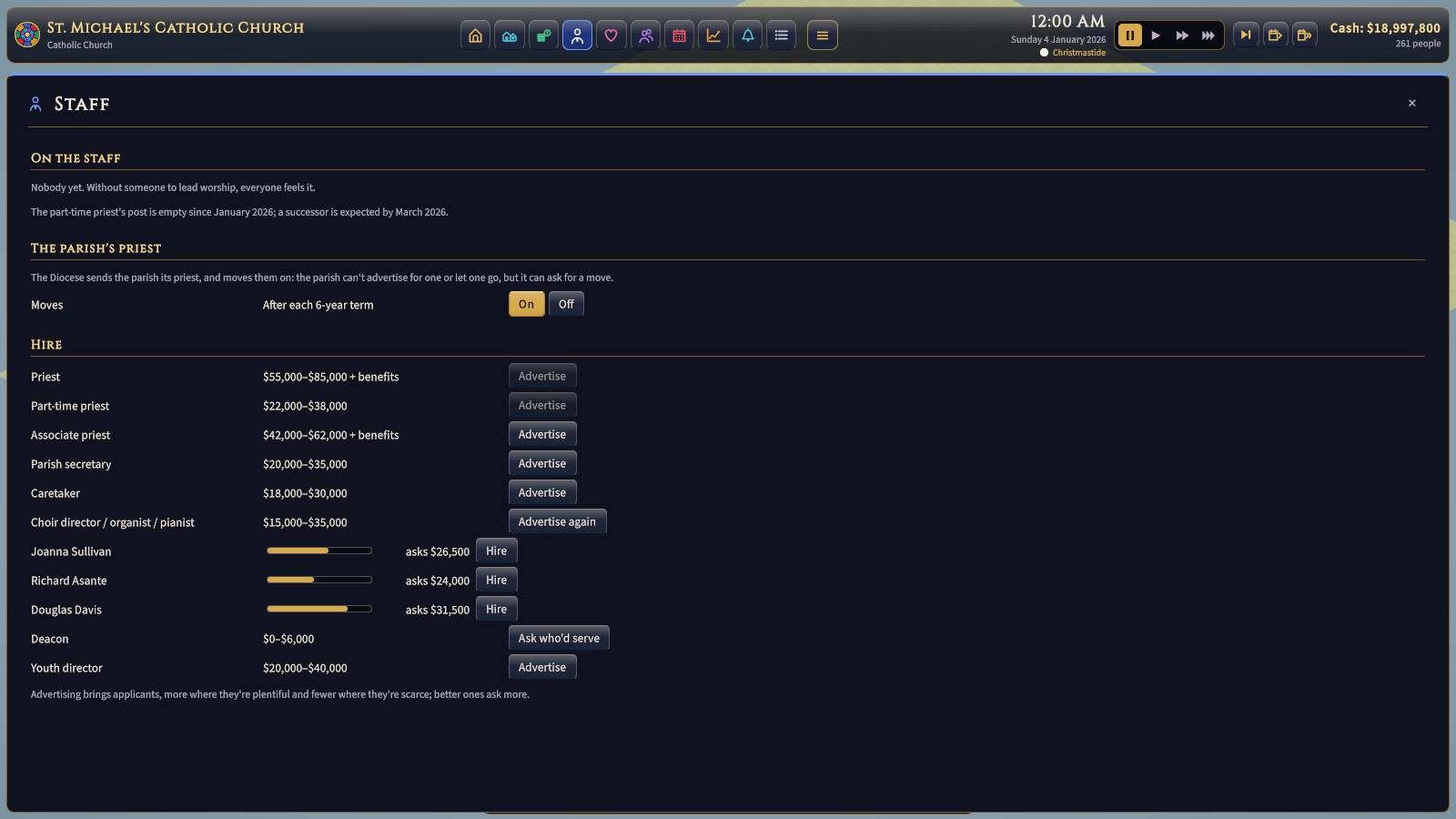
| Role | Salary a year | What they do |
|---|---|---|
| Leader (full time), named as your tradition names it: pastor, priest, rabbi, imam, minister, granthi, head priest, swami, chief priest | $55,000–$85,000 + $18,000 benefits | Preaches or teaches, leads worship, and cares for the congregation. Can know about 150 people well. Where the leader is a monk or nun the temple keeps (a Theravada or Vietnamese abbot, a Chinese Buddhist abbess, BAPS's and ISSO's swamis, Jain Vishva Bharati's samanis), they lead as this, unpaid and without benefits, living in the temple's own quarters. |
| Bivocational leader (a bivocational pastor, rabbi, pandit, minister) | $22,000–$38,000 | Preaches and leads worship part-time, alongside another job, as most small congregations' leaders do, and as the Indo-Caribbean mandir's pandit, the Arya Samaj's acharya, a Zen center's teacher, and the Konko and Tenrikyo ministers usually are. Can know about 75 people well. |
| Associate (full time: an associate pastor, rabbi, imam, granthi, priest) | $42,000–$62,000 + $15,000 benefits | A second leader, who preaches some weeks and shares the care. Can know about 100 people well. Only where your clergy are paid. |
| Lay leader | unpaid | A member called to lead, alongside their own work: an elder, a Reader, a bishop of a ward, an imam who leads unpaid, a Yiguandao master. Can know about 60 people well. Only where your tradition's leaders are unpaid (and not monastics), plural, or called from the members. |
| Deacon, local elder, and other assisting orders | unpaid (a deacon up to $6,000) | Named from the members, where your Christian tradition has them. Each cares for 30 more people (an IPHC church elder, 25). |
| Choir director / organist / pianist | $15,000–$35,000 | Plays the organ or piano, directs the choir, and chooses the music. Up to +0.06 for everyone. Part time. Christian and Jewish traditions only. |
| Youth director | $20,000–$40,000 | Runs the youth group and keeps teenagers coming. Up to +0.08 for households with someone under 19 (a tenth less where the tradition is discerning about entertainment, 30% less where it keeps its young from films and dances). Part time. |
| Caretaker | $18,000–$30,000 | Opens up, cleans, and fixes small things before they become big ones. Slows building wear by up to half. Part time. Once called the sexton. None where congregations share a hall, since its members clean it. |
| Secretary (in your tradition's word: church, parish, synagogue, mosque, temple, gurdwara secretary) | $20,000–$35,000 | Runs the office, the bulletin, and the calendar, so the leader can lead. The leader can care for 50 more people. Part time. |
Some roles belong to one faith, and the hire list offers only those that fit yours:
| Role | Salary a year | Where, and what they do |
|---|---|---|
| Cantor (full time) | $48,000–$88,000 + $15,000 benefits | Synagogues. The hazzan leads the sung prayers and chants the Torah, trains the choir, and teaches the b'nai mitzvah; leads worship where there's no rabbi. Directs the music as a music director does. Can know about 50 people well. |
| Education director | $30,000–$55,000 | Synagogues. Runs the Hebrew school. Up to +0.08 for households with young people, as a youth director. Part time. |
| Executive director (full time) | $55,000–$95,000 + $15,000 benefits | Synagogues and mosques. Runs the business side; the leader can care for 30 more people. |
| Mashgiach | $8,000–$24,000 | Orthodox and Conservative synagogues. Supervises the kosher kitchen, so a kosher meal costs 1.2 times an ordinary one, not 1.35. Part time. |
| Muezzin | unpaid | Mosques. A member who gives the adhan before each prayer and leads the prayer when the imam is away. Cares for 20 more people. |
| Qur'an teacher | $15,000–$32,000 | Mosques. Teaches recitation, and runs the weekend school's classes. Up to +0.08 for households with young people, as a youth director. Part time. |
| Community outreach director | $25,000–$45,000 | Mosques. Open houses, interfaith visits, new Muslims, the food pantry. Cares for 40 more people. Part time. |
| Resident monk or nun | up to $2,400 | Buddhist temples, and Hindu and Jain ones. An assisting order who lives at the temple on a small stipend while families bring food by turns; chants, gives the precepts, visits, teaches meditation. Cares for 40 more people. |
| Tanto | $6,000–$20,000 | Zen centers. Leads the practice beside the teacher. Cares for 40 more people. Part time. |
| Visiting lama | $6,000–$18,000 | Tibetan centers. Comes a few times a year to teach and give empowerments; teaches as the leader does while there. Part time. |
| Organist / pianist, Dharma School superintendent, minister's assistant | $8,000–$20,000; unpaid; unpaid | Japanese Pure Land temples (the Buddhist Churches of America): the gathas' music; the Dharma School; a certified member who leads the service when the minister is at another temple (cares for 30 more). |
| Ward clerk, counselors in the bishopric | unpaid | Latter-day Saint wards: called from the members beside the bishop. Each counselor cares for 30 more people. |
| Pujari (full time) | $24,000–$45,000 + $9,000 benefits | Hindu temples with deities. A priest beside the head priest, often from India and housed on the grounds: keeps the aratis, leads worship, and performs the rites families book, at the temple and in their homes. Cares for 30 more people. |
| Temple manager (full time; in your tradition's word: gurdwara, Jain center manager) | $40,000–$70,000 + $12,000 benefits | Hindu, Sikh, and Jain congregations. Runs the counter that books the rites, the rota, the kitchen, the hall, and the parking: the leader can care for 30 more people. |
| Cook | $22,000–$38,000 | Hindu temples and Jain centers. Cooks with the volunteers and keeps the kitchen to its rules. Part time. |
| School coordinator (Bal Vihar, Punjabi school, pathshala) | unpaid | Hindu, Sikh, and Jain congregations. A member who runs the weekend school: up to +0.08 for households with young people, as a youth director. |
| Assistant granthi (full time) | $24,000–$40,000 + $9,000 benefits | Gurdwaras. Opens the Guru Granth Sahib at dawn and lays it to rest at night, leads the Ardas, and reads paths in families' homes. Cares for 30 more people. |
| Ragi jatha (full time) | $36,000–$66,000 + $9,000 benefits | Gurdwaras. Three kirtan singers, at the harmonium and the tabla, who lead the music as a music director does; the pay is for all three. |
| Langri | $22,000–$38,000 | Gurdwaras. Cooks the langar with the volunteers. Part time. |
| Punjabi and kirtan teacher | $12,000–$28,000 | Gurdwaras. Teaches Gurmukhi, the Gurbani, and kirtan: up to +0.08 for households with young people. Part time. |
| Visiting scholar | $4,000–$12,000 | Jain centers. Brought from India for Paryushana and Das Lakshana, since the monks and nuns can't come: teaches and leads as the leader does while there, but knows few people well. Part time. |
| Pujari (shrine attendant, full time) | $22,000–$36,000 + $6,000 benefits | Jain centers with images. Opens and cleans the shrines and sets out the puja materials; slows the building's wear, as a caretaker does. |
| Negi (full time) | $30,000–$48,000 + $12,000 benefits | Shinto shrines. An assistant priest trained in Japan: makes the daily offerings and performs the prayers families book, at the shrine and away. Cares for 40 more people. |
| Miko | $8,000–$18,000 | Shinto shrines. Assists at the rites, dances the kagura, and keeps the shrine office, as a secretary does. Part time; always a woman. |
| Service teacher | unpaid | Tenrikyo. A member who teaches the dance and the nine instruments and draws up the monthly rota; leads the music. |
| Temple keeper | $15,000–$30,000 | Chinese folk and Daoist temples. Opens the doors, keeps the incense and lamps, and shows visitors the moon blocks: slows the building's wear, and cares for 20 more people. Part time. |
| Daoist priest | $6,000–$20,000 | Chinese folk and Daoist temples. Hired for the jiao, Pudu, the god's birthday, and funerals: leads those rites and performs the rites families ask for, but knows few people well. Part time. |
| Fortune-slip interpreter, tai chi instructor, lecturer | unpaid | Members: at a folk or Daoist temple, reading the god's answer (cares for 15 more); at a Daoist temple, teaching the tai chi classes (20 more); at Yiguandao, teaching the classes after initiation (25 more). |
A member of staff who performs rites (a pujari, an assistant granthi, a negi, a Daoist priest) can be booked for the rites families ask for, as the leader can, so the more of them, the more of the price list is held (Money). Pay for the new faiths' roles is an estimate.
Payroll taxes add 7.65% to every salary. The Staff screen calls your clergy what your tradition does: a Catholic parish hires no "pastor" but has its priest, a part-time priest, or an associate priest; a synagogue has its rabbi, a mosque its imam, a gurdwara its granthi, a Hindu temple its head priest, a shrine its chief priest, a Zen center its teacher, a Theravada temple its abbot; and a Salvation Army corps has its corps officers. This chapter says "leader" for all of them: read pastor, priest, rabbi, imam, granthi, swami, or teacher, as yours is. The assisting orders go by their own names too: the Free Methodists' consecrated deacons, the Witnesses' ministerial servants, a Latter-day Saint bishop's counselors, the Army's Corps Sergeant-Major.
Hiring
- Advertise a role and three applicants apply, with skills from 0.3 to 0.95. Better ones ask for more. Hire the one you want, or Advertise again for a new three. A role filled from the members (a deacon, a muezzin, a school coordinator, a fortune-slip interpreter) shows Ask who'd serve instead: the candidates are your longest-standing members of 25 to 75, more skilled the longer they've belonged.
- A skilled leader is worth paying for. Preaching (the sermon, the khutbah, the d'var Torah, the dharma talk, the katha, the discourse) moves everyone by (performance − 0.5) × 0.16, so the swing from a poor preacher to a great one is 0.16 for everyone, every week. That's more than the whole building's fit.
Your clergy, as your tradition has them
The top of the Staff screen says how your congregation's leader comes, and the hire list follows it. There are six ways.
| How the leader comes | What you do | Traditions |
|---|---|---|
| Advertised and called | Advertise, then Call the one you want. The call is a proposal: it goes to whoever calls in your tradition, and the leader starts only if it carries (see Projects, approvals and conflict). | The Baptists (Southern, American, National), Assemblies of God, ELCA, Presbyterians, Christian Reformed, UCC, Episcopal, Nazarenes, Brethren, Mennonites, United Pentecostals, Unitarian Universalists, Friends United Meeting, the nondenominational church, Calvary Chapel, the Christian Churches, Vineyard USA, ARC, ACNA, PCA; the Reform, Conservative, Orthodox, and Reconstructionist synagogues; the Sunni and Shia centers, and the W. Deen Mohammed masjid (its imam elected, unpaid, and reviewed yearly); the Zen, Theravada, Tibetan, and Vietnamese temples; the Hindu community temple (its priests scarce, from India), the Indo-Caribbean mandir (its pandit for life), and the Arya Samaj; the gurdwara (the committee hires the granthi); the Shinto shrine (its guji trained in Japan, and scarce) |
| Nominated | The wider body puts forward one nominee. Call them, or advertise again for another. | Missouri Synod Lutherans, Pentecostal Holiness |
| Named from the members | Ask who'd serve: your own members are the candidates, and the wider body consents where it ordains them. | Coptic Orthodox (a priest ordained from the parish, for life), Christian Science (two Readers), Churches of Christ (up to five elders beside one paid minister), Acts 29 (up to five elders beside a paid lead pastor, who is advertised and called), Jehovah's Witnesses (a body of unpaid elders), Community of Christ (an unpaid pastor from its priesthood) |
| Sent | Nothing: the wider body sends one, and moves them on. You can't advertise for or dismiss a leader it sent, but you can ask for a move. | Catholic, Orthodox (OCA), Greek Orthodox, Ukrainian Catholic, United Methodist, AME, Free Methodist, Church of God (Cleveland), COGIC, Seventh-day Adventist, Salvation Army, Moravian; the Buddhist Churches of America's ministers; Chabad's shliach couple, for life; the Ahmadi missionary, appointed and paid from the centre; the Nation of Islam's student minister; BAPS's and the Swaminarayan dioceses' sadhus, ISKCON's temple president, the Vedanta Society's swami (from Belur Math), Chinmaya Mission's acharya, SRF's monastic minister, Jain Vishva Bharati's samanis (for two years); the Konko minister and the Tenrikyo head minister (often a child of the last); a Fung Loy Kok temple's priest, a Yiguandao master, and a Chinese Buddhist temple's abbess (for six years) |
| A member called to lead | Nothing: the wider body calls one of your members, unpaid, for a term (five years). | Latter-day Saints (the bishop) |
| None | Nothing: the meeting has a clerk, not a leader, and misses no one; a Soka Gakkai center's members lead their own gongyo; a Jain center's members do their own puja, and its president leads the committee; a Sathya Sai center's officers lead the bhajans; a folk temple's board runs it, and volunteers chant. | Friends (FGC), Soka Gakkai, the Jain center, the Sathya Sai center, the Chinese folk temple |
Dismissing the congregation's leader (Ask to dismiss on the Staff screen) goes to whoever calls them in your tradition: the members' vote, a board, or the wider body. Never the leader alone. The less content the congregation, the likelier it carries: about half at 50% satisfaction, three in four at 30%. If it carries, they go with a month's pay. Other staff, and an interim, are let go at once.
Making a bivocational leader full-time (Make full-time) makes them the congregation's full-time leader, with its benefits, at a quarter more pay, at least the full-time leader's least ($55,000). It goes to the same decision as a call, weighing their skill against what it costs. A full-time leader can know about 150 people well, against a bivocational one's 75.
Asking for a move (Staff screen, for a leader who was sent) works once they've been with you two years and the wider body regards you at 70% or more. It costs the congregation a little of that regard (5%), and a successor comes within two months.
The candidates
- How many apply. Usually three. Two where clergy are scarce (Catholic and Orthodox priests, Ukrainian Catholic priests; an imam for a Sunni or Shia center, a monk for a Vietnamese temple, a priest for a Hindu temple, often from India on a religious-worker visa, an acharya for an Arya Samaj, a priest trained in Japan for a shrine). Four where they're plentiful (Southern and National Baptist pastors, Community of Christ). Two from a wider body's vetted list (ELCA, Presbyterians, Christian Reformed; the Reform and Conservative movements' placement lists; the Theravada temple's council of monks, and FPMT for a Tibetan center), a little more skilled for it. One fewer where clergy must be celibate (a Catholic priest; a Theravada, Tibetan, or Vietnamese temple's monks).
- Their training sets their skill and what they ask:
Training Skill Pay asked Seminary or its like (most mainline, Catholic, and Orthodox churches; the Reform, Conservative, Orthodox, and Reconstructionist synagogues; the Sunni, Shia, and Ahmadi centers; the Buddhist Churches of America, the Tibetan center, and the Chinese Buddhist temple; the Hindu community temple and Chinmaya Mission; the shrine and Konko) as usual 100% In-house (Salvation Army, the nondenominational church, ARC, the Coptic Orthodox, the Witnesses, Community of Christ; Chabad; the W. Deen Mohammed community and the Nation of Islam; the Theravada and Vietnamese temples; BAPS, ISSO, ISKCON, the Vedanta Society, SRF; Jain Vishva Bharati; the Daoist temple and Yiguandao) as usual 90% College (the Christian Churches, Churches of Christ, United Pentecostals; the gurdwara's granthis), or an ordination council (Southern and National Baptists) −0.03 95% A course of study (AME, Assemblies of God, Church of God, Nazarenes, IPHC, Friends United Meeting; the Arya Samaj; Tenrikyo) −0.05 90% Apprenticeship (COGIC, Calvary Chapel, Vineyard, Acts 29; the Indo-Caribbean mandir's pandits; the Soto Zen center's teachers) −0.06 85% - Women are among the candidates (about a third of them) only where the tradition ordains women or lets them lead: most mainline churches, the Reform, Conservative, and Reconstructionist synagogues, most Buddhist temples, the gurdwara, ISKCON, the Arya Samaj, Chinmaya Mission, SRF, the shrine, Konko, Tenrikyo, the Daoist temple, and Yiguandao; not at the mosques (but the Nation of Islam), the Catholic and Orthodox churches, an Orthodox shul or Chabad, the Hindu community temple, BAPS, ISSO, or the Vedanta Society. Where women may preach but not pastor, they can still be associate pastors. Where a temple is kept by nuns (the Chinese Buddhist temple's abbess, Jain Vishva Bharati's samanis), every candidate is a woman.
- Spouses. Candidates are married or not as the tradition has it: never where clergy must be celibate, nine in ten where marriage is expected (many Baptist and independent churches, an Orthodox shul, the W. Deen Mohammed community and the Nation of Islam, the Indo-Caribbean mandir's pandit, a Tenrikyo minister), seven in ten otherwise. Salvation Army officers, an ARC church's lead pastor, and a Chabad house's shluchim always serve as a married couple; where couples may serve together (the United Methodists, ELCA, Presbyterians, and others; Chinmaya Mission; Konko and Tenrikyo), about one married candidate in seven comes as a couple.
- Rank. Where the tradition has a credential ladder (licensed, then ordained; lieutenant, captain, major; in a Jodo Shinshu temple tokudo, kyoshi, kaikyoshi; in Zen shuso, osho, roshi; in a Theravada temple samanera, bhikkhu, thera, mahathera; in a Tibetan center getsul, gelong, geshe; at a Chinese Buddhist temple the novice, the bhikshu or bhikshuni, the senior Dharma master; at a shrine chokkai, gonseikai, seikai, meikai; in Tenrikyo yoboku, minister, head minister; at a Daoist priest's own temple the Zhengyi registers), each candidate holds a rank by their skill. Synagogues, mosques, Hindu temples, gurdwaras, and Jain centers have no ladder.
What they're paid
- The wider body's scale. Catholic, Ukrainian Catholic, Greek Orthodox, Adventist, and Salvation Army clergy, and the Ahmadi missionary, are paid what the scale sets for their rank, not what they ask.
- The parsonage. Where the congregation houses its leader (a Catholic rectory, a Methodist parsonage, a gurdwara's or a Hindu temple's rooms for its granthi or priests, a shrine priest's house, a Konko or Tenrikyo church where the minister's family lives, an ISKCON or Vedanta ashram), candidates ask 12% less, and the house costs $900 a month to keep up (three quarters of that for a celibate priest, monk, or swami). Where your tradition leaves it to you (the Episcopal and Missouri Synod churches, an Orthodox shul, the Buddhist Churches of America, the Tibetan center, and others), the Staff screen has a Housing setting: Parsonage or Allowance.
- Dues and tithes they pay upward. A pastor who owes the wider body ministers' dues (Assemblies of God $600 a year, United Pentecostal $900) or a ministers' tithe (a tenth of pay: Church of God, IPHC) asks for it on top of their salary.
- A minimum. A full-time Presbyterian pastor is never paid under $50,000, a United Methodist one under $48,000.
- Paid from above. Where the tithe goes up to the conference (Adventists) or the wider body funds the congregation (Salvation Army, the Ahmadi chapters, the Self-Realization Fellowship's temples), the wider body pays the clergy and the congregation pays nothing for them.
Shared leaders and part-time ones
Where a tradition shares small congregations' leaders (Catholic, Ukrainian Catholic, United Methodist, AME, Missouri Synod, Adventist; the Buddhist Churches of America's ministers; Chinmaya Mission's acharyas), a full-time leader of a congregation below the tradition's full-time attendance (60 unless it says otherwise) serves another too. You pay half their salary and have half their care, and they lead only the first service each week: those at your later services miss them a little (−0.03). It's looked at again each July, so growing past the line brings them back to you. Where the wider body sends leaders and doesn't share them, a small congregation is sent a part-time one.
Spouses, ranks, and assisting orders
- A recognized spouse (the First Lady of an AME, COGIC, or National Baptist church; the pastor's wife in the Assemblies, a Southern Baptist, a Calvary Chapel, an Acts 29, or a nondenominational church; the priest's wife in the Orthodox, Coptic, and Ukrainian Catholic churches; the rebbetzin of an Orthodox shul; the priest's or minister's spouse at a Shinto shrine, a Konko church, or a Tenrikyo church) lifts every adult a little after each service (+0.01), where the leader is married.
- A couple serving together (Salvation Army officers, an ARC church's lead pastor and spouse, a Chabad house's rabbi and rebbetzin, and any couple who came together where couples may) care for 75 more people than one could, and so does a married pastor where the spouse leads alongside (Vineyard USA, a charismatic nondenominational church).
- Promotion. Clergy rise a rank after the years it asks, a little more skilled each time (+0.03), and better paid where the wider body sets pay. Where women may not hold the highest office (the Church of God's bishops), a woman stays a rung below it.
- The visiting elder. Where none of your leaders holds a rank that may celebrate the sacraments (an AME licentiate or itinerant deacon), an elder comes for each communion, for $150.
- Assisting orders are nearly free pastoral care: name a deacon, a local elder, a bishop's counselor, or a Shin temple's minister's assistant from the members, or take in a resident monk or nun (at a Theravada, Vietnamese, Tibetan, or Chinese Buddhist temple, BAPS, ISSO, ISKCON, the Vedanta Society, SRF, or Jain Vishva Bharati) on a small stipend, and the leader's reach grows by 30 (40 for the monastic). In a stretched congregation, they're the cheapest help there is.
Overload
Past their capacity (150 people for a full-time leader, 75 for a bivocational one, 100 for an associate, 60 for a lay leader, plus 50 with a secretary, 30 for each assisting order, what each other role adds (a temple manager 30, a negi 40), and half of a shared leader), the preaching's performance is divided by the overload. A leader caring for 300 people preaches at half their skill. A growing congregation needs a secretary, a deacon or a resident monk, a pujari or an assistant granthi, or a second leader before the preaching suffers.
Years of service and training
Staff grow into the job. On each anniversary of their hiring, everyone on the staff is 5 points more skilled (up to 100%) and paid 5% more, so the payroll grows year on year while giving doesn't: a $50,000 leader costs $81,000 after ten years. Where the wider body pays clergy by a scale, a promotion pays the scale or what the years have raised them to, whichever is more.
Train up on the Staff screen adds 20 points of skill at once, for a tenth of their yearly salary, once a year each (not while they're on sabbatical). It's the cheapest way to better preaching: $5,000 takes a $50,000 leader from 60% to 80%, worth +0.03 to everyone at every service.
Strain and sabbaticals
A leader's strain builds month by month: a little anyway, more for each whole load over their capacity and each weekly main service beyond the first (a mosque's daily prayers or a temple's aratis add only a little, shared among all who lead worship, and open hours nothing), and it eases when the load is light. The Staff screen shows it as a bar. Past half, it tells on their work (at full strain they work at 40%), and from 90% they may resign, worn out. A three-month sabbatical clears it, due five years after they came and every five years after. While they're away, a supply leader (the ledger's "Supply pastor", "Supply rabbi", "Supply granthi") fills in for $800 a month, not as well, and the congregation misses them a little (−0.02). Where someone else on the staff leads worship (an associate, a pujari, a negi, a muezzin, a cantor), they keep the services going and no supply leader is needed.
How long they stay, and who comes next
A congregation with no leader costs everyone 0.1 after every service (except where worship isn't led by clergy, as in an unprogrammed Friends meeting, a Soka Gakkai center, a Jain center, or a Chinese folk temple). Some traditions have a service for when there's no leader, and hold it until one comes: the Catholic Sunday Celebration in the Absence of a Priest, with communion from the tabernacle, or a lay-led service (Episcopal, ACNA, PCA, Christian Reformed, Mennonite, Brethren, Acts 29, and Unitarian Universalist churches; Friends United Meeting falls back on unprogrammed worship). A synagogue holds a lay-led Shabbat service, a mosque's Jumu'ah is led by a member who can give the khutbah (a Shia center's Du'a Kumayl by its members), a Buddhist temple's members lead its practice, a gurdwara's sangat holds its own diwan (any Sikh may read and lead the Ardas), and an SRF temple holds a reading service. The laity leading it costs everyone 0.04, not 0.1. Elsewhere (a Hindu temple, BAPS, ISKCON, Konko, Tenrikyo, the Daoist temple, Yiguandao, and others) the services go on without one, at the full cost. Every tradition: services and what they need says which does what. How long a leader stays is the tradition's tenure:
| Tenure | What happens | Traditions |
|---|---|---|
| A term | At its end, a leader the wider body sent is moved to another congregation and a successor arrives the same day; a member called to lead is released. A leader the congregation chose itself has the term renewed. | Catholic (six years), Salvation Army (three), Latter-day Saints (five), Christian Science Readers (three); a Chinese Buddhist temple's abbess (six), Jain Vishva Bharati's samanis (two) |
| Yearly review | Each July the wider body may move the leader it sent: at least 8%, plus 3% for each year they've served, plus as much again as the congregation's average contentment is below 0.6 (twice that where a committee such as the staff-parish relations committee is consulted), up to 60%. | United Methodist, AME, Church of God, Nazarene (for a pastor it appointed); the W. Deen Mohammed masjid's elected imam |
| Open | The leader settles for the tradition's usual years (half as long again where the leader's authority is strong), then may be called elsewhere, 0.4% a month. | Most of the rest, a synagogue's rabbi, a mosque's imam, a gurdwara's granthi, and a Hindu temple's priest among them |
| Lifelong | No call elsewhere. They retire after 35 years, and less readily (4% a month). | COGIC, Coptic Orthodox, United Pentecostal; Chabad's shliach; the Vietnamese temple's abbot; the Indo-Caribbean mandir's pandit; a Tenrikyo head minister; a Yiguandao master |
Any other leader retires after 25 years, 8% a month. The Moves setting on the Staff screen (where the wider body sends your leader on a term or a yearly review) turns its moves off: they stay till they retire.
When the post falls empty
- The associate succeeds at once where the tradition has the assistant take over (Assemblies of God, the nondenominational church, Calvary Chapel, Vineyard, Acts 29; a Zen center's senior student, a Vietnamese temple's senior monk, a Vedanta Society's assistant swami). An associate there is insurance against a vacancy.
- The family succeeds where the post passes in the family (COGIC, ARC, a charismatic nondenominational church; a Chabad house; the Indo-Caribbean mandir's pandit; a Shinto shrine's priestly family; a Konko or Tenrikyo church, which passes to the minister's child): when the leader retires, a son or daughter takes over at once, skilled halfway between the one retiring and 0.5.
- Sent: a successor comes within two months. One whose obligations leave it no voice with the wider body is sent the weakest of those available.
- Called: the search takes nine months (four longer where clergy are scarce, three shorter where they're plentiful). Where the tradition has an interim (American Baptist, ELCA, Episcopal, Missouri Synod, Presbyterian, Southern Baptist, UCC, Unitarian Universalist; the Reform, Conservative, and Reconstructionist synagogues), an interim leader (an interim pastor or rabbi) of middling skill serves at the role's lowest pay, and the search runs three months longer.
- Call your own sooner if you can, and no one else is sent. An interim stays until the search would have ended.
Order of hiring
- A leader, if your congregation calls its own: bivocational below about 75 people, full time above about 150.
- Someone to lead the music once there's a steady surplus of about $2,500 a month: a choir director or organist (a cantor in a synagogue, the ragi jatha at a gurdwara, an organist at a Shin temple, a service teacher, unpaid, at a Tenrikyo church).
- Deacons or elders, a bishop's counselors, a muezzin, a resident monk or nun, a minister's assistant, a fortune-slip interpreter, tai chi instructors, Yiguandao's lecturers, where your tradition has them: they cost little or nothing and widen the leader's care.
- Where families book rites, someone to perform them beside the leader: a pujari, an assistant granthi, a negi, a Daoist priest (Money).
- A youth director (or an education director, a Qur'an teacher, a Punjabi and kirtan teacher, a school coordinator for Bal Vihar or pathshala, a Dharma School superintendent) if you have young families.
- A caretaker (a Jain center's pujari, a Chinese temple's temple keeper) for a big or busy building.
- A secretary (a shrine's miko), an executive director, a temple manager, or an associate before the leader is stretched.
Volunteers
| Role | On duty | Effect |
|---|---|---|
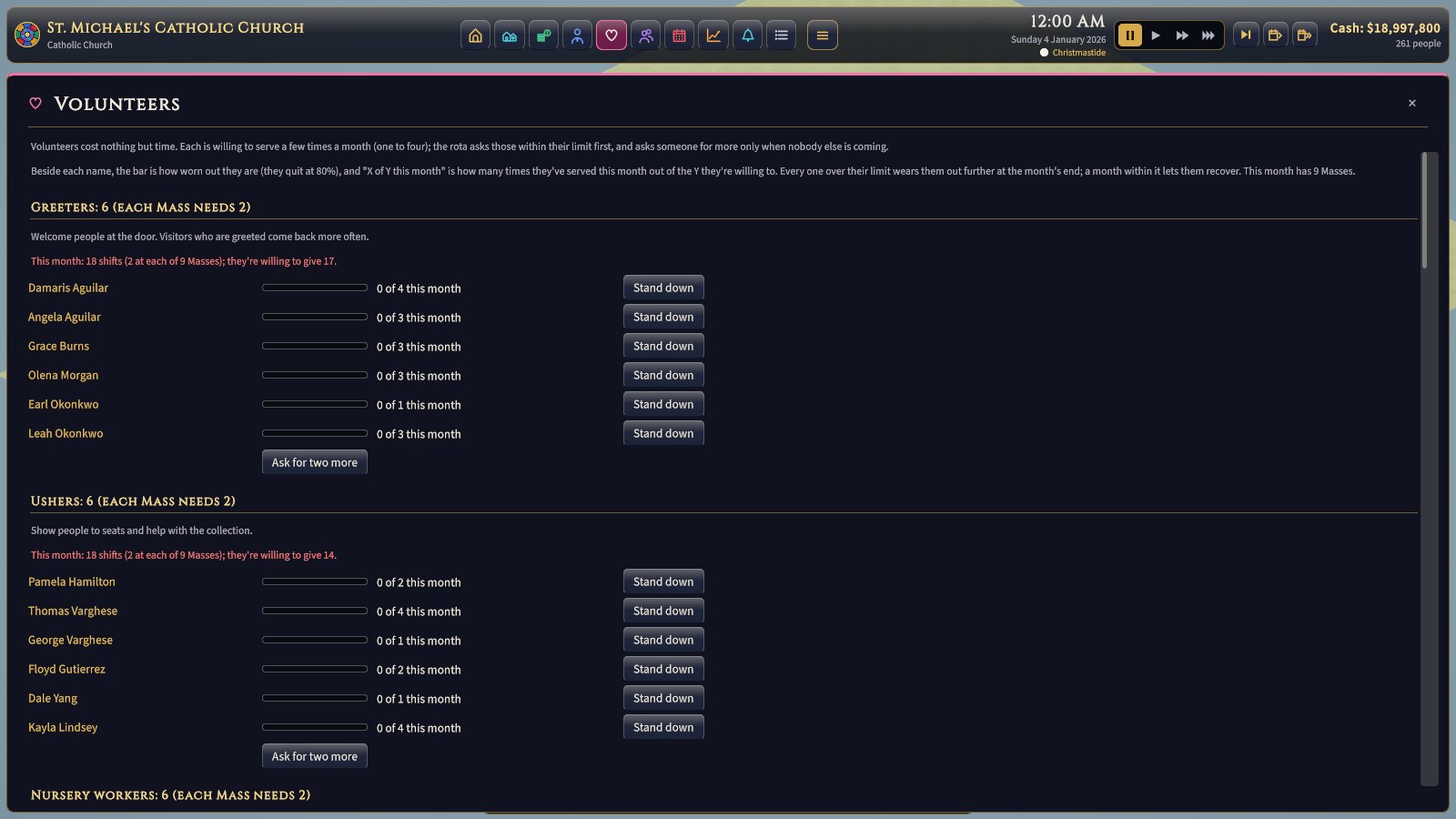
| Greeter | 2 | Welcome people at the door before a service. Up to +0.25 to the chance a visitor is welcomed (+0.15 instead of −0.1). Open hours keep no rota: nobody is on duty through the window, so its visitors are welcomed (or not) by the entrance hall and whoever is about. |
| Usher | 2 | Show people to seats and help with the offering and, in Christian traditions, communion. Visitors shown to a seat gain +0.03. |
| Nursery worker | 2 | Look after babies and toddlers during the service. The nursery only opens with someone on duty. |
| Choir | all of them | Sing every week they come. +0.04 for everyone with at least four singing (and +0.02 more from a choir loft). Eight are needed for the choir ministry. |
| Musician | up to 4 | Play for each piece of music (one at a time at the organ, piano, or any other instrument, unless a music director plays; the game says the organ or piano and the hymns in a Christian tradition), or all together in the band at a drum kit where the tradition's music allows a band. |
| A/V tech | 1 | Needed on duty to live stream the service. |
| Driver | 1 a vehicle | Drives the congregation's van or bus to the main services, giving rides and running a bus route (The congregation in its community). 21 to 79; a vehicle without one stays parked. Shown once there's a vehicle. |
| Teacher at the tradition's school (Sunday school, Hebrew school, the weekend Islamic school, Dharma School, Bal Vihar, the Punjabi school, pathshala, the Chinese school) | 1 a classroom | A classroom only holds a class with a teacher on duty. Teachers serve at the school, not at services, and teach Vacation Bible School where it's held (Christian traditions). |
| Cook | 1 for every 40 diners | Cooks a free meal the tradition holds (a gurdwara's langar, ISKCON's Sunday Feast, BAPS's Mahaprasad, a Jain center's Swamivatsalya, a vegetarian lunch at Yiguandao or a Chinese Buddhist temple), with the sponsoring household. Short of cooks, those it can't feed go without (−0.02). |
| Group leader | 1 a group | Leads a small group through the week (Community → Ministries). |
| Worship helpers: acolyte, crucifer, lector, communion assistant, and their like in other faiths | 1 to 9 | Worship's lay helpers, only in traditions that have them, by their names there (altar server, reader, deacon; the Latter-day Saints' priests, 16 and up, and deacons, 12 and up, men and boys only; a synagogue's Torah reader; a gurdwara's sevadar; Tenrikyo's instrument players and dancers). A required one missing costs everyone at the service 0.03; one the tradition hopes for adds 0.02. Communion assistants serve only when there's communion. |
Lutherans need an acolyte, a lector, and two communion assistants at communion, and hope for a crucifer. Catholics and Episcopalians need altar servers and a lector; the Orthodox, altar servers and a reader. Presbyterian elders and Baptist deacons serve communion. A synagogue's lector is its Torah reader: an Orthodox shul needs its ba'al koreh, a Conservative one hopes for a Torah reader, and a Reform temple can do without. A gurdwara hopes for a sevadar to sit behind the Guru Granth Sahib with the chaur sahib; a Tenrikyo church needs nine instrument players at every service and hopes for six dancers, by the month's rota. Each helper's card on the Volunteers screen says what your tradition asks.
Recruiting
Ask for two more on the Volunteers screen asks the happiest adults in the congregation, who say yes with a chance equal to their satisfaction. You can also ask a particular person from their inspector (Ask: Greeter, Ask: Usher, and so on). Recruit when people are content.
The rota and burnout
- Each volunteer is willing to serve 1 to 4 services a month: one fewer where the tradition asks little commitment of its people, one more where it asks much, two more where it asks everything (the Witnesses), and more again for those in an auxiliary (see The congregation in its community). The rota asks those within their limit first, and asks someone for more only when nobody else is coming.
- Every service beyond their limit adds 0.25 burnout; a month within it takes 0.15 off.
- Burnout costs them up to 0.25 satisfaction a week, and at 0.8 they quit everything, usually unhappy enough to drift away.
- With services twice a week, each role needs twice the volunteers. The Volunteers screen shows each month's shifts against what your people will give.
- Ministry volunteers must be satisfied (0.5 or more), aged 16 to 80, and not already serving at the main services. Fundraisers and door-to-door outreach tire those who run them too.
Recruit wide, not deep. Six greeters who each serve twice a month beat two who serve every week.
The rest cheat clears everyone's burnout, if you're experimenting in the sandbox (see Sandbox, cheats and quick reference).