Chapter 12
The congregation in its community
A congregation is more than its main day, whether that's a Sunday, a Shabbat, a Friday's Jumu'ah, or a temple's open doors. Ministries serve its people and its neighbours through the week, outreach brings newcomers, fundraisers and tenants bring money, and the people next door have opinions about your bells. All of this lives on the Community screen, and your tradition shapes all of it: which ministries it values, how it reaches out, what it will raise money by, and what its code of life won't have on its property. Each faith has ministries and fundraisers of its own besides those every tradition shares (below, and Faiths and traditions).
Standing in the community
At the top of the Community screen is the congregation's standing in the community, from 0 to 1, with the newcomers it brings. Standing drifts back toward 0.3 (by 5% of the gap each month), and ministries, some tenants, fundraisers, and some outreach raise it. Above 0.3 it brings more newcomers: 0.5 brings a fifth more. It's also what wins back unhappy neighbours, and fundraisers bring in more where it's high.
Ministries
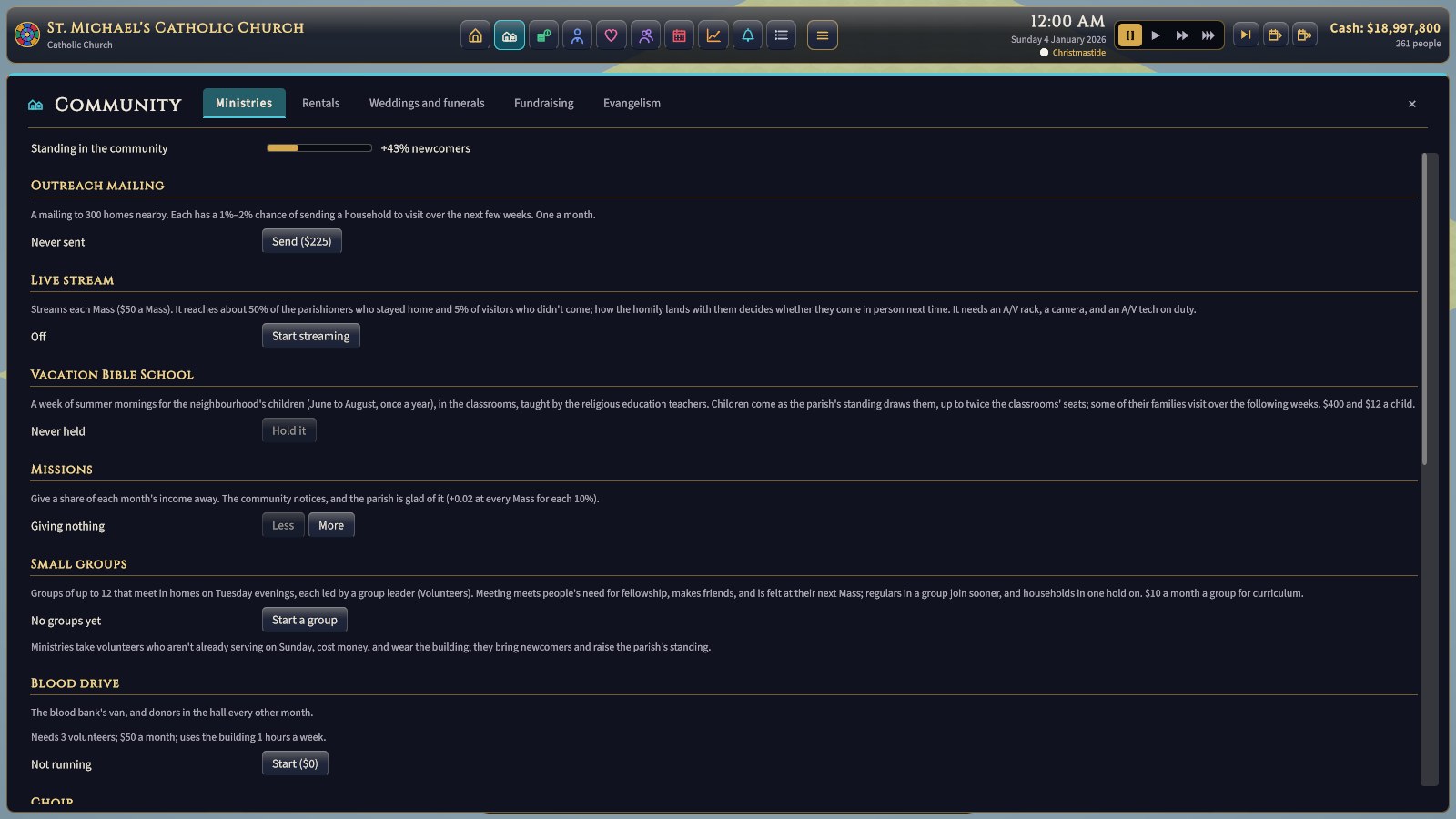
Start a ministry from Community → Ministries. Starting one pays its start-up cost. It needs an enclosed room of a type it can meet in (or, for the choir, choir stalls; for a Zen center's sesshin, the zendo itself; for a mosque's funeral committee, a ghusl room; for the Shia majlis, the imambargah; for a Jain center's bhojanshala or a gurdwara's street langar, a kitchen), and runs as far as it's staffed. Each month it:
- takes its volunteers from people who are satisfied enough (0.5 or more), 16 to 80, and not already serving at the main services (the choir's are the people signed up to sing);
- pays its monthly cost and takes in any income, scaled by how well it's staffed;
- uses the building for its weekly hours, which wears it (every hour a month beyond the week's main service wears the building 0.5% faster);
- raises the congregation's standing in the community.
| Ministry | Kind | Meets in | Volunteers | Start | A month | Hours a week | Standing a month | Newcomers | Serves |
|---|---|---|---|---|---|---|---|---|---|
| Food pantry | Service | Hall or kitchen | 4 | $1,500 | −$350 | 6 | +0.03 | +8% | Everyone (+0.02) |
| Preschool | Education | Classroom | paid teachers | $8,000 | +$1,500 net | 40 | +0.02 | +15% | Families with children of 2–5 (+0.04) |
| Choir (Christian traditions) | Fellowship | Choir loft or stalls | 8 singers | $600 | −$150 | 2 | +0.01 | +3% | Everyone (+0.02) |
| Youth group | Fellowship | Classroom or hall | 3 | $500 | −$250 | 3 | +0.01 | +5% | Families with teenagers (+0.05) |
| Health clinic | Health | Classroom or office | 2 | $2,000 | −$600 | 6 | +0.02 | +4% | Everyone (+0.01) |
| Blood drive | Health | Hall | 3 | none | −$50 | 1 | +0.01 | +1% | Everyone (+0.005) |
| Day school (institution) | Education | Classroom | paid teachers | $25,000 | −$3,000 net | 40 | +0.03 | +12% | Families with children of 5–14 (+0.05) |
| Thrift store (institution) | Service | Hall | 4 | $3,000 | +$1,100 net | 30 | +0.02 | +3% | Everyone (+0.01) |
| Social services | Service | Social-service office | 2 | $5,000 | −$1,000 net | 40 | +0.04 | +5% | Everyone (+0.02) |
Each faith adds its own, and the list shows only those your tradition keeps (see Faiths and traditions):
- Synagogues: the chevra kadisha, bikur cholim (visiting the sick), Torah study, a youth chapter, a sisterhood, and a men's club.
- Mosques: the Qur'an class, the zakat committee, the new Muslims' circle, an open house and interfaith programme, the funeral committee (in a ghusl room), and, for the Shia, the majlis programme in the imambargah.
- Buddhist temples: Dharma School, meditation for beginners, a sesshin (Zen), a study programme (Tibetan), hospital and prison chaplaincy, the monks' meal rota (Theravada), Soka Gakkai's district discussion meetings; at a Chinese Buddhist temple a chanting group, a relief and care drive, and a young adults' division.
- Hindu temples: a bhajan group, Sanskrit and language classes, the canteen (it earns more than it costs), seva meals, the seniors' satsang, yoga for the neighbourhood, Vedanta study groups, the Swaminarayan kishore and kishori sabhas, and ISKCON's harinama and book table.
- Gurdwaras: kirtan classes, gatka, a Gurmat camp, Sikh youth, a seniors' centre, langar on the streets, and Sikh awareness.
- Jain centers: the bhojanshala, jiv daya (care for animals), Young Jains, and, with images, the Paryushana scholars' committee, or, without, Preksha meditation.
- Shrines, Konko, and Tenrikyo: the shrine's supporters' association, children's festivals, a taiko group, and an aikido dojo; Konko's faith study and cemetery care; Tenrikyo's hinokishin days, judo club, and dance and instrument lessons.
- Chinese temples: a folk temple's lion dance troupe, Chinese school, mahjong and tea, and a welcome desk for new arrivals; a Daoist temple's tai chi classes (the way most people come in: +15% newcomers), morning qigong, a health recovery class, and its chanting group; Yiguandao's dharma classes, family altars, a vegetarian cooking class, and children's classes and summer camp.
After each service, the people a ministry serves are glad of it, up to +0.08 in all. A ministry that loses its room (to a building site, say) is suspended, at no cost and no good, until it has one again.
- The preschool pays for itself and brings the most newcomers. Build a classroom early. It wears the building a fifth faster, so budget for maintenance.
- The food pantry builds standing fastest, which brings newcomers and calms the neighbours.
- The choir (in a Christian church) is cheap, and its singers also lift every service (+0.04 with four or more).
- The youth group holds families with teenagers; a synagogue's youth chapter, Sikh youth, and Young Jains do the same in their faiths.
- A faith's own outreach brings newcomers as well as any: Soka Gakkai's discussion meetings and ISKCON's harinama (+12%), Yiguandao's dharma classes (+8%), a Daoist temple's tai chi classes (+15%), meditation for beginners and Preksha meditation (+10%). Several earn their keep, too: a Hindu temple's canteen, a Zen center's sesshin, a Tibetan study programme, a shrine's aikido dojo, a Daoist temple's tai chi.
What your tradition values
Each ministry has a kind: evangelism, service, justice, peace, education, health, heritage, or fellowship. Your tradition emphasises each kind low, medium, or high, and a ministry's newcomers, what it means to those it serves, and the standing it earns are all scaled by that: 60% where the tradition's emphasis is low, 140% where it's high. A ministry of a kind your tradition emphasises highly also earns a little of the wider body's regard each month. A food pantry (service) does more than twice as much in a United Methodist or Presbyterian church, which emphasise service highly, as in a United Pentecostal one, which doesn't; a preschool (education) is at its best in a Catholic, Adventist, or Nazarene church, a synagogue, or a Hindu or Jain temple; and heritage ministries (gatka, a lion dance troupe, a taiko group, a bhajan group) do most where heritage is emphasised highly, as at a gurdwara, a Hindu temple, a shrine, or a folk temple.
- Institutions are offered only where your tradition runs them: the day school for Catholic, Missouri Synod Lutheran, and Seventh-day Adventist churches; the thrift store for Mennonites. Where the wider body shares costs (a Catholic diocese, an Adventist conference), it pays a fifth of an institution's running cost: for a day school, $4,400 a month.
- Social services is for a tradition that is also a social-service agency (the Salvation Army), in the social-service office it requires.
- The code of life rules some out: no blood drive where blood is refused (Jehovah's Witnesses), no health clinic where healing is by prayer alone (Christian Science).
Outreach
The mailing
At the top of Community → Ministries. A mailing goes to 300 homes nearby for $225. Each mailing has a response rate of 1% to 2%, so it usually sends 3 to 6 households. They visit over the next few services, on top of the usual newcomers. You can send another a month later.
The live stream
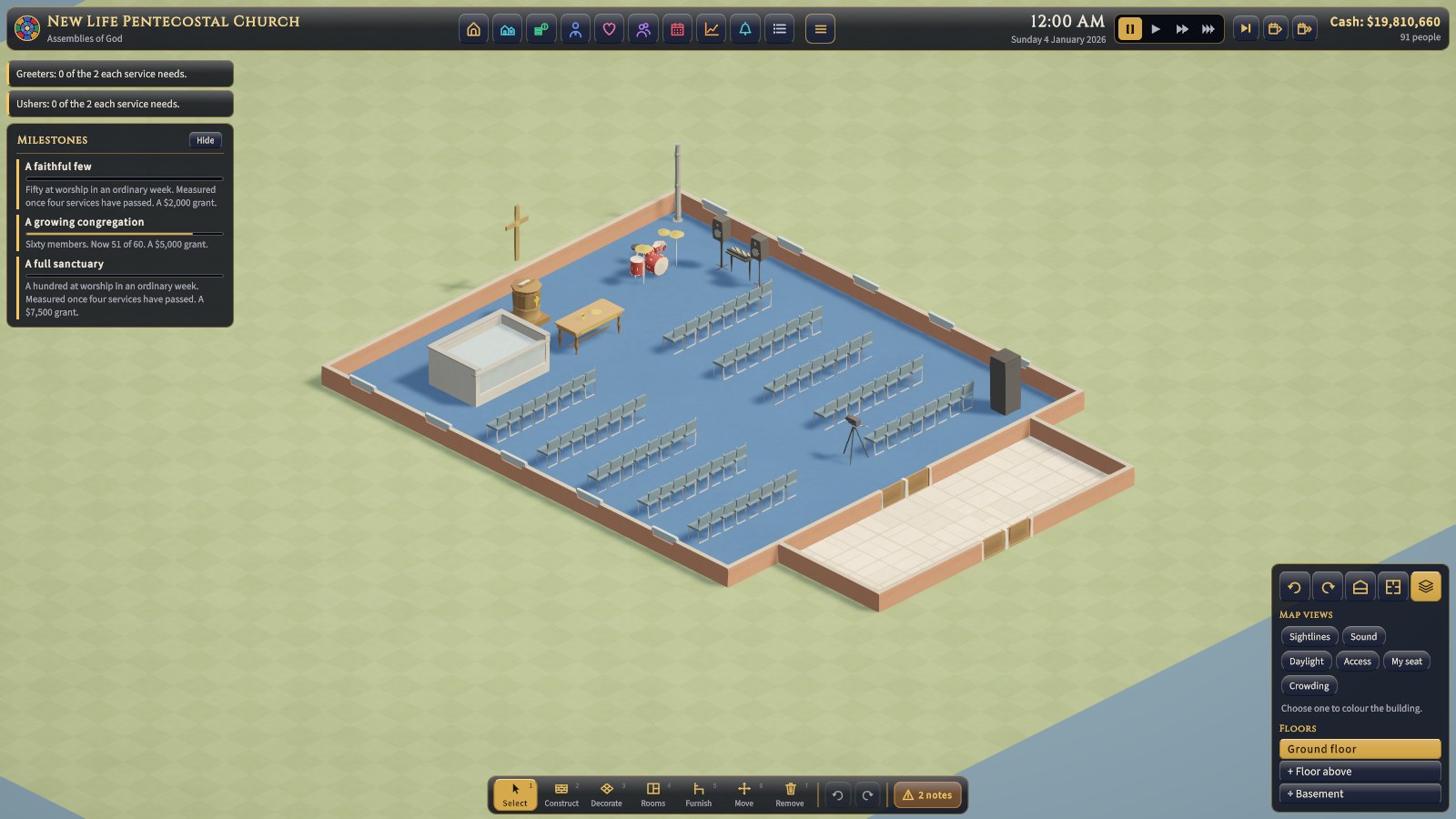
The live stream sends each service out for $50 a service. It needs an A/V rack and a Camera (Furnish → Utility), and an A/V tech volunteer on duty. Without one, the service report says what's missing.
- It reaches half the members and regulars who stayed home, and 5% of the visiting households who didn't come.
- Each viewer takes that day's sermon (or khutbah, d'var Torah, dharma talk, katha) as their tradition leans. At the next service, their household is likelier or less likely to come in person by four times the sermon's reception. Fire & Brimstone (+0.08 to a conservative household) makes it a third likelier to come.
- With no sermon topic chosen, or no sermon at all, streaming has no effect on attendance. So stream, and choose sermons that suit your people.
Your tradition's outreach
Community → Evangelism lists the ways your tradition reaches out, each with its cost and a Go button. Households who respond may visit over the next few weeks. The volunteers each takes tire a little.
| Outreach | Cost | How often | What it brings | Traditions |
|---|---|---|---|---|
| Invitation Sunday (named for the holy day: invitation Shabbat, invitation Jumu'ah; "invitation day" where the day has no name of its own) | $100 | Every 3 months | One household, and one more for every 40 active people | Every tradition but the Witnesses, the Hindu community temple, the Indo-Caribbean mandir, ISSO, the Sathya Sai center, the Shinto shrine, and the Chinese folk temple, which don't reach out at all |
| A revival | $1,500 | Once a year | Three households and one more for every 30 people; members stirred (+0.02). Needs a pastor to host it. | AME, Assemblies of God, Christian Churches, Church of God, Churches of Christ, COGIC, National Baptist, Nazarene, Pentecostal Holiness, Southern Baptist, United Pentecostal |
| Door to door | $50 | Monthly | One or two households; four walkers tire, and the street is a little less glad of it | Jehovah's Witnesses, the Nation of Islam, Tenrikyo |
| A home Bible study (named for the scripture: a home Torah study; "a home scripture study" where it has no one-word name) | free | Every 2 months | One household | Acts 29, Calvary Chapel, PCA, Churches of Christ, Friends United Meeting, Witnesses, United Pentecostal; Orthodox Jewish, Chabad; Soka Gakkai; Yiguandao |
| Send a missionary | $2,000 | Every 6 months | A young adult of 18 to 25 goes out for two years (away, and not at worship); the wider body's regard rises (+0.05), and they come home glad | Latter-day Saints |
| Plant a church (named for the congregation) | $25,000 | Every 5 years | Four contented households leave to found a new church; the wider body's regard (+0.1) and your standing rise. Needs 120 active people. | Most Baptist, Pentecostal, holiness, and Reformed bodies; ACNA, the Missouri Synod, the Orthodox, Churches of Christ, the nondenominational church, and all five networks |
| An open-air meeting | $100 | Monthly | One household, and a little standing | Salvation Army, Chabad, ISKCON, Tenrikyo |
| Literature | $300 | Every 3 months | Two households. Needs a reading room or an office (Christian Science: its Reading Room). | Christian Science, Witnesses, Adventists; the Ahmadis, the Nation of Islam; Soka Gakkai, the Tibetan center, the Chinese Buddhist temple; ISKCON, the Arya Samaj, the Vedanta Society, SRF |
| An evangelistic series | $3,000 | Once a year | Five households and one more for every 25 people | Seventh-day Adventists |
Missionaries away are listed on the Evangelism tab and on the People screen.
Vacation Bible School
Christian traditions only. Once a summer (June to August), with a classroom with seating and at least two Sunday school teachers. Children come as your standing draws them, up to twice the classrooms' seats; for every two, a family visits over the following weeks 30% of the time. It costs $400 and $12 a child, raises standing by 0.03, and counts as three shifts for each teacher.
Missions, or giving beyond the congregation
Every tradition can give 5% to 20% of each month's income away: the game calls it missions in a Christian tradition and giving beyond the congregation (in the tradition's word for its people: the jamaat, the sangat, the sangha) in another (a church's mission giving, a mosque's or gurdwara's charity beyond its own walls). Standing rises a little each month, so it settles higher, and everyone at a service is glad of it (+0.02 at 10%).
Vans and buses
A van, a shuttle bus, or a used school bus parks on the lot (Furnish → Utility). Each week's main day (Sunday, Shabbat, a Friday's Jumu'ah, as the tradition keeps it), every one that's running and has a volunteer driver free goes out, and its seats (less the driver's) go to the households that find it hardest to come: anyone who walks with difficulty or uses a wheelchair, or a household all of 70 or more.
- A ride brings them 15% more often, and snow keeps them home no more than anyone else. Those who rode are glad of it (+0.03).
- A bus route: the shuttle and the school bus also drive a route through the neighbourhood, and each brings about half a new visiting household a week (the old bus ministry).
- What it costs: the vehicle (a van $48,000; the shuttle $110,000; a used school bus $28,000, but 40% worn when you buy it), its insurance and registration each year, and its fuel each week ($20, $40, $65).
- Wear: each week's driving wears it a little (a van lasts about 12 years, the shuttle 15, the old bus 8). The maintenance budget keeps vehicles up with the heating and cooling; Finances → Budget → Vehicles services or replaces them. Neglected, one breaks down for a few days, or, worn out, for good (Keeping the building standing).
- Drivers are volunteers of 21 to 79 (Volunteers); each drives within their monthly limit, and their household comes with them. A vehicle without a driver stays parked.
Small groups
Small groups (a Bible study, a Torah or Qur'an circle, a satsang in a home: the game keeps them all alike) meet in homes on Tuesday evenings, each led by a group leader (a volunteer). Start a group takes the next free leader, their household and friends, and fills to eight; a group takes in one more a week up to twelve. Each meeting meets its members' need for fellowship and makes friends among them. Members who met that week gain 0.03 at the service; regulars in a group join twice as fast, and households in one drift away less. $10 a group a month.
Membership classes
Once a quarter, the People screen can hold a membership class, in a classroom or an office, led by the leader. Regulars of 16 and over who've come three months and are content are invited, and most join. Regulars who go to the school or a small group also join on their own sooner. Where the members vote to receive new members, or joining means leaving any other congregation, joining is a little slower; where the tradition asks much of its people, slower again.
Fundraising
Community → Fundraising lists the fundraisers, each with the volunteers it needs, its cost, and Hold it (its tooltip says why one can't be held). What your tradition allows comes first:
- None where the tradition's congregations are kept by what their people give: Churches of Christ, Jehovah's Witnesses, Latter-day Saints, and a Sathya Sai center, which raises no money of any kind.
- Only the modest ones (bake sale, car wash, raffle, rummage sale, soup supper, and the faiths' own modest appeals and sales) where it limits them: most Protestant and Pentecostal bodies, the Adventists, the Coptic Orthodox, the Friends, the Ahmadis, the Nation of Islam, Soka Gakkai, the Zen and Tibetan centers, BAPS, the Vedanta Society, SRF, Tenrikyo, and Yiguandao.
- All of them where it holds fundraisers freely: Catholic, Orthodox, Ukrainian Catholic, Episcopal, ELCA, UCC, Unitarian Universalist, AME, COGIC, National Baptist, Community of Christ; the synagogues, the Sunni, Shia, and W. Deen Mohammed mosques, the Japanese, Theravada, Vietnamese, and Chinese Buddhist temples; the Hindu community temple, the Indo-Caribbean mandir, ISSO, ISKCON, the Arya Samaj, and Chinmaya Mission; the gurdwara; both Jain traditions; the shrine and Konko; and the folk and Daoist temples.
- Never anything the code of life forbids (below): no bingo, raffle, or casino night where gambling is forbidden, no casino night or festival on dry property.
- Each faith has its own, shown only where they fit: a synagogue's Kol Nidre appeal, Purim carnival, latke dinner and Hanukkah bazaar, and gala and tribute journal; a mosque's Ramadan fundraising dinner and Laylat al-Qadr appeal (in Ramadan), community bazaar, and interest-free building campaign, the Shia's Muharram sponsorships, and the Nation of Islam's bean pies; a temple's Obon festival (Japanese), Kathina (Theravada), Tết festival (Vietnamese), stupa campaign dinner (Tibetan), and Soka Gakkai's May Contribution, and a Chinese temple's Buddha Day, Ullambana, and Water and Land; a Hindu temple's Diwali mela, Navaratri garba, Janmashtami night, a shila campaign for the building, ISKCON's Ratha Yatra, and the Swaminarayan walkathon; a gurdwara's Vaisakhi nagar kirtan, kirtan darbar, kabaddi tournament, and kar seva building fund; a Jain center's boli (below), the Mahavir Jayanti procession, and the pathshala dinner; a shrine's autumn festival, a bon dance booth, and mochitsuki, and Konko's summer bazaar; and a Chinese temple's first incense at New Year, the god's birthday banquet, Pudu tables, lantern sponsors, the autumn jiao, mooncakes, and a vegetarian food fair. The soup supper and the Lenten fish fry are Christian.
| Fundraiser | Needs | Cost | Volunteers | How often | Notes |
|---|---|---|---|---|---|
| Bake sale (modest) | Hall or entrance hall | $100 | 6 | Every 3 months | Small and easy. |
| Soup supper (modest; Christian) | Hall | $200 | 6 | Every 3 months | Members enjoy it (+0.01). |
| Rummage sale (modest) | Hall | $50 | 8 | Every 6 months | Brings a household to visit. |
| Raffle (modest) | — | $200 | 3 | Every 6 months | Gambling. |
| Car wash (modest) | — | $80 | 8 | May to September, every 4 months | Brings a household to visit. |
| Bingo night | Hall | $300 | 5 | Monthly | A steady earner. Gambling. |
| Auction | Hall | $1,000 | 8 | Yearly | Earns well in a big church. |
| Casino night | Hall | $1,500 | 10 | Yearly | Gambling and alcohol. |
| Lenten fish fry | Hall | $1,500 | 12 | In Lent, yearly | Only where a Christian tradition fasts. Two households visit; standing +0.02. |
| Parish festival (named for your tradition: the church, synagogue, temple festival) | — | $6,000 | 20 | June to September, yearly | The biggest earner and the hardest work. Alcohol. Four households visit; standing +0.04. |
The boli is an auction of honours: through Paryushana, each of the season's twenty honours goes to the highest of the few member households with the most to give (see Money). It costs $300 and four volunteers, once a year, and its takings are the bids.
What a fundraiser brings in is a base sum plus a sum for each active person, more the better the community thinks of the congregation (standing 0.4 gives the full per-person sum), and less in proportion if too few willing volunteers (16 to 80, content, and not worn out) turn up to run it. Each volunteer it takes gains burnout. Something the tradition only frowns on (a raffle where gambling is discouraged) can be held, but unsettles members (−0.02 each for each such thing).
Income beyond giving
Below the fundraisers, the Fundraising tab lists what your tradition takes in besides its offerings:
- Candles (Orthodox, Greek Orthodox, Coptic, Ukrainian Catholic; butter lamps at the Tibetan center, lamps at the Hindu community temple): 60¢ for each person at each service.
- Mass stipends (Catholic, Ukrainian Catholic; at the Japanese and Tibetan temples, service offerings for memorials and pujas, the same way): $15 a service, and more with weddings and funerals. Where a tradition keeps rites households book and pay for (below), those take the stipend's place.
- Amulets, the box, and lamps (a Shinto shrine, a Chinese folk temple, the Chinese Buddhist temple): about $2 in the box and $4 of amulets a visit to open hours, and lamps renewed each lunar New Year (Money).
- Fees for rites asked for (a Hindu temple's archana and home pujas, a gurdwara's Akhand and Sehaj Paths, a Jain center's snatra puja, a shrine's kitō and Shichi-Go-San, a folk temple's Tai Sui protection and fortune readings, a Chinese temple's memorial tablets; Money): where a tradition keeps rites households ask for and pay for, each household asks for each at its rate (members more than regulars, the happier more often), and the rite is booked at the first time it can be held: the leader (or a member of staff who performs rites) free for it, with half an hour's journey each way to a home, and the worship room free for one held there. Put off more than a week, the household is let down. Held, its fee goes to the fees line, in the tradition's word (“Puja fees”, “Path offerings”, “Prayer offerings”, “Merit money”), and these fees take the place of the flat stipend at each service. A long rite kept in shifts needs readers from your volunteers through the night, or it breaks off and its gift is given back.
- Life memberships (a Hindu temple's and ISKCON's, $1,001; a Jain center's, $301): where a kind of belonging has a one-time fee, each household that joins it pays once, the more engaged the sooner; until it has, it doesn't vote.
- Amulets and lamps (a Shinto shrine's amulets, the Chinese temples' lamps of brightness; Money) and meal sponsors (a gurdwara's langar and the other free meals; Worship and the year).
- Seats for the holy days (Reform, Conservative, Orthodox, and Reconstructionist synagogues): $150 for each adult who doesn't belong, on the High Holy Days (Money).
- The public appeal (the Salvation Army's Red Kettle): each December, $40 for each active person, more the better the community thinks of the corps.
- Fast offerings (Latter-day Saints): $8 a member a month, given straight on to those in need.
- The share plate (Unitarian Universalists): 5% of each offering, given on.
- Renting space, where the tradition's congregations are known for it (Episcopal, Lutheran, Presbyterian, UCC, United Methodist, the Reform, Conservative, and Orthodox synagogues, the Sunni center, the Zen center, a Hindu temple's, an Indo-Caribbean mandir's, an Arya Samaj's, or an ISSO temple's hall, a Jain center, a folk temple's banquet hall, and others): tenants pay 15% more.
Appeals and fasts
Some calendars carry appeals: the Lottie Moon and Annie Armstrong offerings for Southern Baptists, the American Baptists' offerings, the Army's Self-Denial appeal and Red Kettle season, the Adventists' Ingathering, the United Methodists' UMCOR Sunday offering, and in every synagogue ma'ot chitim, from Purim to Passover, so that those in need can keep the festival. At the main services while an appeal runs, a tenth of the offering is given to it, and everyone there is glad of it (+0.01). Other faiths' appeals are fundraisers of their own (the Kol Nidre appeal, the Laylat al-Qadr appeal) or come through their giving (zakat, khums). In a tradition's strict fasts (the Orthodox and Coptic fasts), meals cost a tenth more, fewer stay for them, and weddings aren't held. In Ramadan a mosque's giving rises instead (Money).
Auxiliaries
Many traditions have an auxiliary or two of their own: the Altar and Rosary Society and the Knights of Columbus, United Women in Faith, the Woman's Missionary Union, the Mothers' Board and the usher board, the Women's Department, the Relief Society, the Home League, the Pathfinders, a Christian church's youth group and its summer conference, an Orthodox parish's Sisterhood; the Buddhist Women's Association at a Japanese temple, and the Buddha's Light association at a Chinese Buddhist temple; the Ahmadis' Lajna Ima'illah, Khuddam-ul-Ahmadiyya, and Ansarullah; the Nation of Islam's Fruit of Islam and MGT; Chinmaya Mission's Devi groups and its youth, CHYK, a gurdwara's istri satsang (the women's weekly Sukhmani Sahib and kirtan), a Sathya Sai center's Ladies' section, and SRF's Kriyaban service group; a shrine's Fujin-kai and Tenrikyo's Women's Association; and a folk temple's incense-burner society. (A synagogue's sisterhood and men's club are ministries, above.) They're listed on the Fundraising tab, each with how many could belong.
- One forms once enough members could belong (four to eight, of the women, the men, the mothers, the youth, or everyone, as it is).
- Its members are heartened each month, and most can give more as volunteers: one more service a month, two for the usher board, the Women's Department, and the Relief Society.
- It keeps its own day once a year, raising money (a sum for each of its members) and, for many, the congregation's standing.
You don't start an auxiliary; you grow the membership it draws on.
The wider body's places
Some traditions have places beyond the congregation: the conference camp, the Latter-day Saint temple, the Holy Convocation, the Assembly Hall, the Christian school; the Reform movement's summer camp, Camp Ramah, Camp Havaya, and Camp Gan Israel, the community mikveh, and the Jewish day school; the Ahmadis' Jalsa Salana and the Nation of Islam's Saviours' Day; Chinmaya Mission's Krishnalaya and the SRF World Convocation; and the Jiba at Tenri, where Tenrikyo's followers return. They hearten members a little each month and hold households (they drift away less), for what the congregation gives toward them each year for each member. Church → Tradition names them.
Calendar and reports
Calendar shows a month at a time: services and their coffee hours and meals, the school, small groups, special services, weddings and funerals, and the feasts and holy days. Hover over a day for everything on it.
Reports chart the congregation week by week. The Overview puts the satisfaction index (how content members and regulars are, 0 to 100) over weekly attendance, and shows the congregation's growth; Engagement charts services, the school, small groups, coffee hour, meals, and each ministry week by week, with a table of the last eight. Each small group's weekly attendance is under Community → Ministries.
The attendance report
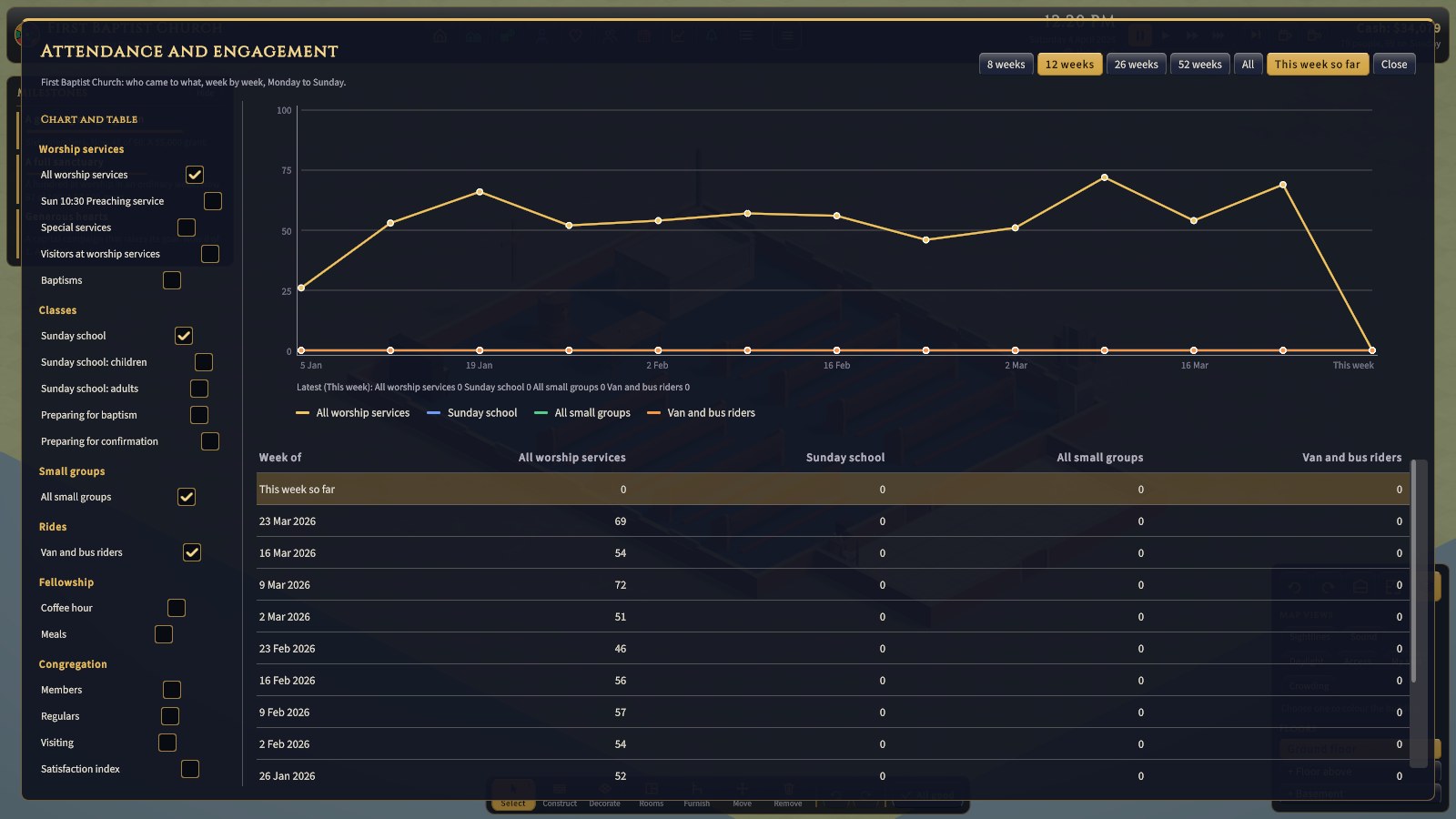
For everything in detail, open the attendance report: Full report on the Reports screen, or click the head count at the top right. It fills the screen, and the game waits while it's open.
- Choose what to chart from the list down the left, in groups: every service on its own (each day and time, so the early and late services can be compared) as well as all of them, special services, visitors, and baptisms; the school, its children and its adults, and those preparing for baptism and for confirmation; every small group, and all of them; each ministry; van and bus riders, in all and at each service; coffee hour and meals; and the congregation itself, members, regulars, visiting, and the satisfaction index. What you choose is remembered from game to game.
- Choose how far back: 8, 12, 26, or 52 weeks, or all of them (the game keeps ten years). This week so far adds the week under way, as it stands.
- The chart draws each one chosen; rest on it for every figure that week.
- The table has the actual figures, a row a week, newest first, and each one's average over the finished weeks shown.
Rentals
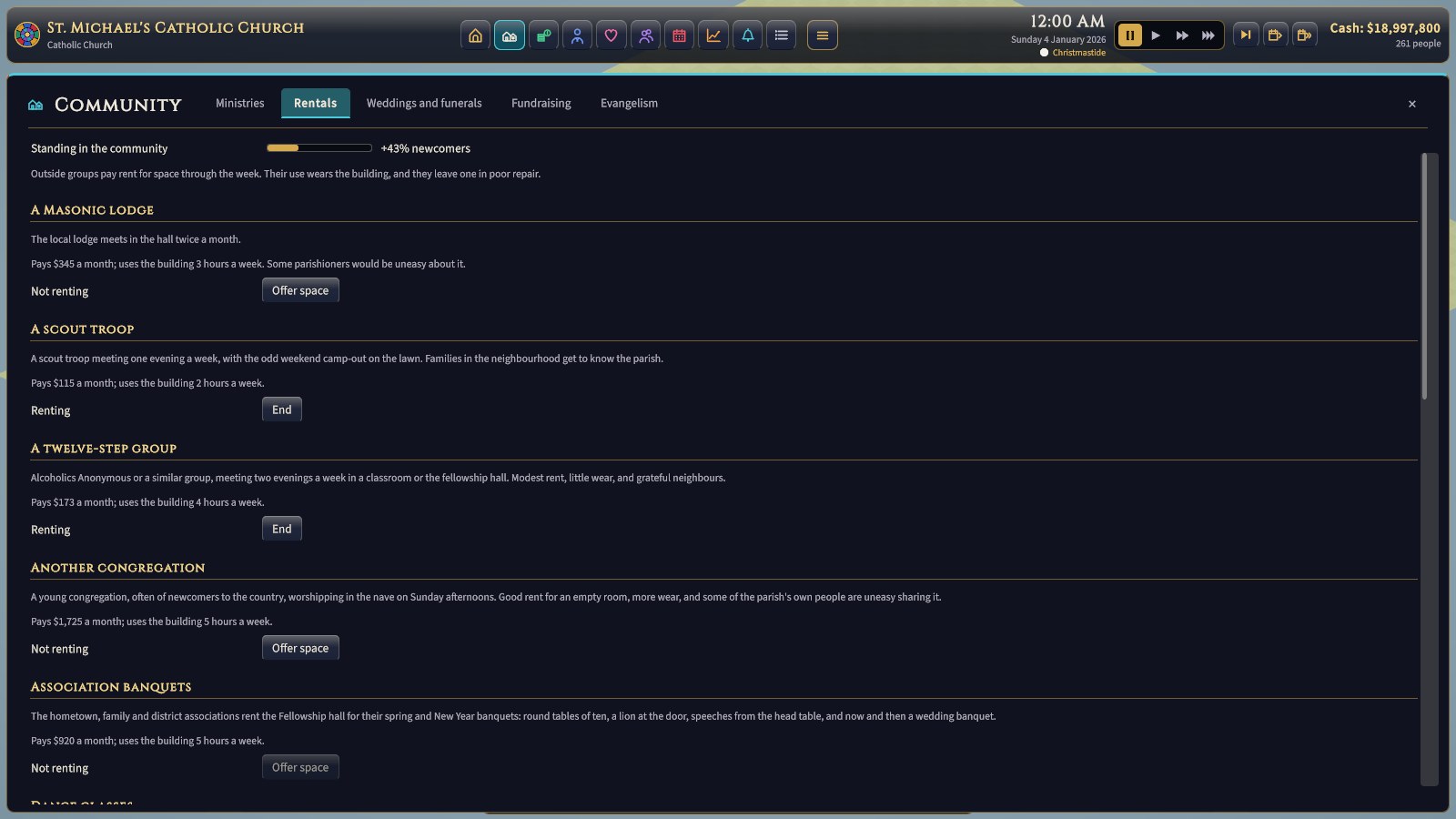
Outside groups rent space. A group needs an enclosed room of a type it rents. Each month it pays rent, uses the building for its hours (wearing it), and may raise your standing. The Rentals tab lists every kind of tenant, what it would pay, and whether some members would be uneasy about it.
| Tenant | Rents | Rent a month | Hours a week | Standing a month | Notes |
|---|---|---|---|---|---|
| A twelve-step group | Classroom, hall, or office | $150 | 4 | +0.008 | Modest rent, little wear, and grateful neighbours. Smoking at the door. |
| A scout troop | Hall or classroom | $100 | 2 | +0.01 | Families in the neighbourhood get to know the congregation. |
| Another congregation (Christian traditions) | The worship room, on the main day's afternoons | $1,500 | 5 | +0.005 | Often an immigrant church, of some Christian tradition. Some of your people are a little uneasy (about −0.01 each service): half as much if it's much like yours, half as much again if it's unlike. |
| Parties and receptions | Hall | $900 | 8 | Hard on the building. Noisy (0.5): neighbours mind. Secular celebrations. | |
| Wedding receptions | Hall | $1,200 | 6 | The best rent of those every tradition is offered. Noisy (0.6). A bar and a band: alcohol and dancing. | |
| Dance classes | Hall | $700 | 10 | +0.005 | Noisy (0.3). Dancing. |
| A Masonic lodge | Hall or classroom | $300 | 3 | +0.003 | A lodge. |
| Polling place and forums | Hall | $50 | 1 | +0.01 | Politics. |
| Weddings in the hall (Hindu temples, the Indo-Caribbean mandir, the Swaminarayan temples, the Arya Samaj) | Hall | $2,500 | 10 | +0.005 | The best rent there is, and hard on the floors. Noisy (0.4). Vegetarian, and dry. |
| Music and dance teachers (Hindu temples, the Indo-Caribbean mandir, Vedanta and Chinmaya) | Classroom or hall | $600 | 10 | +0.005 | Bharatanatyam, kathak, Carnatic singing, tabla. Noisy (0.2). |
| Regional associations (Hindu temples, the Indo-Caribbean mandir) | Hall | $500 | 3 | +0.01 | A Telugu association's Ugadi, a Bengali club's Durga Puja. Noisy (0.2). |
| Receptions with Jain food (Jain centers) | Hall | $900 | 5 | +0.005 | On the center's terms: no meat, eggs, alcohol, or root vegetables. Noisy (0.2). |
| Japanese cultural classes (Shinto shrines, Konko, Tenrikyo) | Hall or classroom | $500 | 8 | +0.005 | Ikebana, calligraphy, tea, a Saturday language school. Quiet tenants, and members are glad of them. |
| Association banquets (Chinese folk temples) | Hall | $800 | 5 | +0.005 | Hometown and family associations' banquets. Noisy (0.5). Meat and alcohol; members are glad of them. |
Tenants give notice from a building below 0.35 condition (a one-in-four chance a month), or one that no longer has their room. Rent is steady money for a struggling congregation; a nesting congregation's $1,500 is often worth the small unease. Where the tradition keeps a strict Sabbath (the Adventists; the Conservative, Orthodox, and Chabad synagogues), tenants keep off the worship day and pay 15% less.
The code of life
Each tradition's code of life says what it forbids on its property and what it only frowns on. A tenant, ministry, or fundraiser that involves something forbidden can't be offered at all (its button says why); one involving something frowned on can, but unsettles members: a tenant costs them 0.01 for each such thing after every service for as long as it rents, a fundraiser 0.02 when it's held.
| It involves | Forbidden where | Frowned on where | What it rules out |
|---|---|---|---|
| Alcohol | The property is dry (most Baptist, Methodist, holiness, Pentecostal, and Anabaptist bodies, the independent churches and networks, Latter-day Saints, Community of Christ, Adventists, Christian Science, the Army; every mosque; the Zen, Theravada, and Vietnamese temples; every Hindu, Sikh, and Jain congregation, Yiguandao, and the Daoist and Chinese Buddhist temples) | It's taken in moderation (Episcopal, ACNA, Presbyterian, Christian Reformed, Moravian, Coptic, Friends, Witnesses, Unitarian Universalist; the Japanese and Tibetan temples, Soka Gakkai; Konko and Tenrikyo) | Wedding receptions, casino night, the festival, a folk temple's association banquets |
| Gambling | It's forbidden (Southern Baptist, United Methodist, Pentecostal and holiness bodies, Christian Reformed, Churches of Christ, Latter-day Saints, Witnesses, Adventists, the Army; every mosque; the Hindu community temple, BAPS, ISSO, ISKCON, the Arya Samaj, both Jain traditions) | It's discouraged (most other Protestants; an Orthodox shul and Chabad; most Buddhist temples; the gurdwara; the Indo-Caribbean mandir, Chinmaya Mission, the Vedanta Society, SRF, and the Sathya Sai center; the Daoist temple and Yiguandao) | Bingo, the raffle, casino night |
| Smoking | Tobacco is forbidden (the holiness bodies and most Pentecostal ones, Latter-day Saints, Witnesses, Adventists, Christian Science, the Army, the Nation of Islam; the gurdwara, the Hindu community temple, BAPS, ISSO, ISKCON, the Arya Samaj, both Jain traditions, Yiguandao) | It's discouraged | The twelve-step group |
| Dancing | Entertainment is restricted (United Pentecostal, the Ahmadis) | Members are discerning about entertainment (many evangelical and holiness churches; most Muslim communities; an Orthodox shul and Chabad; BAPS, ISKCON, Yiguandao) | Dance classes, wedding receptions, the Navaratri garba, the Obon festival, a booth at the bon dance |
| A lodge | Secret societies are forbidden (Christian Reformed, Missouri Synod, Free Methodist, Church of God, Pentecostal Holiness, United Pentecostal, Witnesses) | They're discouraged | The Masonic lodge |
| Politics | The congregation keeps out of politics (Missouri Synod, ACNA, PCA, Orthodox, Greek Orthodox, Coptic, Churches of Christ, the Christian Churches, Christian Science, Latter-day Saints, Witnesses, Adventists, the Army; Chabad; the Ahmadis; the Japanese, Chinese, Zen, Theravada, and Tibetan temples and Soka Gakkai; every Hindu and Jain congregation; the shrine, Konko, and Tenrikyo; the Daoist temple and Yiguandao) | — | The polling place and forums |
| Blood | Blood is refused (Witnesses) | — | The blood drive |
| Medicine | Healing is by prayer alone (Christian Science) | — | The health clinic |
| Secular celebrations | None are kept (Witnesses) | — | Parties and receptions |
| Meat | The kitchen is vegetarian (the Adventists, a Reconstructionist synagogue; the Zen, Vietnamese, and Chinese Buddhist temples; every Hindu, Sikh, and Jain congregation; Yiguandao) | — | The Obon festival, a shrine's autumn festival, Konko's summer bazaar, the god's birthday banquet, association banquets |
| Eggs | The kitchen keeps out eggs (the gurdwara; the Hindu community temple, BAPS, ISSO, and ISKCON; the Jain centers; the Chinese Buddhist temple) | — | The bake sale |
Heads covered. At a gurdwara everyone covers their head in the darbar hall. A visitor who finds head scarves to borrow, on a rack in a room with a door to the outside, is glad of it (+0.02); one who doesn't, and stands bare-headed, minds (−0.03).
The code reaches the congregation's own life too. Vegetarian meals (the Adventists, the Zen and Vietnamese temples, and most Hindu, Sikh, Jain, and Chinese kitchens) cost 15% less, a little more where onion and garlic or root vegetables are kept out too; kosher ones 35% more (20% with a mashgiach), halal ones 10% more; fewer stay for coffee where caffeine is discouraged (a tenth fewer) or where caffeine, or coffee and tea themselves, are forbidden (a fifth fewer: the Latter-day Saints' Word of Wisdom forbids coffee and tea, not caffeine). A kept Sabbath keeps weddings off it, and where the tradition forbids interest, the bank lends by Islamic financing (Money). And the code brings its own dilemmas: jury duty where members only affirm, a Masonic funeral, champagne at a reception, a raffle for the roof, a candidates' forum; and each faith has dilemmas of its own besides, from High Holy Day seats and the mosque's mortgage to tables in the langar hall and smoke from a temple's furnace (Faiths and traditions).
Neighbours
Church → Church shows how the neighbours feel. Relations run from 0 to 1 and settle toward 0.7, closing a tenth of the gap each month. Noise costs them every month, scaled by how many neighbours you have (a city lot 1.6×, a suburb 1×, the country 0.3×):
| Source | Noise |
|---|---|
| A peal of bells (Steeple and bells) | 1.0 |
| The call to prayer from a Minaret | 0 (most American mosques give the adhan inside) |
| A temple's great bell (Temple bell) | 0.6 |
| Wedding receptions | 0.6 |
| Parties and receptions | 0.5 |
| A Sound system | 0.4 |
| A Drum kit | 0.3 |
| Dance classes | 0.3 |
| A joss paper furnace (smoke) | 0.3 |
| A temple censer (smoke) | 0.1 |
| The kagura instruments | 0.1 |
Smoke. A Chinese temple's furnace, where paper offerings are burned, and its great censer bother the neighbours as noise does, and when smoke makes half or more of what bothers them, it's the smoke they complain of. One furnace alone won't bring a complaint; a furnace with a censer and a drum kit in town may.
With bells, relations settle near 0.22 in town, 0.4 in a suburb, and 0.61 in the country.
Below 0.4, the neighbours complain. Your standing falls 0.01 a month, and new construction is refused planning permission, even once approved, until they're back above 0.5. In town, finish building before you ring the bells. Ministries' standing wins neighbours back.