Chapter 8
Money
A congregation has to pay its way. Money comes mostly from its people's giving, which follows their satisfaction, and every faith gives in its own way: the plate and the pledge in most churches, dues in a synagogue or a Zen center, the boxes and zakat at a mosque, the golak and the langar sponsors at a gurdwara, the hundi and the rites families book at a Hindu or Jain temple, amulets and lamps at a shrine or a Chinese temple. It goes mostly on staff and the building. This chapter explains every source of income and every cost, the four finance screens, and how to borrow without sinking.
The finance screens
Finances on the top bar opens four tabs. Every figure is read from the congregation's ledger.
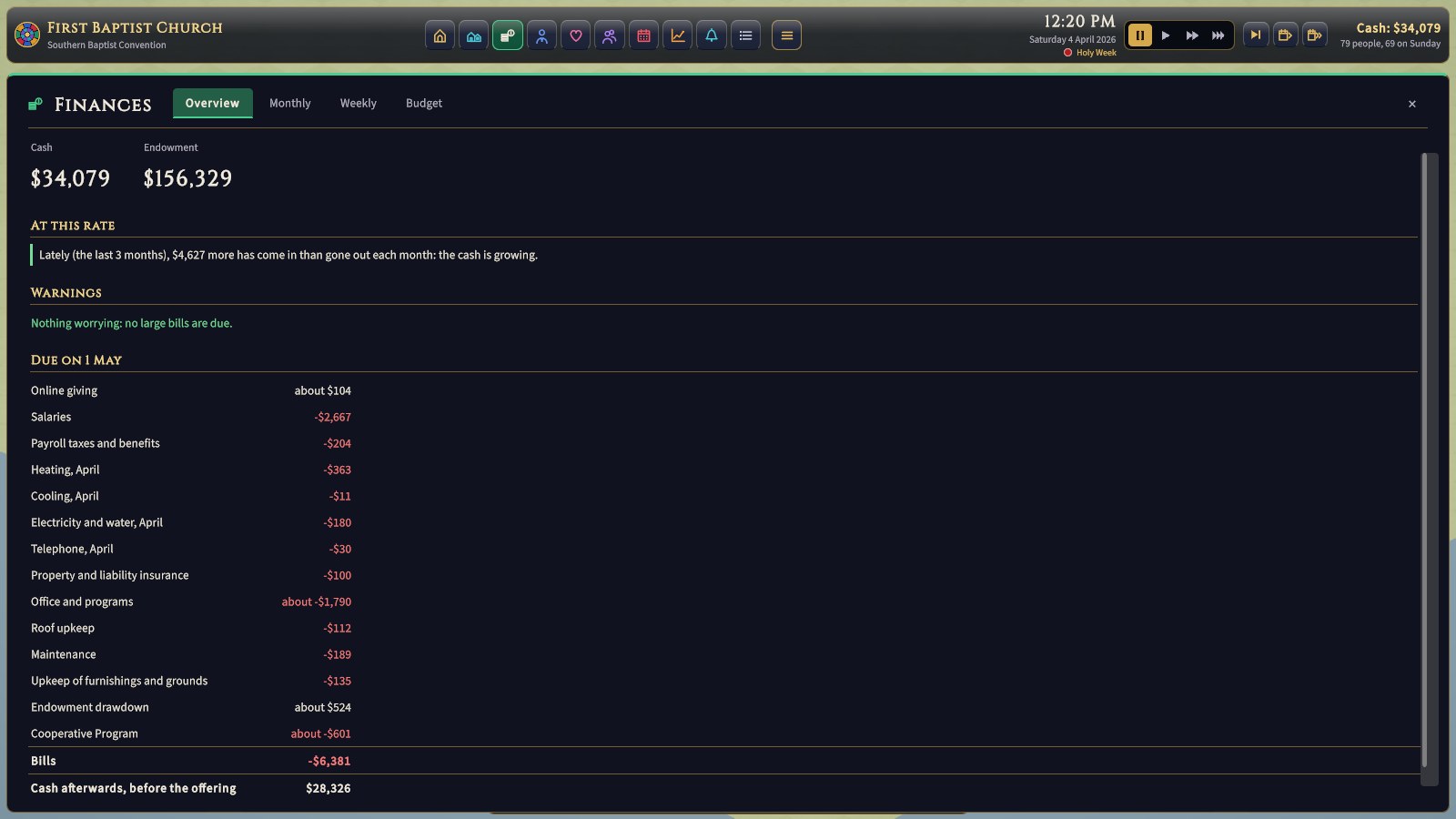
- Overview: the balances (cash, endowment, and any campaign fund), warnings, most serious first, and what the 1st of next month will bring, line by line, ending with the cash you'll have afterwards before the week's offerings.
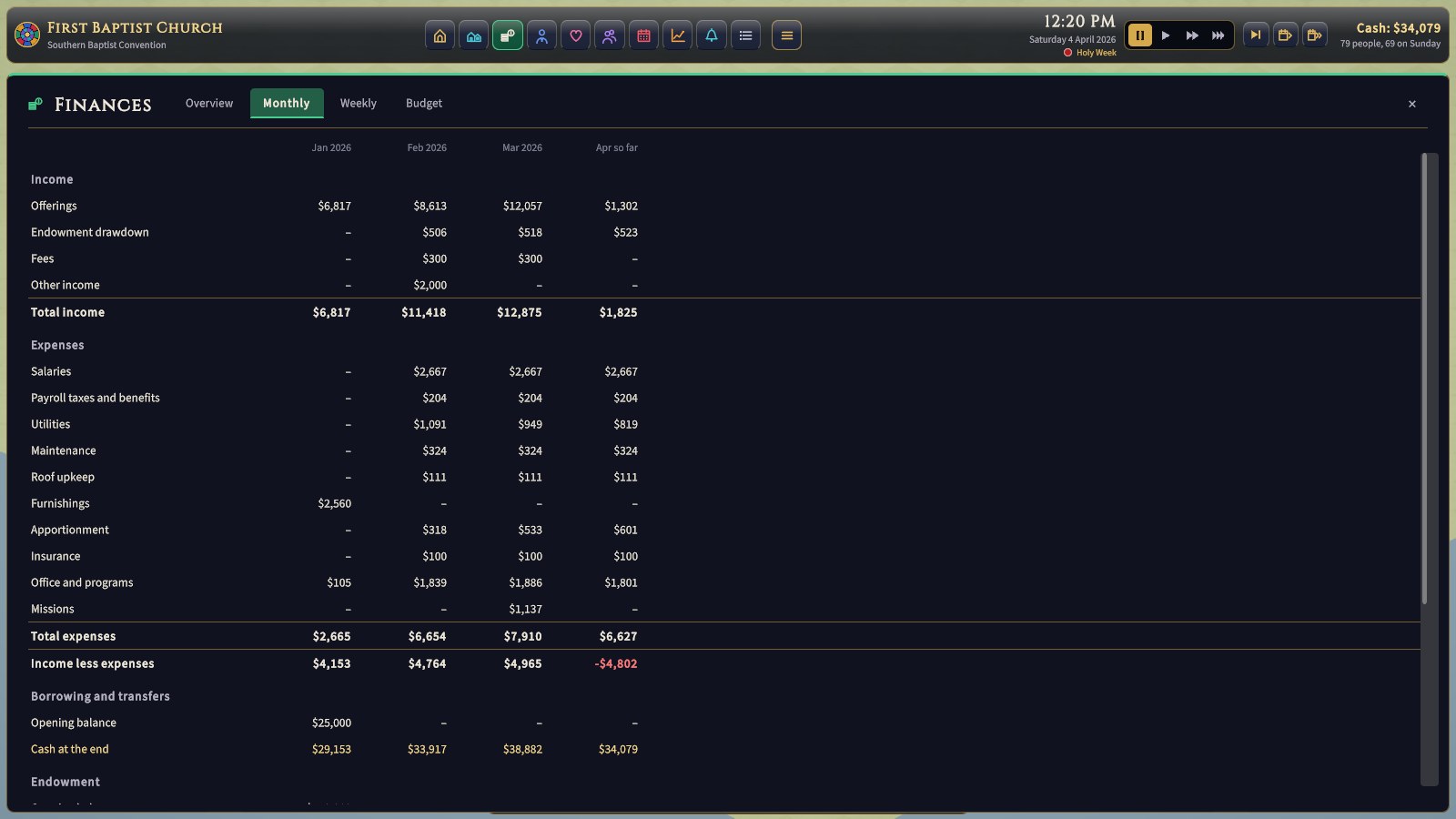
- Monthly: the last five monthly statements and the month so far, by category, with each fund's closing balance and a chart of a year's income against expenses.
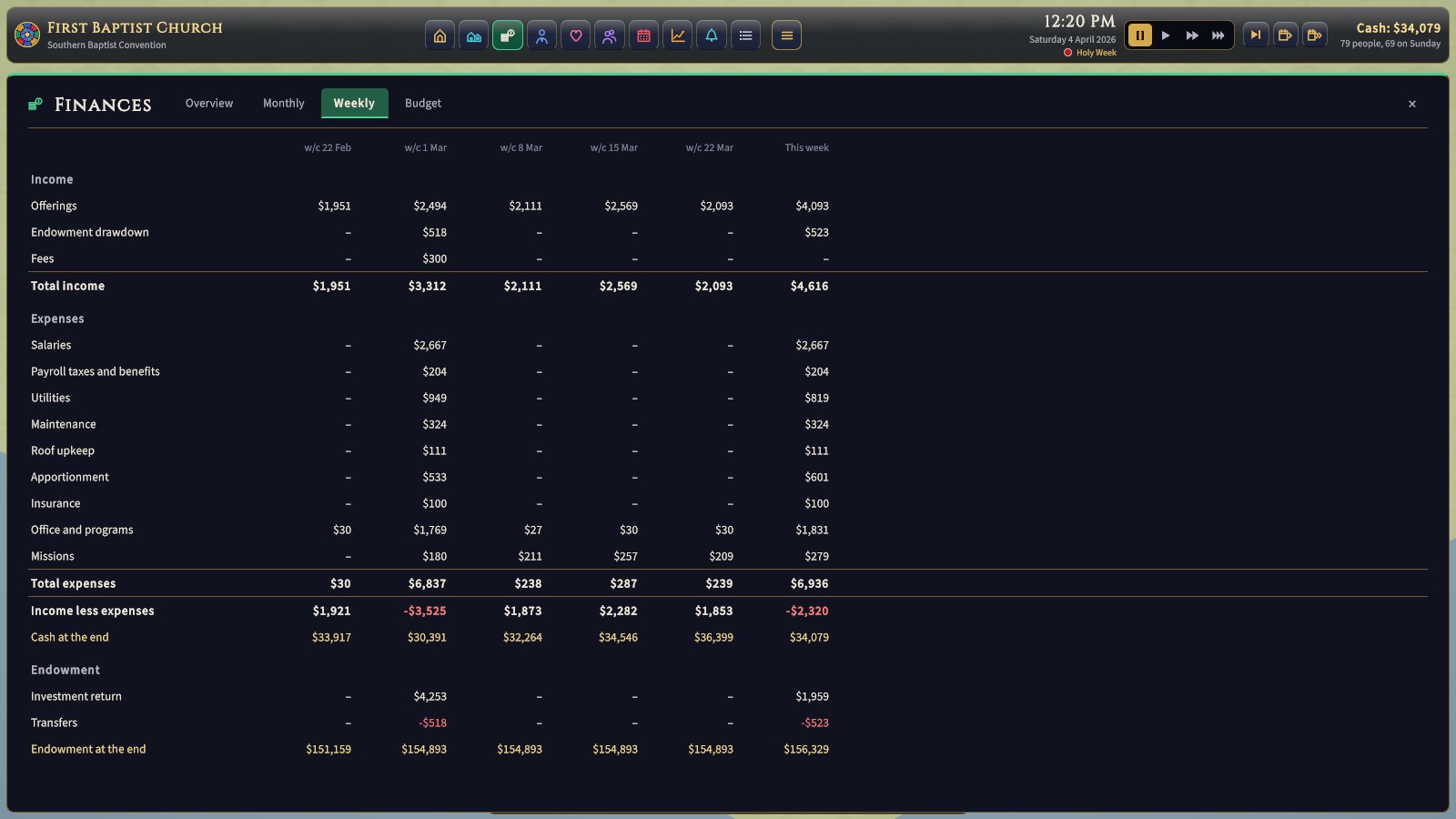
- Weekly: the last six Sunday-to-Saturday weeks (whatever the tradition's main day), which add up exactly to the monthly statements.
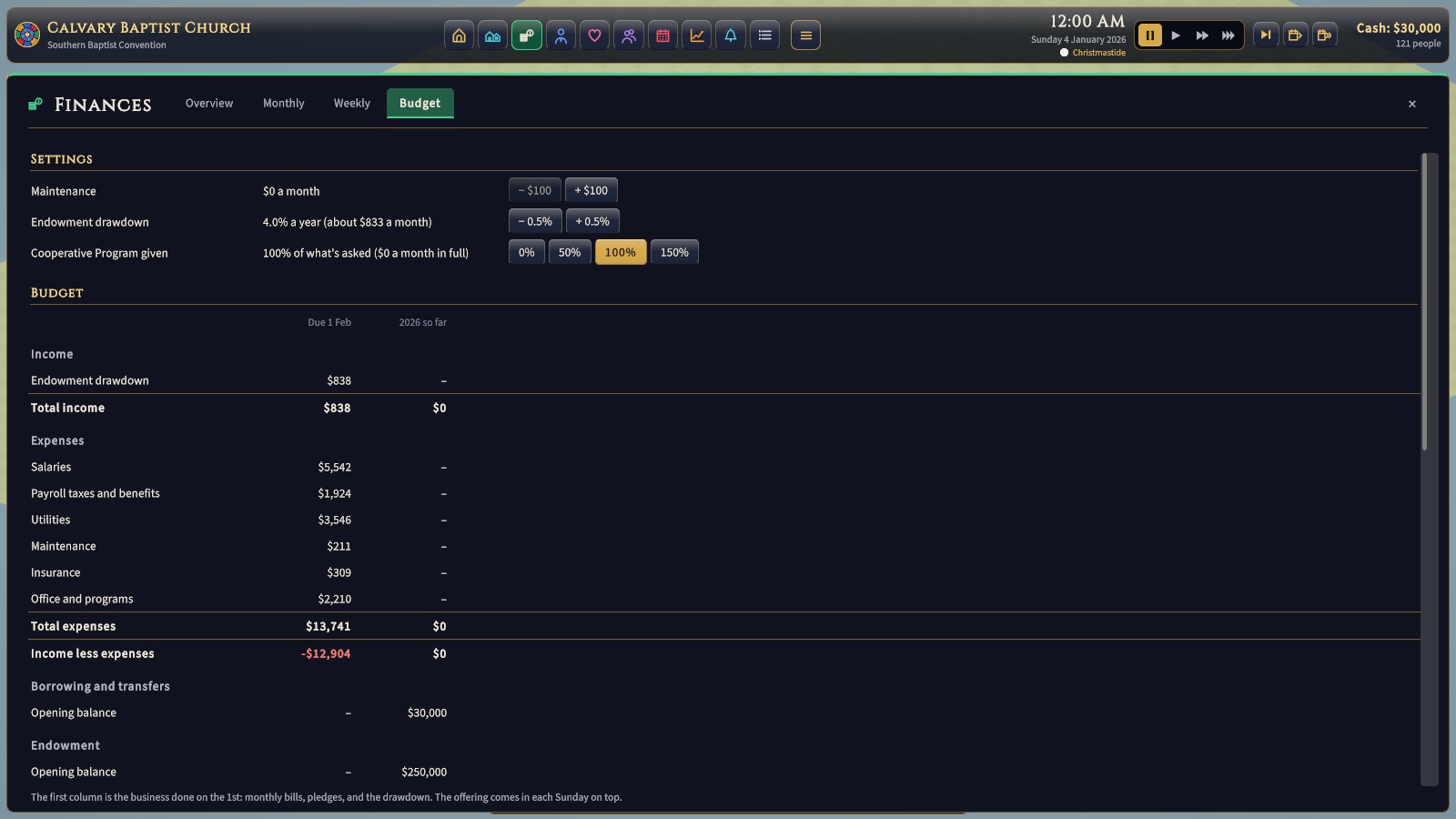
- Budget: the settings (maintenance budget, endowment drawdown, apportionment share), what's due next against this year and last, each building system's risk with a button to replace it, the staff's cost, and the forms to start a capital campaign and take a loan.
Warnings
The Overview warns you, a month ahead, about:
- an overdraft, or bills on the 1st that would cause one;
- any building system with a 4% or greater chance of failing next month (a stronger warning if the repair would empty the account);
- spending more than came in, three months running;
- unpaid apportionment (whatever the wider body calls what it's owed: an assessment, a union's dues).
"Spending more than came in for three months running" is the earliest sign of a slow slide. Act on it before it becomes an overdraft.
Where money comes from
Giving capacity and engagement
Each adult has a giving capacity: what they could give in a year if fully committed. It averages about $3,500 (roughly a tenth of a typical income, the share many traditions teach: a tithe, a Sikh's dasvandh), less for new visitors. How much of it they actually give depends on engagement, which follows satisfaction: nothing below 0.25, rising in a straight line to full at 0.8.
The offering
Each tradition gives in its own way, and the game calls the gift by its name (the offering, the collection, tithes and offerings, tzedakah, sadaqah, chanda, dana, incense money): a plate passed along the rows (most churches, an Indo-Caribbean mandir, an Arya Samaj, a Vedanta Society's chapel), an offering walked forward (the AME, National Baptist, COGIC, and United Pentecostal churches), boxes by the door or before the altar (a mosque's boxes, a gurdwara's golak before the Guru Granth Sahib, a Hindu or Jain temple's hundi, a shrine's offertory box, a Buddhist temple's dana box; the Witnesses' contribution boxes too), envelopes mailed in (a synagogue's gifts, a Konko church's), or giving kept private (a Latter-day Saint's tithing, a Vietnamese temple's named envelopes, a Sathya Sai center's). At every main service, as the tradition takes it:
- A household that hasn't pledged (or pays no dues) gives about capacity × 0.8 × engagement ÷ 52, give or take 30%; where the tradition doesn't pledge at all, the full capacity × engagement ÷ 52, each week it comes.
- Tithing expected gives 15% more (most Pentecostal and holiness churches, the Latter-day Saints, the Adventists, the Ahmadis); not emphasised, 10% less (most synagogues, most Buddhist and Hindu temples, the shrine and the Chinese temples, as well as many churches).
- A pledging household drops in a few dollars of loose cash.
- Daily services take no offering.
- A visiting household gives $5 to $25 where a plate is passed, half as much again where the offering is walked forward, and nothing where there are only boxes: a visitor to a mosque, a gurdwara, or a Hindu temple gives nothing at the service. Where the boxes are the only way to give, members give a tenth less than into a plate, and an offering walked forward brings 15% more. (A temple or a shrine that keeps open hours takes something at the box from every visit, below.)
- Where it's mailed in or given privately, it comes at the month's start; online givers add 8% a month. See The congregation in its community for income beyond giving.
Summer holidays thin attendance (June by 7%, July and August by 15%), so the offering dips in summer. Pledges and dues keep coming.
Pledges
- Only where the tradition takes pledges (15 of the 80: the Lutherans, the United Methodists, the Episcopalians, the PC(USA), a Reconstructionist synagogue, a Theravada temple, a Jain center, and others; see Faiths and traditions). Every November a pledge drive runs for the next year. A household with a member pledges with a chance of 0.9 × engagement; a household of regulars only, 0.3 × engagement.
- The pledge is about capacity × 0.75 × engagement.
- Pledges are paid monthly from January. Each month's payment is scaled by 0.5 + 0.6 × engagement (at most 1), so unhappy households fall behind. Households that leave stop paying.
- Opening the books (a new game) runs a drive for the current year.
Dues
- The Reform, Conservative, and Orthodox synagogues, the Japanese, Zen, and Tibetan temples, the Ahmadi chapters, the Nation of Islam's mosques, the Indo-Caribbean mandir, Chinmaya Mission's member families, a Shinto shrine's sukeikai, and the Daoist temple assess dues instead (12 traditions). In the November drive each household with a member takes up its assessment, about capacity × 0.7 (give or take 15%; a shrine's sukeikai asks only 0.35, a supporters' association's smaller dues), with the chance it would pledge (0.9 × engagement): the disengaged let their dues lapse and give, if at all, as they come. Regulars who haven't joined pay none.
- Dues are paid monthly, and nearly always: each payment is scaled by 0.85 + 0.3 × engagement (at most 1), so only the most unhappy fall behind. The ledger calls them "Dues".
- A synagogue that sells seats for the High Holy Days charges $150 for each adult in a household with no member that comes on a feast drawing at least twice the usual crowd (Rosh Hashanah, Kol Nidre, Yom Kippur), in place of their offering. The ledger calls it "Seats for" the day.
Zakat and Ramadan
- In a mosque that collects zakat (the Sunni center and the W. Deen Mohammed masjid), giving at the boxes is 1.8 times as much through Ramadan, by the Islamic calendar's dates, so it moves about eleven days earlier each year.
- In the month Ramadan ends, each household that belongs gives about capacity × 0.3 × engagement (counted as at least half engaged) as zakat. It passes through the mosque's books ("Zakat") and straight out to the needy the same month ("Zakat given to the needy"): it doesn't pay the bills.
Be at your happiest in November, and turn regulars into members: members are three times as likely to pledge, and where dues are the income (a synagogue, a Zen or Tibetan center, a Japanese temple, an Indo-Caribbean mandir), only members pay them at all. At a mosque, plan the year's big appeals for Ramadan, when giving nearly doubles. A congregation of 200 at 0.6 satisfaction gives about $1,600 a year per attender, roughly $225,000 in all.
Visits, amulets, and lamps
A temple or a shrine that people visit one by one, in its open hours (Worship and the year), takes its money a visit at a time:
- The box. Where the tradition gives at boxes, each visit drops in about $2.
- Amulets (a Shinto shrine, a Chinese folk temple, a Daoist priest's temple): each visit buys about $4 of amulets, talismans, incense, or fortune slips, half as much again on a feast day, once there's an amulet counter to sell them from. A shrine's New Year, thousands strong, is its year's income.
- Lamps (the folk temple, the Daoist priest's temple, the Chinese Buddhist temple): at the lunar New Year, households renew their lamps, $30 a household ($100 at the Chinese Buddhist temple): of member households, 85% of the fully engaged; of regulars', half; fewer the less engaged. The ledger names them in the tradition's words ("Lamps of brightness").
Rites asked for, and long readings
Many Hindu, Sikh, Jain, Shinto, and Chinese congregations live on rites families ask for and pay for, at the prices the temple lists. Each such rite has its fee and a rate (how many times a year a household asks for it):
- Asking. Each month a household asks for each at its rate, a member household half as often again, a household of regulars three quarters as often, and the more engaged the more often. A rite on a day of the year (the 7-5-3 rite in November) is asked for in the ten days up to it.
- Booking. It's booked at the first time it can be held, within four weeks, between seven in the morning and nine at night: the leader, or a member of staff who performs rites (a pujari, an assistant granthi, a negi, a Daoist priest), free for it; the worship room free, for one held there; and half an hour's journey each way to a home. Put off more than a week, the household is let down (−0.02); not held within four weeks, it goes without.
- Paying. Held, its fee goes to the fees line, in the tradition's words ("Puja fees", "Path offerings", "Prayer offerings"). Where fee rites are kept, they take the place of the flat stipend at each service.
- Long rites, such as the gurdwara's Akhand Path (48 hours of unbroken reading, $501), are kept in shifts (two readers at a time, two hours each). Members of staff take six shifts each, volunteers two; at night, between eleven and six, only one volunteer in four will sit up to read. A shift that goes unfilled breaks the reading off: the fee is given back, and the family is hurt (−0.06). Finished, the bhog gathers the family's friends (+0.01).
| Rite | Fee | Asked for, a household a year | Where |
|---|---|---|---|
| Archana (a Hindu temple) | $11 | 6 times | At the temple, 15 minutes |
| Puja at home | $151 ($251 at a community temple, $101 at a mandir) | about once in two years | At home, two hours |
| Jhandi (an Indo-Caribbean family's puja and flags) | $101 | about once in two years | At home |
| Akhand Path (a gurdwara) | $501 | about once in twelve years | At the gurdwara, 48 hours in shifts |
| Sehaj Path (a gurdwara) | $151 | once in ten years | At home |
| Snatra puja (a Jain center) | $101 | about once in two years | At the center |
| Kitō (a shrine's prayer) | $100 | once a year | At the shrine |
| Shichi-Go-San, house blessing, car blessing | $120, $200, $50 | now and then | The shrine; a home; the grounds |
| Tai Sui protection, fortune reading (a folk temple) | $20, $10 | most households, most years | At the temple |
| Memorial tablet (Chinese temples) | $30 to $50 | about once in two years | At the temple |
The price list rewards a temple with staff who perform rites: a head priest alone can't be at the temple and in three homes on a Saturday. Each tradition's page in Every tradition: services and what they need lists its rites, their fees, and their rates.
Honours and life memberships
- The boli (a Jain center with images, through Paryushana): the honours of the season's rites (twenty of them: waving the lamps, swinging the fourteen dreams, the parents of the Lord at the birth celebration) go to the highest bidders. The wealthiest member households (the top 8%, at least two) bid for each, 1% to 3% of a year's giving capacity, the more engaged the more, and a household that's won one bids less for the next. Winning is an honour (+0.03); losing narrowly, by a tenth or less, stings (−0.02). It's held on Community → Fundraising, and needs four volunteers.
- Life memberships (a Hindu temple's and ISKCON's, $1,001; a Jain center's, $301): each household in the tier pays its fee once, with a chance each month of 0.15 × its engagement; until it has, it doesn't vote.
Capital campaigns
A campaign raises money for one purpose over 3 to 36 months, one at a time (Budget → Capital campaign: choose the purpose, goal, and length).
- Each active household commits with a chance of engagement × the cause's popularity, and gives about capacity × 0.6 × engagement × popularity, spread over the campaign.
- Popularity: expansion 1.0, accessibility 0.9, repairs 0.8, music 0.6.
- Gifts go to the campaign fund. Construction, furnishings, and repairs are paid from that fund first, then from cash.
- A happy congregation of 150 raises about $160,000 over a year for an expansion, and about $45,000 for new instruments (an organ, a piano, a temple's drums).
- Some faiths raise building money their own way too, as fundraisers: a mosque's interest-free building campaign, a Hindu temple's shila campaign, a gurdwara's kar seva fund, a Tibetan center's stupa dinner (The congregation in its community).
The endowment
- It earns about 6% a year on average, varying about 12% either way from year to year.
- Each month, the drawdown you set (0 to 10% a year, 4% by default) moves into cash.
- A member who had attended ten years or more leaves the endowment a bequest a quarter of the time when they die: 2 to 15 times their yearly giving capacity.
Spend the endowment's income, not the endowment: a drawdown of 4 to 5%. Above about 5 to 6%, you're eating the capital that pays for the future.
Other income
| Source | Amount | Notes |
|---|---|---|
| Weddings of your own couples | $400 | Young adults in the congregation marry at about 5% a year. |
| Outside weddings | $2,500 | Up to one a month for a formal, handsome building. |
| Funerals | $300 | For each of your people who dies, where the congregation holds funerals (a Shinto shrine, the Hindu community temple, and a Sathya Sai center don't). The tradition's own rites go with them: a janazah, shiva, a Buddhist memorial, the antim ardas. |
| Rites asked for | $10 to $501 each | See above. |
| Amulets, the box, and lamps | $2 to $4 a visit; $30 to $100 a household a year | See above. |
| Meal sponsors | a meal's cost and a fifth more | A household sponsors each free meal in turn: a gurdwara's langar, ISKCON's Sunday Feast, BAPS's Mahaprasad, an Indo-Caribbean mandir's Sunday lunch, an Arya Samaj's Preeti bhoj, a Jain center's Swamivatsalya, Yiguandao's and the Chinese Buddhist temple's vegetarian lunch (Worship and the year). |
| Rentals | $100 to $1,500 a month | See The congregation in its community. |
| The preschool | about +$1,500 a month net | Tuition covers the teachers and a little more. |
| Support from the wider body | varies | In the suburban plant, a $4,000 monthly grant for four years. |
| Insurance | varies | In the fire-damaged church, $1.4 million at the start. |
Where money goes
| Cost | How it works |
|---|---|
| Staff | About 55% of a typical congregation's spending. Salaries, plus 7.65% payroll taxes, plus $18,000 benefits for a full-time leader (a pastor, priest, rabbi, imam, granthi, or head priest). See Staff and volunteers. |
| Utilities | Heating and cooling follow the climate, the volume (floor area × ceiling height), and the style's heat loss, for the share of the building your heating and cooling units serve and at what they cost to run: a heat pump 30 to 40% less than a furnace, electric heaters two and a half times as much, worn units up to half as much again. With no units there's no bill, and a cold building. A Gothic nave (9 m ceilings, 1.3× heat loss) costs several times a brick one to heat. Electricity and water $0.90 per m² a month. A telephone line for each of the clergy and the secretary on staff (and a cantor, an executive director, an outreach director, a temple manager), $30 a month each. Solar panels take 5% each off every bill but the telephone, up to 30% with six. Bills are paid on the 1st of the following month. See Keeping the building standing. |
| Insurance | $6 per m² a year. |
| Maintenance | The budget you set, plus each item's upkeep. See Keeping the building standing. |
| Repairs | When a building system fails or a heating or cooling unit breaks down: 10 to 50% of its replacement cost. Servicing a unit is a repair too. |
| Office and programs | $1,000 a month plus $10 per active person, plus ministries' costs, mailings, and the live stream. Where communion is kept (Christian traditions only), its bread and wine cost 6.5¢ for each person who receives. |
| What's owed upward | Each of the wider body's obligations, by its own basis: a share of income (Catholic dioceses 10%, United Methodist apportionments 12%), a sum for each member (the Orthodox assessment), a levy or a goal; a Shia center's khums goes to the office of the marja' it follows (here a tenth of what people give). Some are voluntary (the Cooperative Program, 4.67%). A Tenrikyo church sends a tenth of its income up the line of parent churches, an ISKCON temple 1% to its regional body, and a Konko church a voluntary 5% (all three estimates). Where the wider body funds the congregation centrally (the Latter-day Saints, Soka Gakkai, the Ahmadi chapters, whose chanda all goes to the national headquarters, the Self-Realization Fellowship, and the Salvation Army), giving goes up and the budget comes back down. You set how much of the required ones to pay (0% to 200%), and of each voluntary one, in Budget. Members' and clergy's own dues don't appear here. See Faiths and traditions. |
| Rent | In the suburban plant, $2,500 a month until the church has a building of its own. |
| Loan repayments and interest | See below. |
Debt
- Loans cost 6.5% a year, over 1 to 30 years, up to $5 million in all. Take one in Budget → Loans. Where the tradition forbids interest (every Muslim tradition but the Nation of Islam), the same form arranges Islamic financing instead: the bank leases or sells at a markup, for 7.5% a year, and the ledger names it so.
- Overdraft costs 12% a year, and most scenarios are lost if it runs deep for months.
Never sit in overdraft when a loan costs about half as much. The Overview warns you a month ahead. Take the loan before you need it.
Rules of thumb
- A full-time leader needs about 150 active people to pay for. Below about 75, a bivocational one is the difference between solvency and an overdraft.
- Fund building projects with a campaign first, then a loan, never the overdraft.
- Hire someone to lead the music once you average a surplus of about $2,500 a month: a choir director or organist in a church or a synagogue, an organist at a Shin temple; a cantor, full time, costs about three times as much, and a gurdwara's ragi jatha about twice as much.
- In a crisis month, paying half of what's owed upward (the apportionment, the assessment, the movement's dues, the parent church's offerings) is a reasonable compromise. Paying nothing for long is not.
- A preschool pays for itself and brings the most newcomers of any ministry.
- Small, steady maintenance is far cheaper than repairs.