Chapter 13: Faiths and traditions · Part 11
Jainism
Two traditions. Jain monks and nuns walk everywhere and don't come to America, so a Jain center has no resident clergy: its members do the puja themselves, bathed and in puja clothes, before the tirthankaras' marble images, and the year turns on Paryushana, when scholars come from India. Ahimsa reaches the kitchen: no meat, eggs, onion, garlic, or root vegetables, and for many nothing after sunset. Shoes and leather stay outside. The Terapanth worships without images.
Jain center its page →
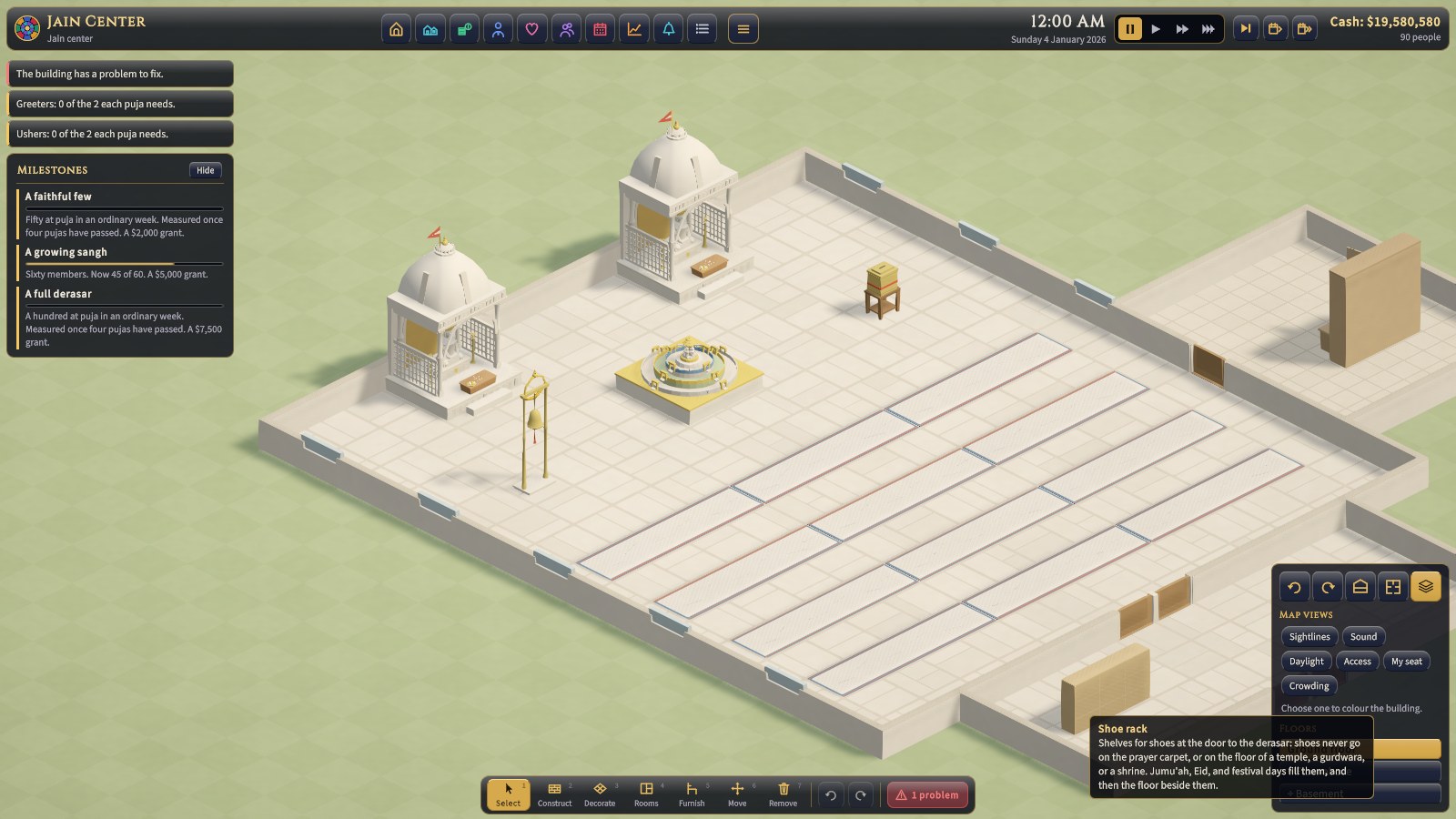
The independent society most American Jains belong to, whose building houses Shvetambara and Digambara shrines side by side, with a hall for the Sthanakvasi members and for lectures. It's open all day for darshan and puja, with the aarti and mangal divo each evening; the busy time is the weekend, with pathshala for the children, a sung snatra puja and a talk on Sunday, and Swamivatsalya, a lunch a family sponsors. Paryushana, eight days in late summer, is the peak: the vyakhyan every morning, fasting, the reading of the fourteen dreams, and Samvatsari, the year's greatest day, twice the usual crowd, with its pratikraman and the asking of forgiveness. Money comes from honours more than offerings: the boli, auctions of the right to do each rite, through Paryushana; sponsorships of pujas (a snatra puja, $101); and pledges. Life members pay $301 once. The Digambara jinalaya and the Sthanakvasi sthanak are rare variants.
- Required: a jin shrine, a shoe rack, a kitchen.
- Expected: a changing room (with puja clothes lockers), a temple bell, a hundi, an incense burner. Pianos, organs, and drums are discouraged.
- Fits best: the jin shrine (+1); the bell, the hundi, the incense burner, and the shoe rack (+0.5); pews, stained glass, pillars, the dome, and formal items (+0.33). The pipe organ −0.33, drums and the sound system −0.5; pianos, the electronic and Hammond organs, and handbells −1; chairs and the screen 0.
There's no leader to hire: an elected executive committee runs the center under its president, deciding small purchases and renovations, a board of trustees keeps the money, and the members vote on new building; keeping the sects in balance is part of the work. Life members vote and may hold office; other members only vote. A pujari keeps the shrines, and a visiting scholar teaches through Paryushana. JAINA, the federation, has no authority over the center: nothing is owed, and there's nothing to leave.
Jain Vishva Bharati its page →
A center of the Shvetambara Terapanth, led by a single acharya in Rajasthan: only three or four in the United States, each with a pair of samanis living on site, nuns of an order founded so that they could travel and teach abroad, assigned by the acharya and rotated every two years. The Terapanth worships without images, so there's no shrine, no puja, and no boli. Its weekly gathering, on Saturday, is a session of Preksha meditation (yoga, breathing, meditation, and a samani's talk), free and open to anyone, and many who come aren't Jain; a Wednesday swadhyay evening and the Paryushana discourses are the Terapanth families'. The samanis bless homes with the mangal path.
- Required: floor sheets, a shoe rack, and monks' quarters (the samanis').
- Discouraged: pews, pianos, organs, drums.
- Fits best: floor sheets and the shoe rack (+0.5); chairs and the projection screen (+0.33). Pews, stained glass, pillars, the dome, and formal items −0.33, the pipe organ −0.67; the jin shrine, pianos, the electronic and Hammond organs, and handbells −1.
The samanis take no salary and handle no money; the center houses them, and its families feed them. The senior samani leads as a full leader would (caring for 150) at no cost in pay, and a new one is always a woman. The executive committee decides renovations and new building; Jain Vishva Bharati assigns the samanis and can recall them. Nothing is owed, and a center can't vote to leave.