Chapter 13: Faiths and traditions · Part 9
Hinduism
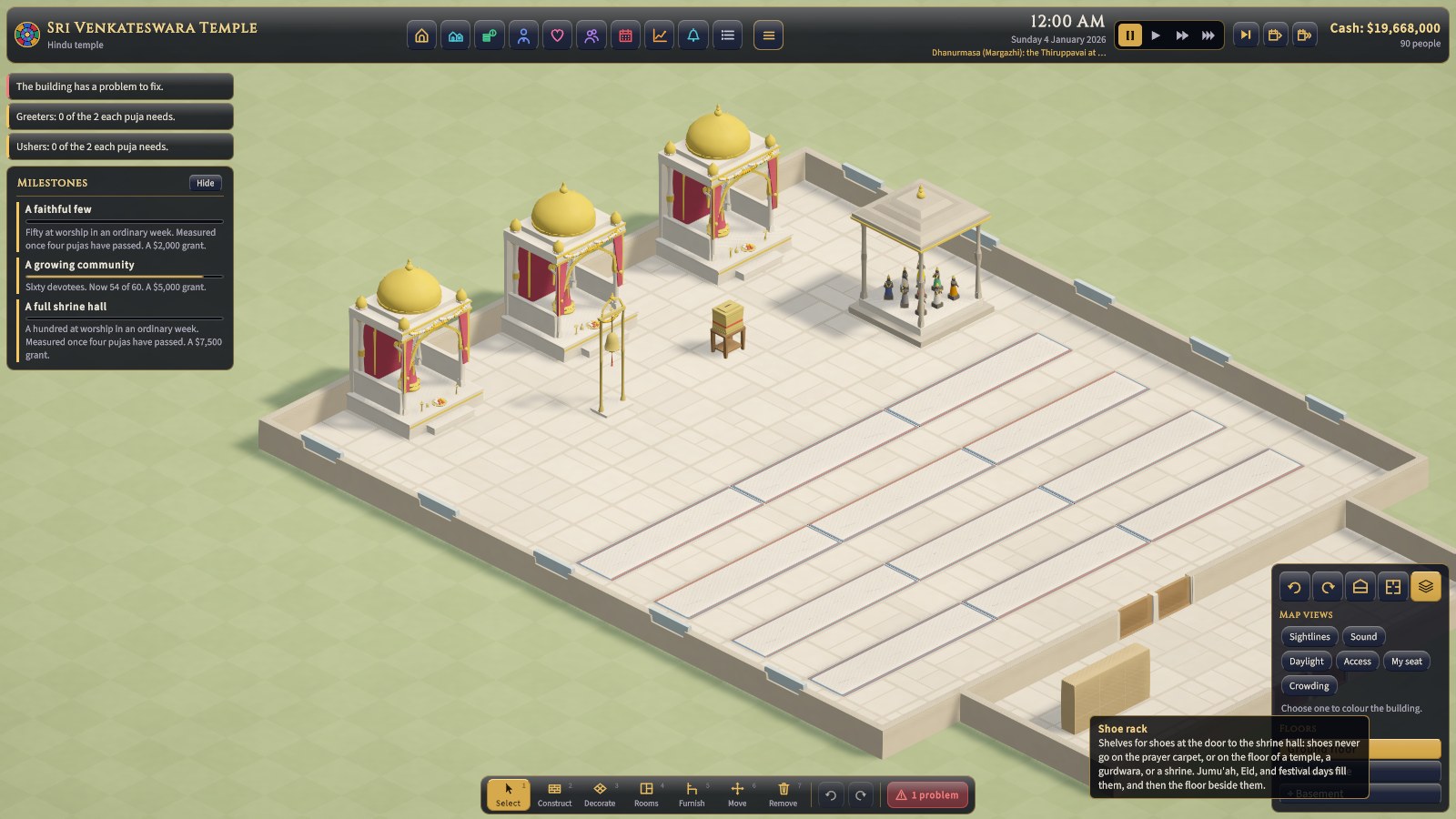
Ten traditions, from the community temple where families come all day to see the deities to the Vedanta Society's Sunday lecture in a chapel of pews. Most centre on the murtis, the deities present in their images, each in its own murti shrine, where priests or monks wake, bathe, dress, and feed them: a temple with images requires its shrines and a shoe rack, and expects a temple bell and a Hundi, and where its priests live on the grounds, their quarters. The Arya Samaj worships without images, around the fire. Most keep a vegetarian kitchen without eggs, sit on floor sheets, and keep a Hindu lunisolar year reckoned at the temple's own location. There's rarely a rite of joining: belonging comes by family, by vows, or by a life membership, and none but ISKCON seeks converts.
The Self-Realization Fellowship and the Sri Sathya Sai Organization don't describe themselves as Hindu: SRF teaches "original Christianity and original Yoga", and the Sai organization calls itself universal and non-religious; members of either needn't leave their own faith. Scholars class both with the Hindu traditions, and most American Sai devotees are of Indian origin, so the game lists them here, and their descriptions say so.
Hindu temple its page →
The independent community temple that Indian immigrants have built across America since 1977: a house of the gods more than an assembly, written as South Indian (Agamic), with Venkateswara, Shiva, Ganesha, and the goddess each in a sanctum of their own; the North Indian variant has marble murtis on one altar, a pandit, Hindi, and a Sunday satsang of bhajans, havan, and arati with a free meal. The priests keep their timetable whether anyone comes or not: a morning abhishekam and an evening arati every day, and on Sunday the abhishekam, with the canteen's lunch after. In between, the temple is open for darshan from eight in the morning to half past eight at night, busiest at the weekend: families come when they like, ring the bell, circle the shrines, leave something in the hundi, and go. Its economy is a price list: archanas ($11, asked for most), pujas at home ($251), namings, sacred threads, car pujas, and weddings, besides the hundi, the lamps, the canteen, and the hall. Life members pay $1,001 once, and vote. The premises are vegetarian, without eggs or alcohol, and there are no funerals at the temple.
- Required: murti shrines (one for each deity you'll keep), a shoe rack, a kitchen.
- Expected: a temple bell, a Hundi, an incense burner, and priests' quarters. Pianos, organs, and drums are discouraged.
- Fits best: pews, stained glass, pillars, the dome, and every formal item (+1); the bell, the hundi, the incense burner, and the shoe rack (+0.5). Chairs, instruments, the sound system, and the screen −1.
An elected board of trustees hires the priests (Brahmins trained in the Agamas, brought from India on religious-worker visas, scarce, and housed on the grounds) and decides renovations; an executive committee looks after the property, big donors sit on an advisory board of patrons, and the life members vote on new building. Women govern, but aren't its priests. There's no wider body: nothing is owed, and there's nothing to leave. The head priest can't be at every family's puja at once: a pujari or two, who perform rites too, turn the price list into income.
Indo-Caribbean mandir its page →
The Sanatan Dharma mandir of Guyanese and Trinidadian Hindus, most of them in Richmond Hill, Queens, and South Florida: English-speaking, devotional, and the most congregational of Hindu forms. Its centre is a Sunday-morning service: bhajans to harmonium, dholak, and dhantal, a havan, the arati, a reading from the Ramayan, a sermon by the pandit in English, and lunch, free to everyone; a Ramayan satsangh on Wednesday evenings. Many mandirs are converted houses, storefronts, and churches, and some keep the pews for the elders while the rest sit on the floor. Much of the pandit's work is in families' homes: a Hanuman puja or Satyanarayan katha ($101), after which the jhandi flags go up in the yard. Phagwah (Holi) is its great public day, and Maha Shivaratri fills the hall all night. Weddings are on Sunday mornings.
- Required: murti shrines (here one raised altar), a shoe rack, a kitchen.
- Expected: a temple bell, a hundi, an incense burner. Pianos, organs, and drums are discouraged.
- Fits best: the bell, the hundi, the incense burner, and the shoe rack (+0.5); chairs and the projection screen (+0.33). Pews, stained glass, pillars, the dome, and formal items −0.33, the pipe organ −0.67; pianos, the electronic and Hammond organs, and handbells −1.
The pandit, a married householder, leads for life and is succeeded by his family; he decides small purchases, and works another job until the mandir passes 300. The trustees decide renovations, and the member families vote on new building, pay dues, and give in the plate. Mandirs are independent, and split when trustees fall out. Nothing is owed, and there's nothing to leave.
BAPS Swaminarayan Sanstha its page →
A Hindu fellowship in the Swaminarayan tradition, run from its guru's seat in Ahmedabad, with over a hundred mandirs in North America, nearly all Gujarati: most are hari mandirs (a hall with a shrine, often a converted building), and the stone mandir variant is a carved shikharbaddha mandir with resident sadhus, five artis a day, and far more visitors. The week centres on the Sunday sabha at half past four: kirtans, discourses, and the arti, with the children, teens, and young adults in sabhas of their own at the same time, then Mahaprasad, a meal free to everyone. Darshan is open all day between the morning and evening artis. The sadhus are celibate and keep apart from women, so men and women enter, sit, and serve apart throughout, and women lead the women's sabhas. Belonging is by vows (the kanthi and the vartman), not dues: no meat, eggs, alcohol, onion, or garlic. Volunteers run everything.
- Required: murti shrines, a shoe rack, a kitchen.
- Expected: a temple bell, a hundi, an incense burner, priests' quarters for the sadhus. Pianos, organs, and drums are discouraged.
- Fits best: the bell, the hundi, the incense burner, and the shoe rack (+0.5); pews, stained glass, pillars, the dome, and formal items (+0.33). The pipe organ −0.33, drums and the sound system −0.5; pianos, the electronic and Hammond organs, and handbells −1; chairs and the screen 0.
There's no elected board: the organisation assigns the sadhus (unpaid and scarce; the senior sadhu leads as a full leader would, caring for 150), decides renovations and new building, and can close, merge, or take over a mandir; the swami decides small purchases, and the karyakars only advise. Satsangis don't vote. Fundraising is limited, and no rite carries a fee. A mandir can't vote to leave.
International Swaminarayan Satsang Organisation its page →
The temples of the original Swaminarayan Sampraday, as its followers call it: the Ahmedabad diocese's American body, with the Vadtal diocese's temples as the variant. Each diocese is led by a hereditary acharya of Swaminarayan's family, who alone installs a temple's murtis and initiates sadhus and satsangis; his visits are the year's great events. About forty temples serve Gujarati families, many of them Kutchi. The gathering is the Saturday evening sabha, with katha, the children's Bal Mandal, and prasad after; the murtis have five artis a day, from mangala at half past six to shayan at half past eight, with darshan open morning and evening between them. Men and women sit apart. Much of the money comes from sponsorships at published prices: a thal, the meal offered to the deities ($75), a festival's yajman, the hall for weddings and banquets.
- Required: murti shrines, a shoe rack, a kitchen.
- Expected: a temple bell, a hundi, an incense burner, priests' quarters for the sadhus. Pianos, organs, and drums are discouraged.
- Fits best: the bell, the hundi, the incense burner, and the shoe rack (+0.5); pews, stained glass, pillars, the dome, and formal items (+0.33). The pipe organ −0.33, drums and the sound system −0.5; pianos, the electronic and Hammond organs, and handbells −1; chairs and the screen 0.
The temple committee decides small purchases, renovations, and new building by its own vote; the diocese assigns the sadhus (celibate, unpaid, and scarce; the senior sadhu leads as a full leader would, caring for 150), can remove one or expel a temple, and initiation waits for the acharya. Satsangis vote. Leaving takes two thirds, the diocese's consent, and a negotiated settlement. Vadtal's succession has been in court since rival acharyas were named, which can pull a temple between factions.
International Society for Krishna Consciousness its page →
An ISKCON temple, Gaudiya Vaishnava, worshipping Krishna and chanting the Hare Krishna maha-mantra. The deities are never neglected: aratis through the day, from mangala arati at half past four in the morning to shayana arati at nine, and the Bhagavatam class each morning. A small core of initiated devotees lives at the temple, the brahmacharis in its ashram; the much larger congregation, now mostly Indian American families, comes for the Sunday Feast at five (kirtan, arati, a class, and a vegetarian feast for everyone) and for Janmashtami, the year's greatest day, twice the usual crowd. Initiates vow sixteen rounds of japa a day and the four regulative principles; the kitchen keeps out onion, garlic, and eggs, and the devotees take no tea or coffee. Unlike the other Hindu temples, ISKCON seeks converts: harinama, the book table, and the Ratha Yatra.
- Required: murti shrines, a shoe rack, a kitchen, and monks' quarters (the ashram).
- Expected: floor sheets, a temple bell, a hundi, an incense burner. Pews, pianos, organs, and drums are discouraged.
- Fits best: floor sheets, the bell, the hundi, the incense burner, and the shoe rack (+0.5); pews, stained glass, pillars, the dome, and formal items (+0.33). The pipe organ −0.33, drums and the sound system −0.5; pianos, the electronic and Hammond organs, and handbells −1; chairs and the screen 0.
The temple president runs it, deciding everything from small purchases to new building, appointed by the GBC's zonal secretary, who can remove him; the temple board only advises. Each temple gives 1% of its income to the North American regional body, which is required, and the GBC can expel or take over a temple; a temple can't vote to leave. Life members pay $1,001 once; the initiated don't vote. Leading every arati wears on the president as the daily prayers wear on an imam: a pujari shares them.
Arya Samaj its page →
The Hindu reform movement Swami Dayananda Saraswati founded in 1875: one formless God, the four Vedas, and no images. It worships around the fire: each Sunday morning the samaj meets in a plain hall with the havan kund at its centre, for Sandhya and the Gayatri mantra, the havan (the week's sponsoring family at the kund, everyone offering ghee into the flames), bhajans, a pravachan, and the Preeti bhoj, lunch given by the same family. With no deity to wake or feed, there are no daily rites and no darshan: people come for the service and go home after lunch. The samskaras are its work: namings, the sacred thread (for girls too), havans at home, and weddings, which couples of different castes, or none, seek out. Its priesthood is by learning, not birth, and women serve as priests. American samajs are North Indian (often Punjabi) or Indo-Caribbean, and the two rarely mix.
- Required: a havan kund, a shoe rack, a kitchen.
- Expected: a Lectern, for the pravachan. Forbidden: murti shrines. Pianos, organs, and drums are discouraged.
- Fits best: the havan kund and the shoe rack (+0.5); chairs and the projection screen (+0.33). Pews, stained glass, pillars, the dome, and formal items −0.33, the pipe organ −0.67; murti and navagraha shrines, pianos, the electronic and Hammond organs, and handbells −1.
An elected management committee hires the acharya (part-time until the samaj passes 200, and scarce) and decides renovations; its elections are fought over. The members vote on new building. The Arya Pratinidhi Sabha of America runs conventions and trains priests, but directs no one. Nothing is owed; leaving takes a majority and costs nothing.
Vedanta Society its page →
A branch of the Ramakrishna Order, teaching the Vedanta of Sri Ramakrishna, Holy Mother Sarada Devi, and Swami Vivekananda; there are fourteen in the United States. The week centres on the Sunday lecture at eleven, in a chapel of pews facing the shrine of the three; the monks who live at the society keep the daily worship, with vespers each evening and a weeknight class. Vedanta accepts all religions as paths to one truth, so Christmas Eve and Easter are kept beside Durga Puja and Kali Puja, by Belur Math's almanac. There are no fees for rites and little fundraising: money comes from gifts, the bookshop, and bequests. Membership is small and select, by interview with the swami.
- Required: murti shrines (the shrine of the three), a Pulpit, a shoe rack, and monks' quarters.
- Expected: a temple bell, a hundi. Banners, organs, and drums are discouraged.
- Fits best: the murti shrine, the bell, the hundi, and the shoe rack (+0.5); pews, stained glass, pillars, the dome, and formal items (+0.33). The pipe organ −0.33, drums and the sound system −0.5; banners, the electronic and Hammond organs, and handbells −1; chairs and the screen 0.
The swami is a monk of the Order, sent by Belur Math and recallable by it: a society can't hire its own, and swamis are scarce. He's paid and housed, and his assistant succeeds him. The board of trustees keeps the money and the building, deciding renovations and new building; the swami keeps the teaching and the worship. Leaving takes two thirds and costs nothing.
Chinmaya Mission its page →
A teaching mission more than a temple, teaching Advaita Vedanta through the Gita and the Upanishads, whose heart is Bala Vihar: on Sunday mornings through the school year, after an assembly of chanting, bhajans, and arati, the children learn in classes by grade taught by volunteer parents, while their parents study with the acharya; a Gita class meets on Wednesday evenings. Belonging is by family, a yearly membership; study groups and the women's Devi groups meet in homes, and a jnana yajna, a week of public lectures, is the Mission's signature. The center as written has an altar in its satsang hall; a center with a temple is its variant, with archanas and home pujas asked for at listed prices.
- Required: murti shrines (the altar), a Pulpit, a shoe rack, a classroom.
- Expected: a temple bell, a hundi. Pianos, organs, and drums are discouraged.
- Fits best: the murti shrine, the bell, the hundi, and the shoe rack (+0.5); chairs and the projection screen (+0.33). Pews, stained glass, pillars, the dome, and formal items −0.33, the pipe organ −0.67; pianos, the electronic and Hammond organs, and handbells −1.
The acharya (a swami or swamini, a brahmachari or brahmacharini, as often a woman as a man) is trained in Mumbai and posted by the Mission, not hired; acharyas are scarce, and the Mission can move one. The acharya governs, with a managing committee that decides renovations and new building. Member families pay dues. A center can't vote to leave. Its classrooms are its growth: Bala Vihars keep waitlists.
Self-Realization Fellowship its page →
A temple of the fellowship Paramahansa Yogananda founded in 1920, teaching Kriya Yoga meditation through a line of gurus from Jesus Christ and Krishna to Yogananda (see the note above). The Sunday service at eleven is an hour of readings from Yogananda, chanting, silent meditation, and the Prayer Circle for healing, with the minister's talk, in a quiet, church-like chapel; there's little Hindu ritual, and no puja or murtis. Meditations on Sunday morning and Thursday evening. Members belong not to the temple but to the SRF Lessons, a home-study course, and ask for Kriya initiation after it; the year is on fixed dates, its peak the all-day Christmas meditation. The lay-led meditation center variant, as most of SRF's groups are, is conducted by a member reading Yogananda's words.
- Required: a Pulpit.
- Discouraged: banners, organs, drums.
- Fits best: chairs and the projection screen (+0.33). Pews, stained glass, pillars, the dome, and formal items −0.33, the pipe organ −0.67; murti and navagraha shrines, banners, the electronic and Hammond organs, and handbells −1.
SRF owns its temples and funds them centrally: giving goes up to the Mother Center, and a budget comes back. It assigns the minister, a monastic of its order (a Brother or a Sister), decides renovations and new building, and can close or merge temples; the minister decides only small purchases. Nobody votes, and a temple can't leave. Without a minister, a reading service stands in.
Sri Sathya Sai Organization of USA its page →
A Sathya Sai Center, devoted to Sri Sathya Sai Baba of Puttaparthi (see the note above). Most of its 200 and more centers meet in homes or rented rooms; the center with a hall of its own is a variant. Its heart is the weekly devotional meeting on Thursday evening: bhajans sung line by line, men on one side and women on the other, a reading, silent meditation, and the Arathi. Service (seva) and the children's Sai Spiritual Education are the rest of its work. There are no clergy, no fees, no dues, and no fundraising of any kind: anonymous gifts meet the costs, and projects wait until the money is there. It keeps no rites of passage, and holds no funerals.
- Expected: floor sheets, an incense burner. Banners, pianos, organs, and drums are discouraged.
- Fits best: floor sheets and the incense burner (+0.5); chairs and the projection screen (+0.33). Pews, stained glass, pillars, the dome, and formal items −0.33, the pipe organ −0.67; murti and navagraha shrines, banners, pianos, the electronic and Hammond organs, and handbells −1.
Its officers (a president, a vice president, and coordinators) are chosen by consensus for two-year terms, serve unpaid, and decide everything by consensus too. The National Council accredits centers and can disaffiliate one. Nothing is owed, and a center can't vote to leave. With no one to pay and nothing to raise, the building is the whole budget: keep it small.