Chapter 13: Faiths and traditions · Part 13
Chinese religion
Three traditions: a Chinese folk temple, a Daoist temple, and Yiguandao; the Chinese Buddhist temple is under Buddhism. Chinese popular religion isn't a denomination: most who light incense at a folk temple wouldn't name it as their religion, mixing Daoist, Buddhist, and ancestral rites as their families always have. The temples keep the Chinese lunar year, the 1st and the 15th of each month their days, and much of their money comes per visit and per rite: lamps renewed each New Year, Tai Sui protection, fortune readings, memorial tablets. The gods sit on a deity altar, with a censer outside for incense.
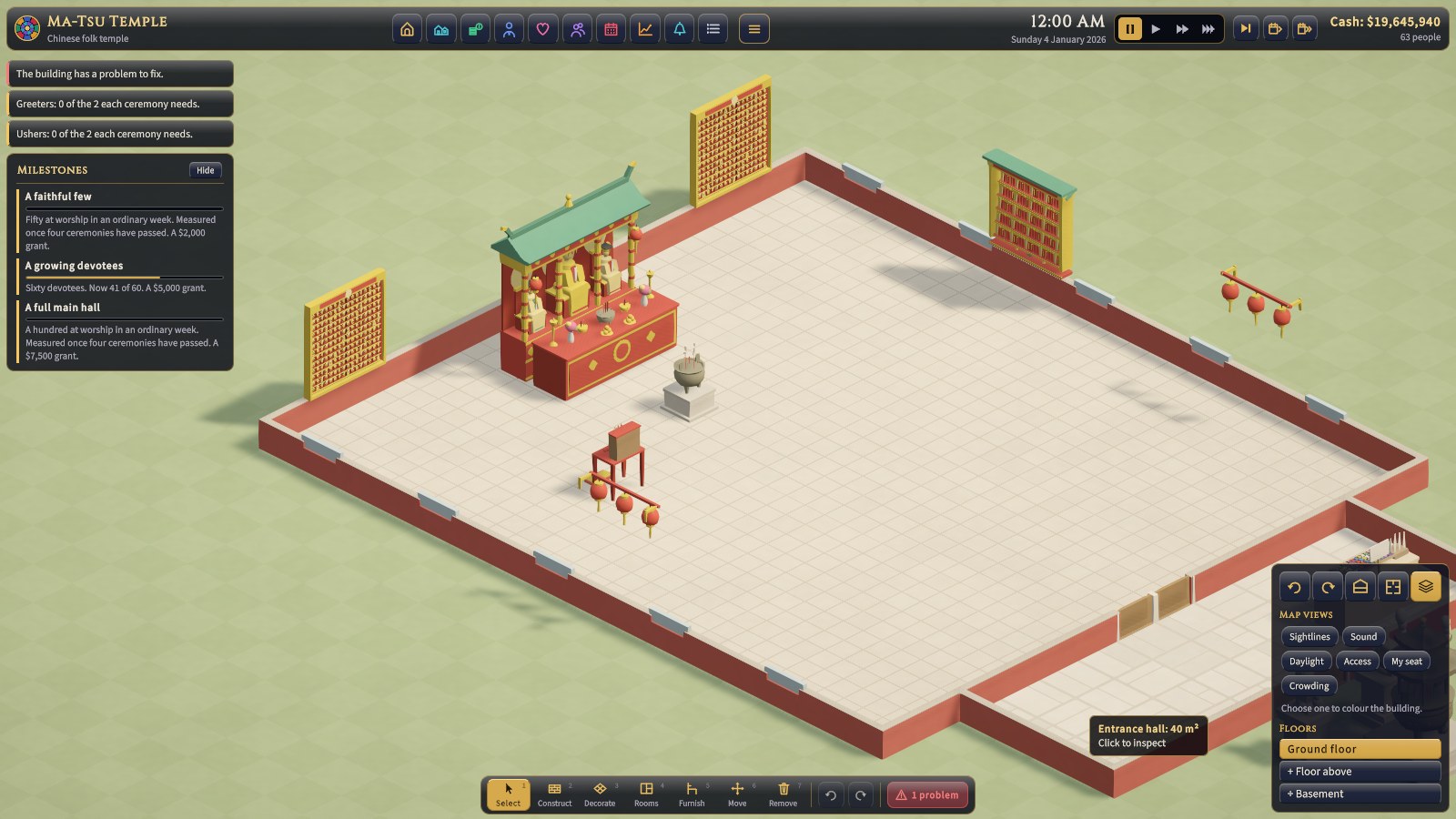
Chinese folk temple its page →
A community temple to a patron god, here Mazu, the Holy Mother in Heaven, with Guanyin, Guan Di, the earth god, and the year's Tai Sui on side altars, after Ma-Tsu Temple of U.S.A. in San Francisco. It isn't a congregation: the doors are open every day from nine to five, and people come alone or as a family to bow at the great censer and before each altar, put a question to the god with the moon blocks and fortune sticks, buy incense, paper, and charms, and burn paper money in the furnace. More come on the 1st and the 15th and on Sundays. There's no weekly service, and the game holds none: the temple's week is its open hours, and its rites, with the god's scripture chanted by volunteers, are its great days', held as services of their own. A few days are enormous: Lunar New Year's Eve, when crowds press in at midnight to plant the first incense, the god's birthday, and the Ghost Festival, in a month when no weddings are held. The money is per service: lamps of brightness renewed at New Year ($30), Tai Sui protection ($20), fortune readings ($10), memorial tablets ($30), the box, and amulets. Its variants are a Chinatown association temple, Cantonese, on the top floor of a district or clan association's building, and a Fujianese village temple in a leased storefront, open until nine at night.
- Required: the deity altar.
- Expected: the temple censer, an incense burner, the joss paper furnace, a divination table, and the lamps of brightness. Pianos, organs, and drums are discouraged.
- Fits best: the deity altar, censer, furnace, divination table, lamps, and incense burner (+0.5); pews, stained glass, pillars, the dome, and formal items (+0.33). The pipe organ −0.33, drums and the sound system −0.5; pianos, the electronic and Hammond organs, and handbells −1; chairs and the screen 0.
The player is the temple's board (its association, or its own nonprofit, with a chair): there are no resident clergy. A temple keeper opens the doors and tends the incense and the lamps, volunteers chant and cook, and a Daoist priest is hired for the jiao, Pudu, and funerals. The board decides everything; association members vote. There's no wider body. The furnace and the censer smoke, and in town the neighbours will say so (The congregation in its community).
Daoist temple its page →
Daoism is China's own organised religion, with its scriptures, its gods, and its priests, but a Daoist temple with ordained priests barely exists in America as a local congregation, as the tradition's description says. This one follows the pattern of the Fung Loy Kok Institute of Taoism and its Taoist Tai Chi Society: tai chi is the gathering and the way nearly everyone comes in (Sunday's practice with chanting, classes on Tuesday and Thursday evenings, and a beginners' class on Saturday), taught by unpaid volunteer instructors. Most come for their health and never look at the altar; a few stay for the chanting, on the 1st and the 15th and at the festivals of the Daoist year. A priest leads the rites the temple offers, for fees: memorial plaques, merit rites for the dead ($300), and rites at funerals. The variant, a priest's temple serving Chinese families, is a Zhengyi priest's own, open daily for incense and living on rites for the dead, Tai Sui, amulets, and lamps.
- Required: the deity altar.
- Expected: the temple censer, an incense burner, the lamps of brightness. Pianos, organs, and drums are discouraged.
- Fits best: the deity altar, the censer, the lamps, and the incense burner (+0.5); chairs and the projection screen (+0.33). Pews, stained glass, pillars, the dome, and formal items −0.33, the pipe organ −0.67; pianos, the electronic and Hammond organs, and handbells −1.
The Institute holds the property, accredits the instructors, and appoints the priest (part-time, and scarce); it decides new building, and can close or merge a branch. The branch board decides small purchases and renovations. Members pay dues and don't vote, and a branch can't vote to leave. At the priest's temple, the priest governs for life, is succeeded by family, and rises through the Zhengyi registers.
Yiguandao (I-Kuan Tao) its page →
"The Way of Unity", which teaches that the Eternal Venerable Mother is calling her children home in the last age, and that the Way behind Confucianism, Daoism, Buddhism, Christianity, and Islam is one; banned in Taiwan for thirty-five years, it's now one of Taiwan's largest religions. It isn't a Buddhist temple, though Maitreya and Guanyin sit on its altars. This is a public hall of the Fa Yi Chong De lineage, with many family altars in members' homes around it. One belongs by initiation, qiudao, brought by an introducer and vouched for by a guarantor: many are initiated, and most never come back; a few go on to the classes, the vows, lecturing, an altar of their own, and mastership. The week is a Sunday class on the Tao with a short rite before the Mother lamp and a free vegetarian lunch, and incense morning and evening; the year, the four Grand Ceremonies to the Mother. Men and women sit apart. Everything at the hall is vegetarian, without onion or garlic, alcohol, or tobacco.
- Required: the Mother lamp altar, a kitchen.
- Expected: an incense burner. Pianos, organs, and drums are discouraged.
- Fits best: the Mother lamp altar and the incense burner (+0.5); pews, pillars, the dome, and formal items (+0.33). The pipe organ −0.33, drums and the sound system −0.5; stained glass, pianos, the electronic and Hammond organs, and handbells −1; chairs and the screen 0.
Everyone is lay and unpaid: the master, appointed up the lineage for life, governs the hall and funds it rather than drawing a salary, and the lineage decides new building and can remove a master or expel a hall. No one is asked for money, and fundraising is limited. Neither the initiated nor the cultivators vote, and a hall can't vote to leave. Unpaid lecturers carry the classes that turn the initiated into cultivators.