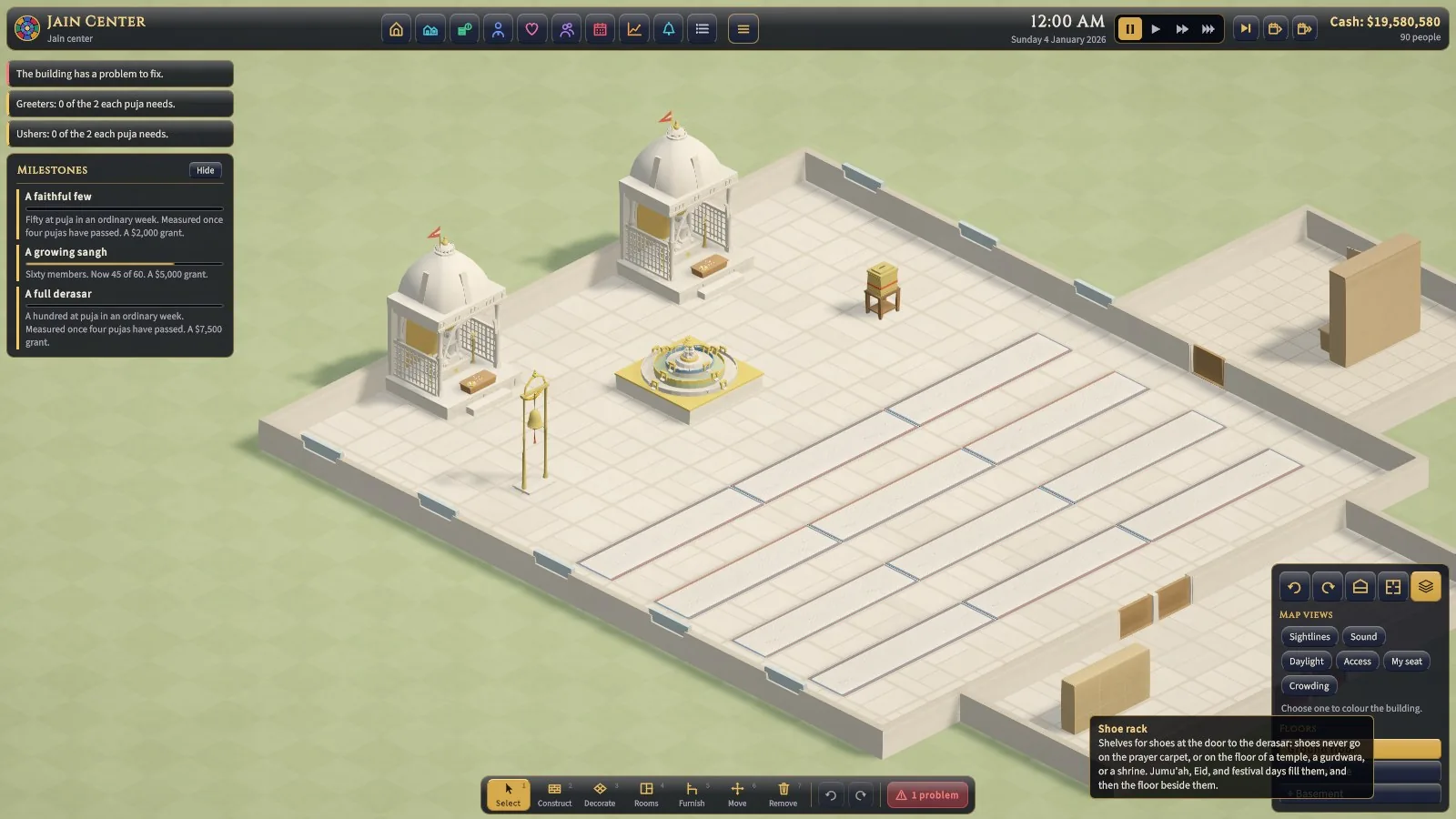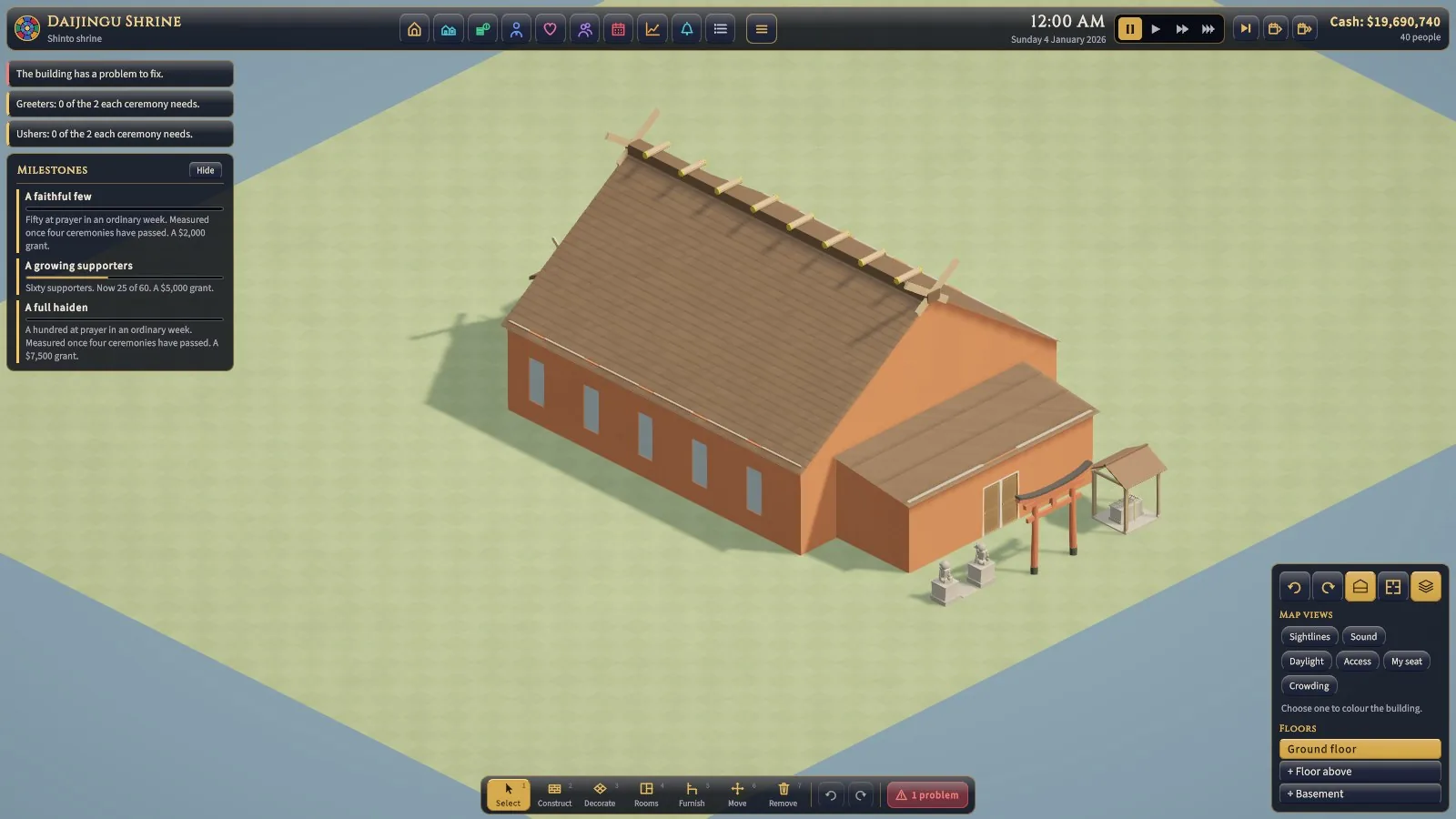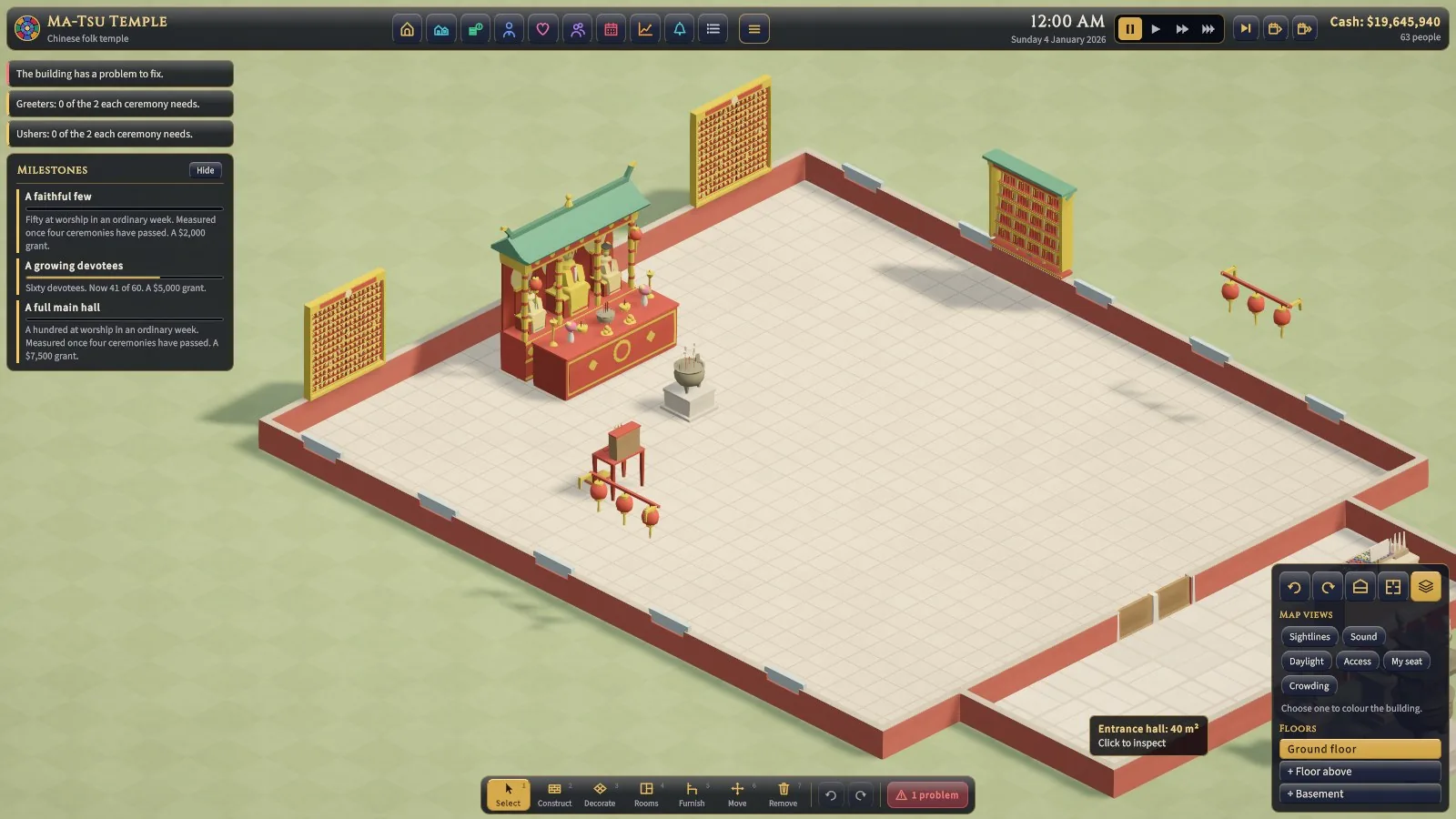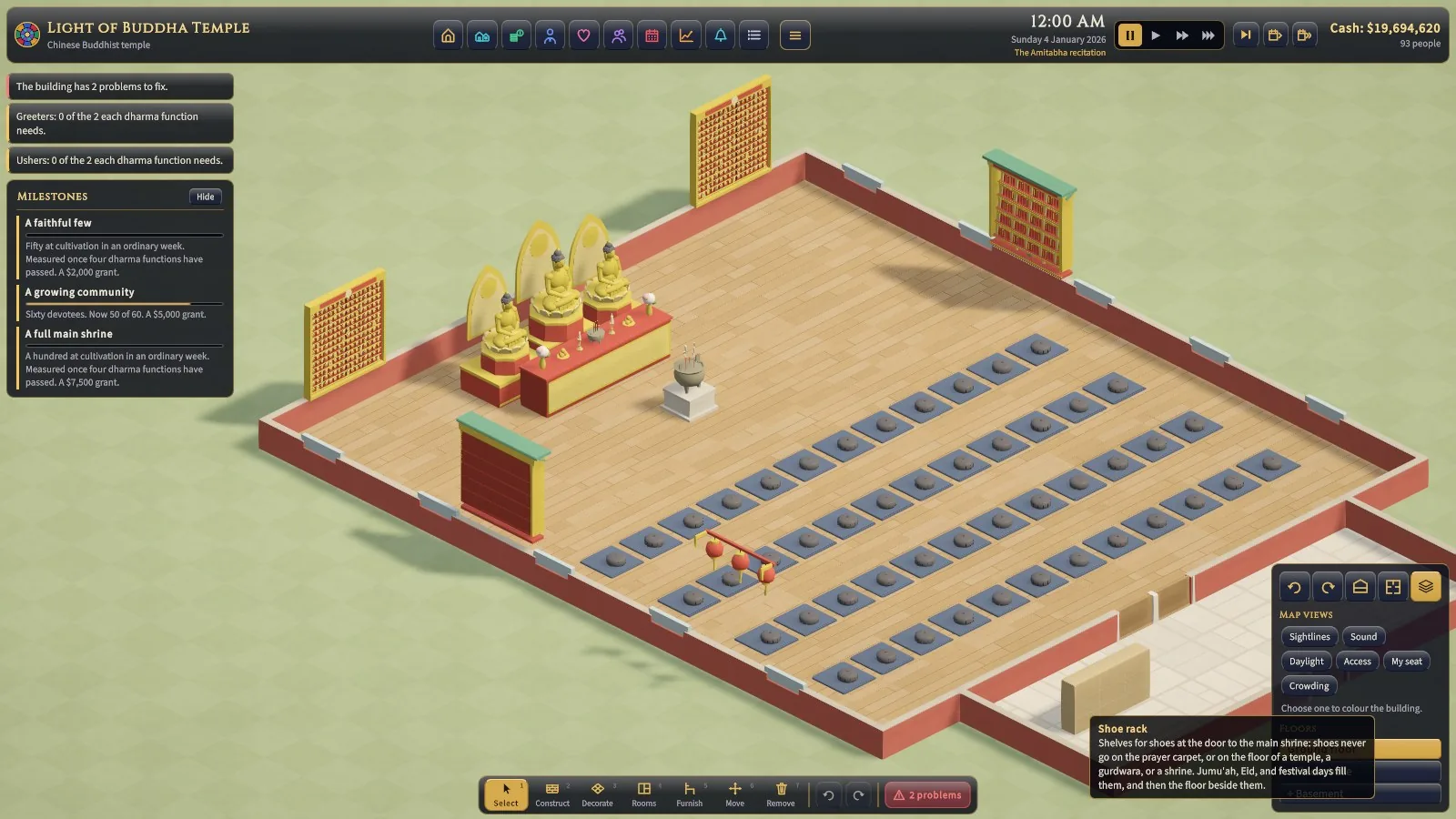
A house-of-worship management sim

Rejoice!Build a house of worship. Gather a people. Keep the faith.

Lay out a church, a synagogue, a mosque, a temple, a gurdwara, or a shrine tile by tile, furnish it for one of eighty traditions in nine faiths, and run it week after week while every person in the congregation is simulated: their family, their faith, their health, the weather, and seventy-eight reasons to stay or drift away.

Sign up to test

Launching exclusively on Steam on Black Friday, 27 November 2026, for Windows, Mac & Linux · $9.99 on launch day

--days
--hours
--minutes
--seconds
80traditions in nine faiths, each with its own rules
78reasons a person stays or goes
193furnishings, from pews to prayer carpets
168rites, from baptism to bar mitzvah
53calendars, by the sun and the moon
100dilemmas to decide

Design

Draw it tile by tile, then watch it go up

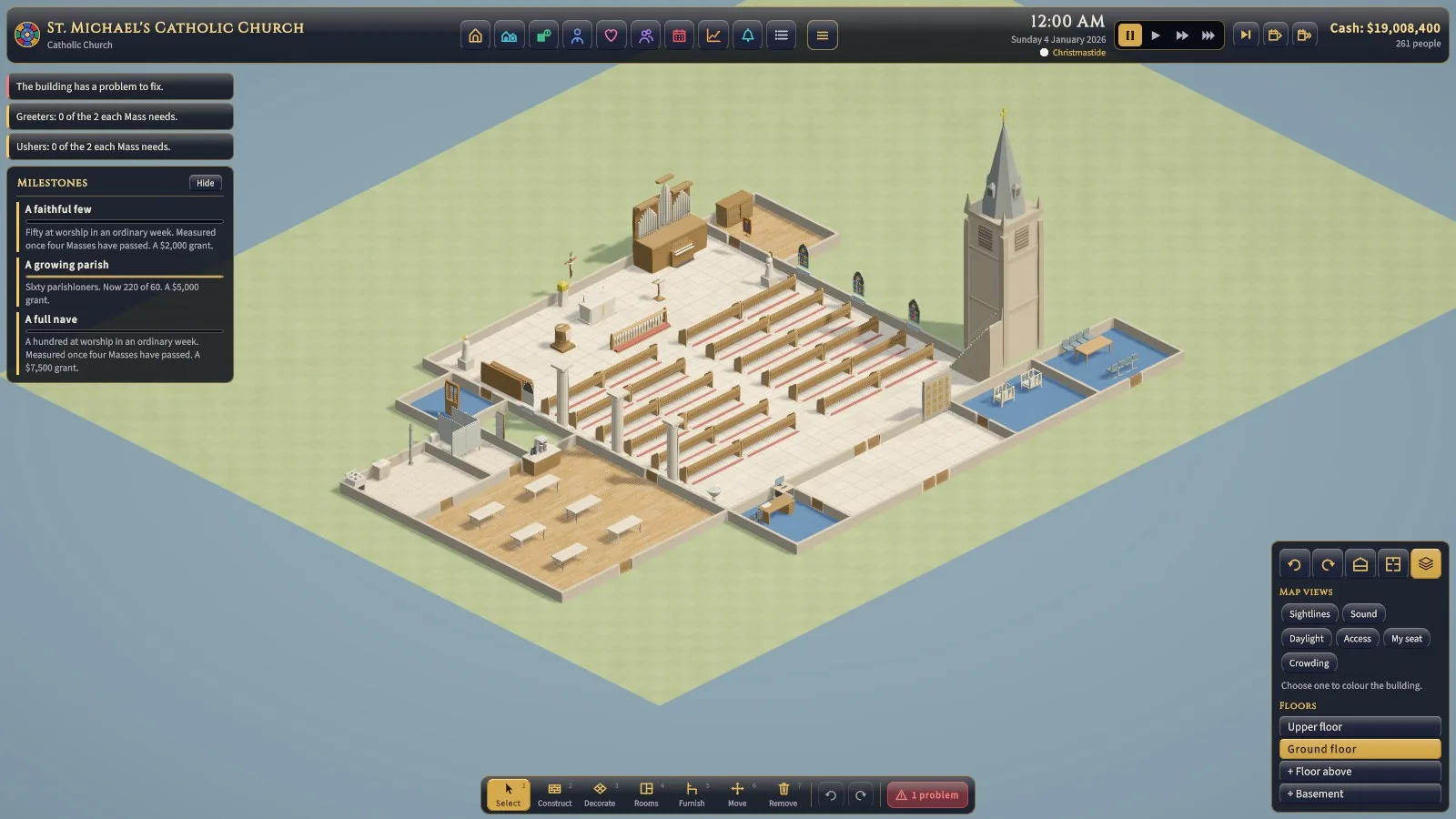
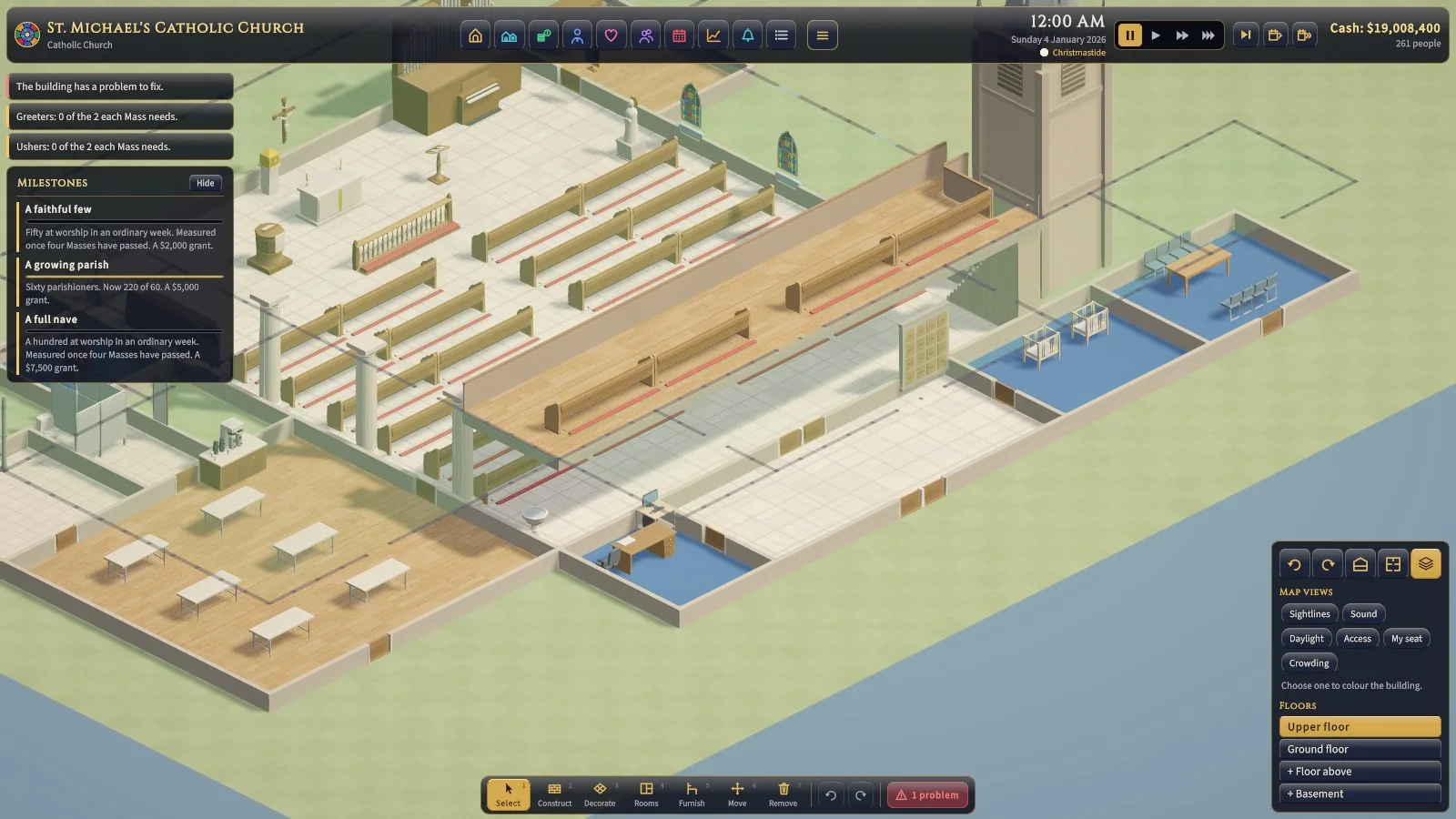
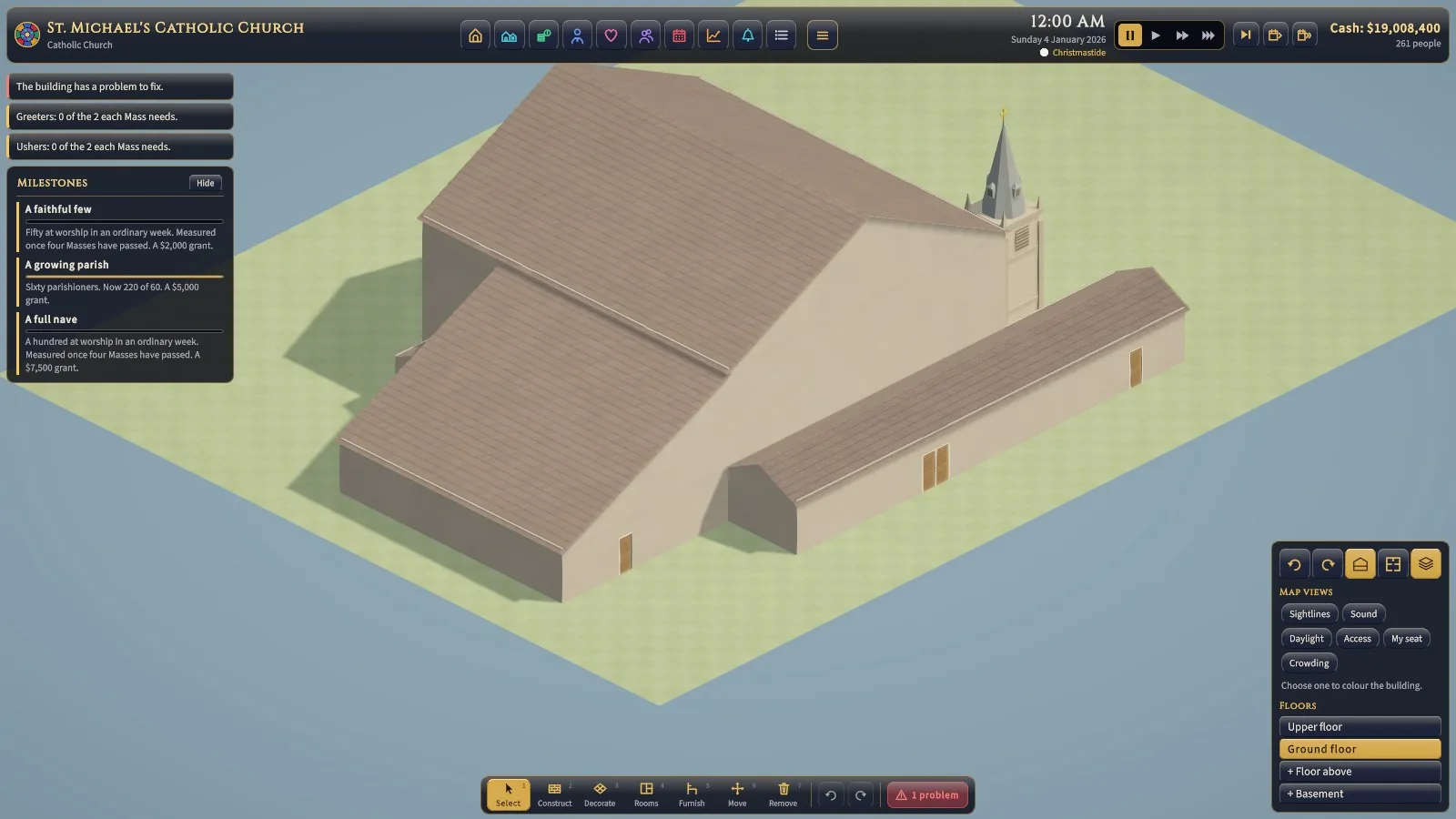
Walls, doors, and windows; a sanctuary or a prayer hall, a social hall, a kitchen, classrooms, a beit midrash, a wudu room, monks' quarters, a sachkhand where the Guru Granth Sahib rests at night, and the rest of twenty-six kinds of room, each with a job and its own needs. Stone, plaster, brick, and panelling inside and out, fifty-one materials and finishes, twelve building styles, a balcony or a women's gallery upstairs and a basement below, on a lot with its own zoning in one of fourteen American regions.

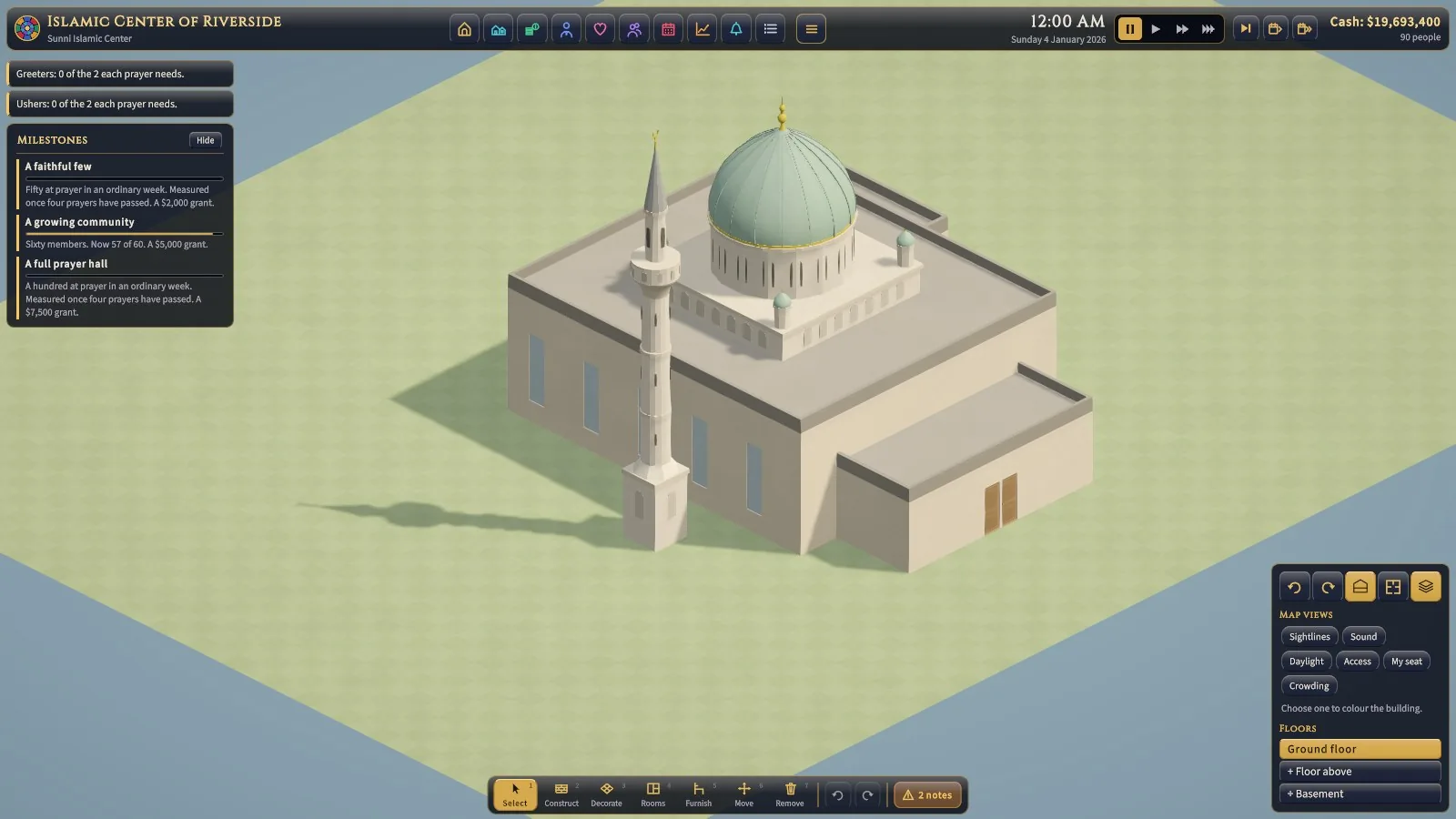
Raise a steeple, a dome, or a minaret; a stupa or a pagoda tower; a shikhara, a vimana, or a gilded dome; a gopuram, a torii, or a paifang at the gate; a temple roof with upturned eaves, in glazed tile or cypress bark. Turn the whole lot to face the qibla. Then contractors, approvals, and weeks of work, paid as it goes.
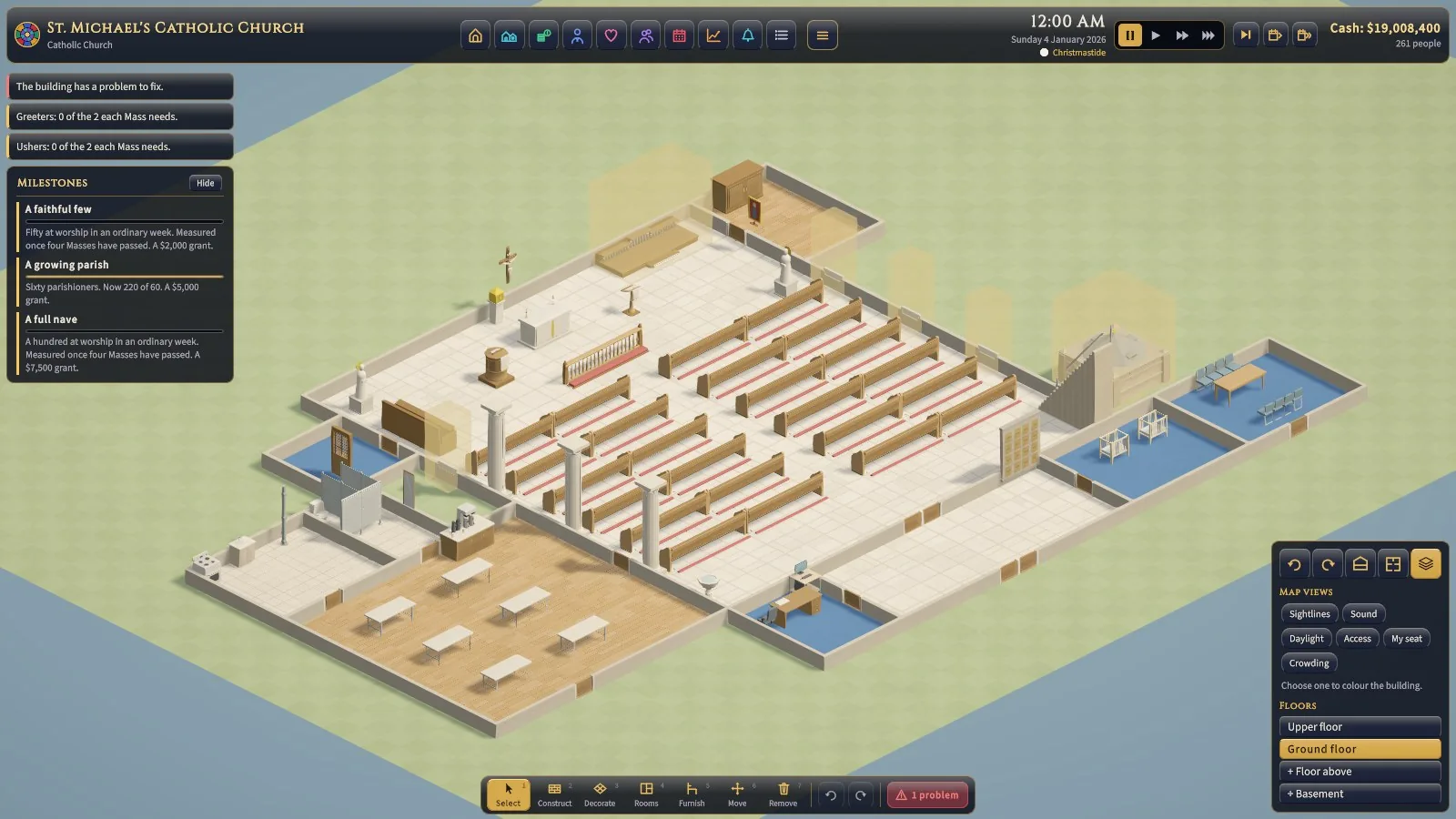
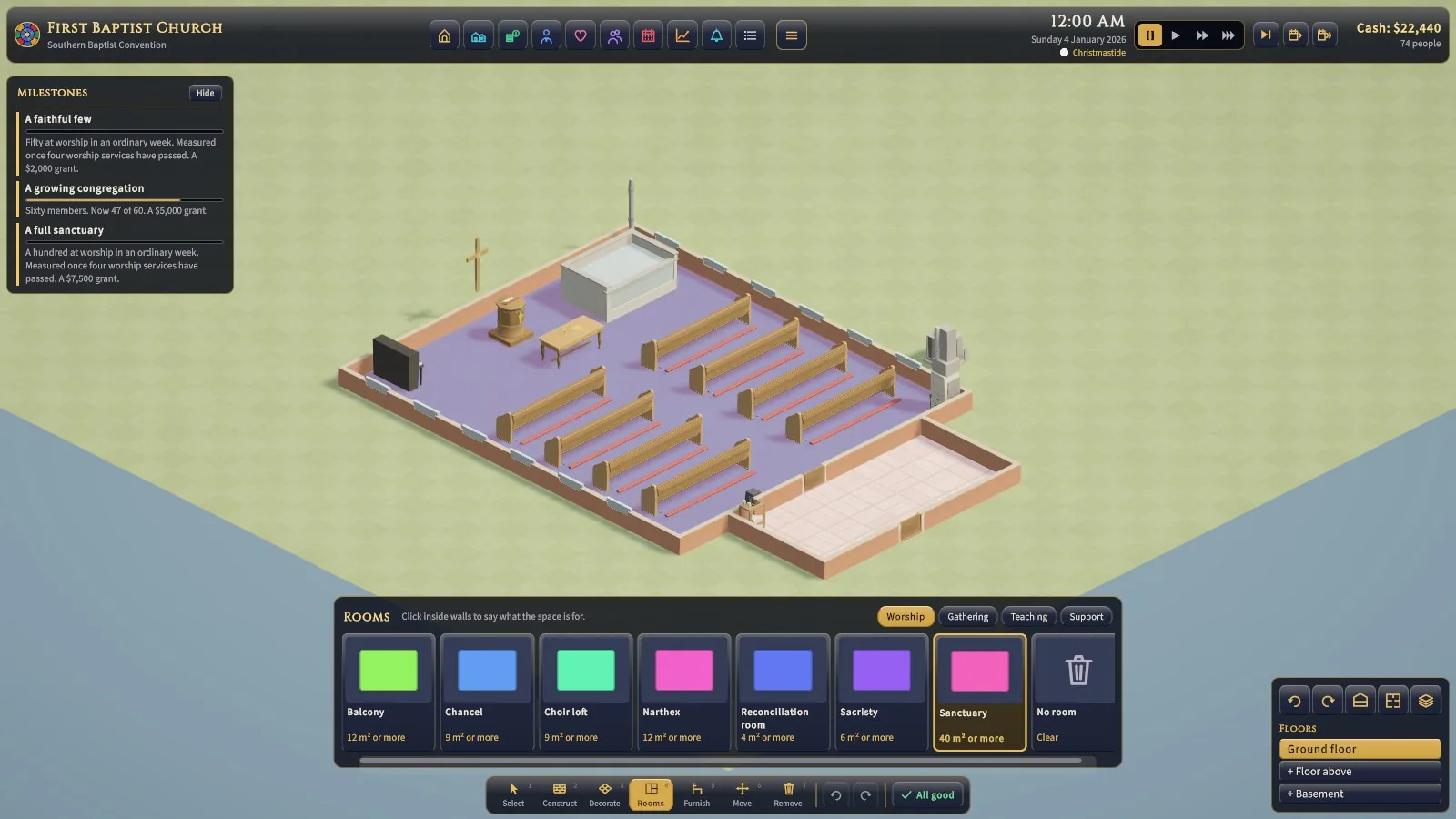
A church under construction, its new rooms marked out as a building site. Rooms coloured by type, with the room tool's cards open.

Eighty traditions, nine faiths

The same room delights one congregation and offends another

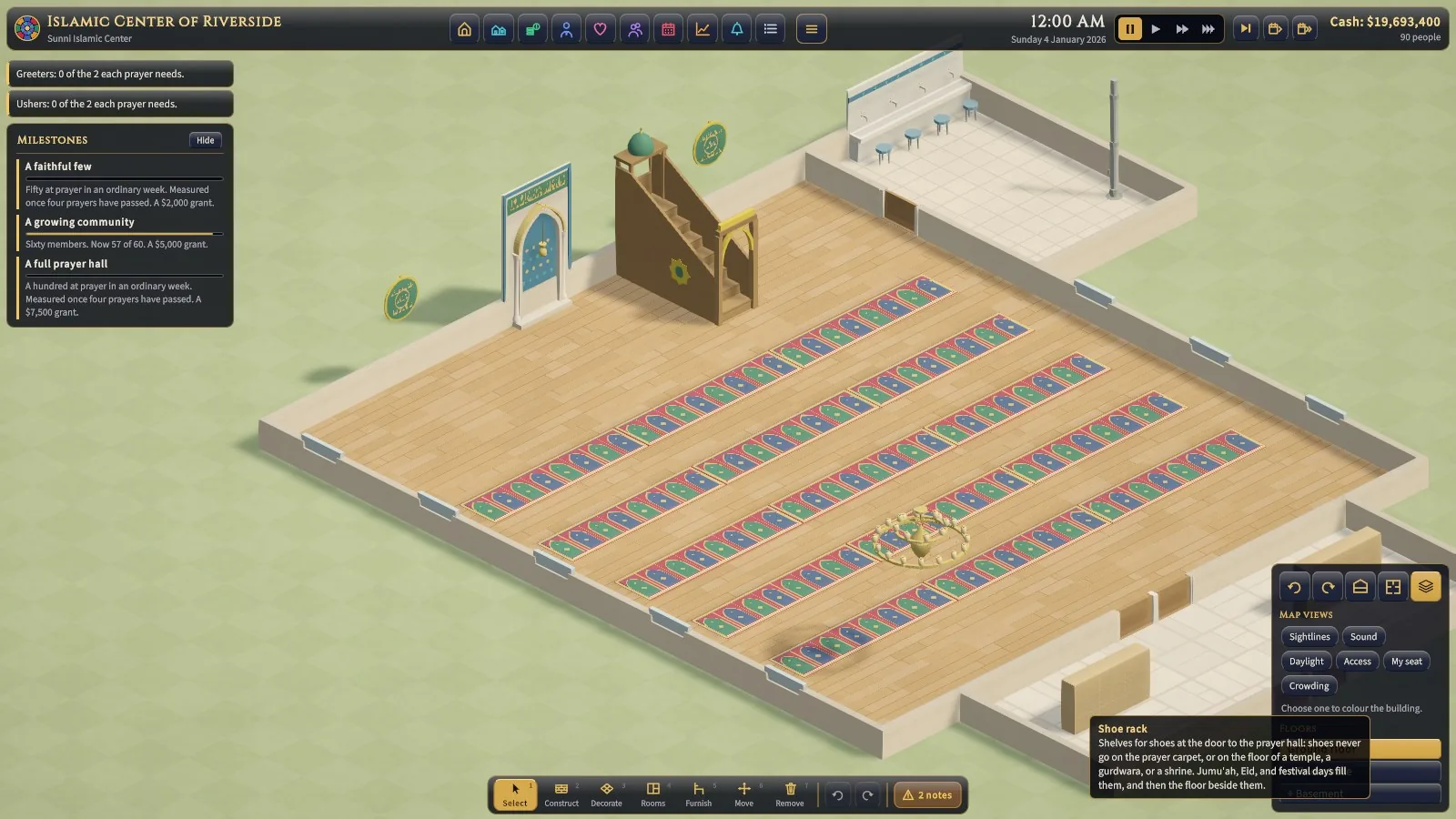
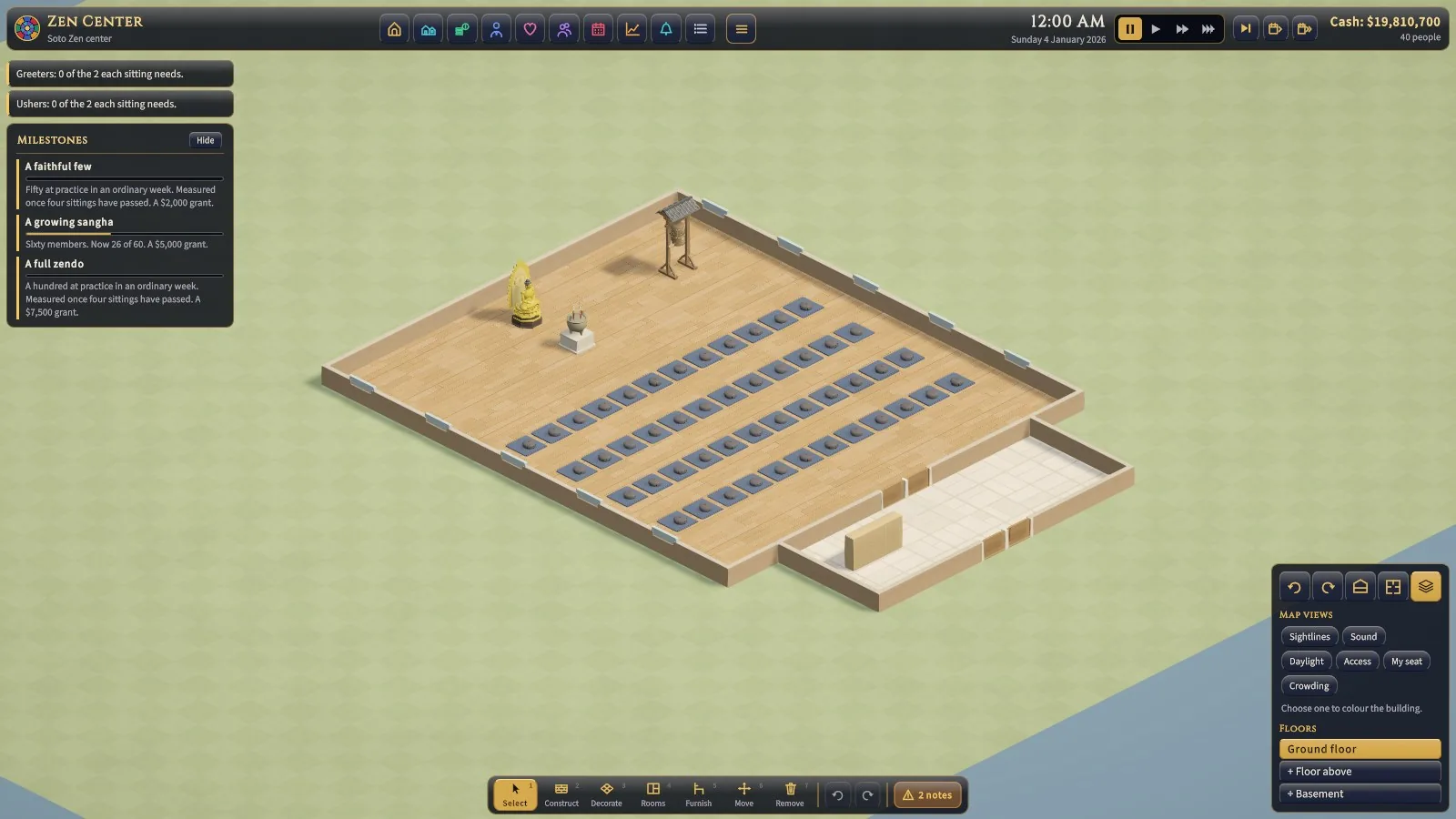
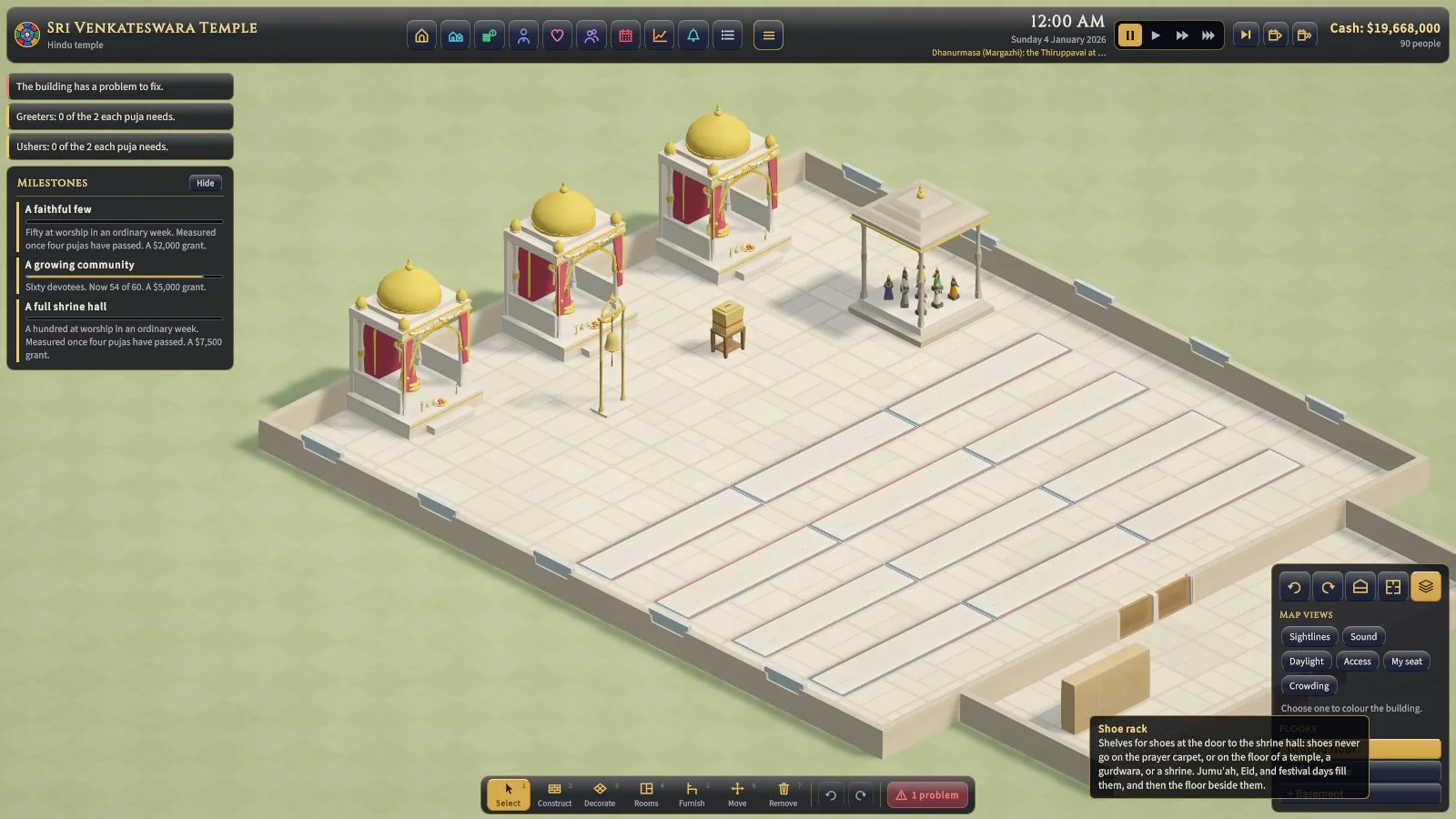
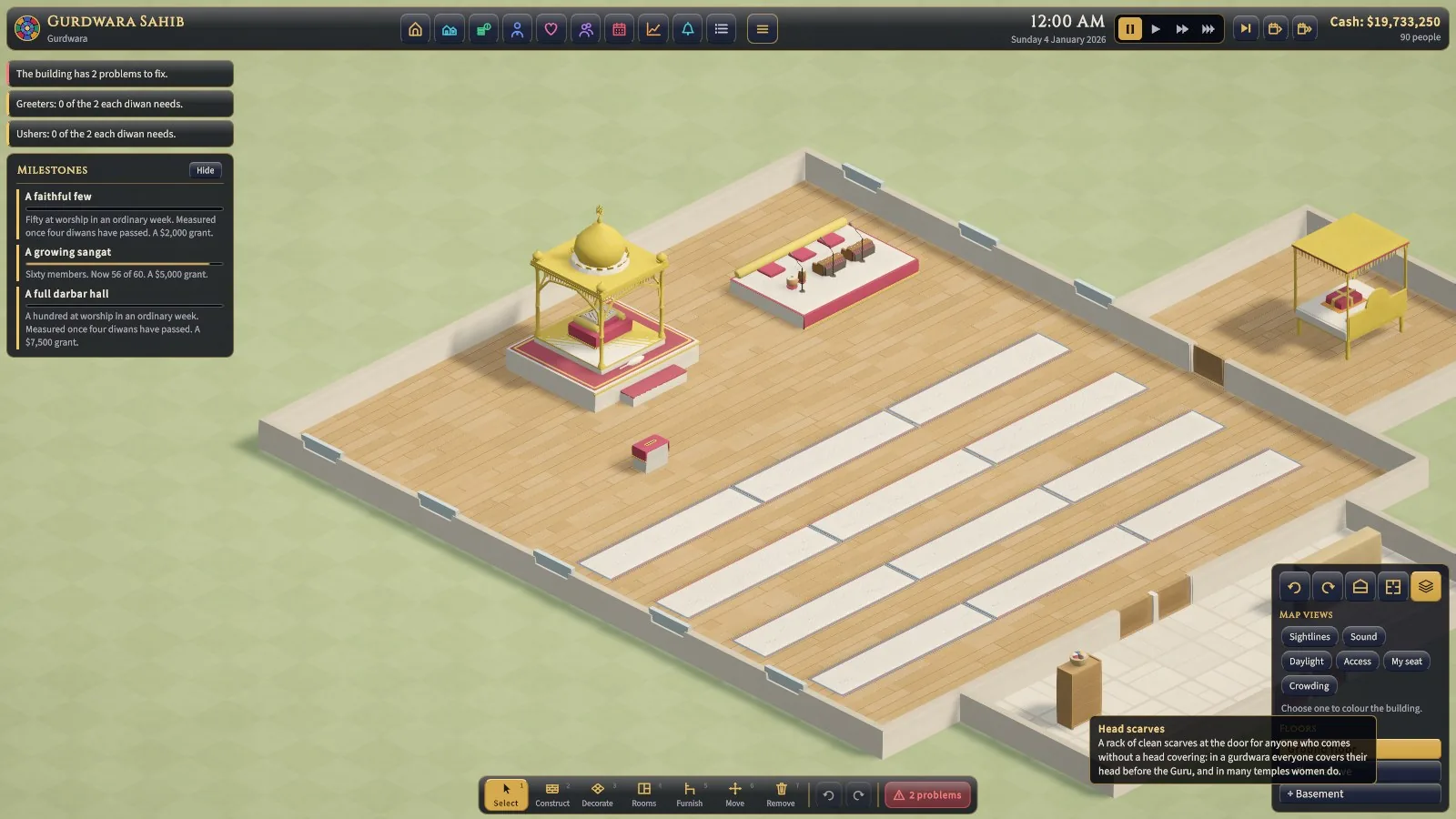
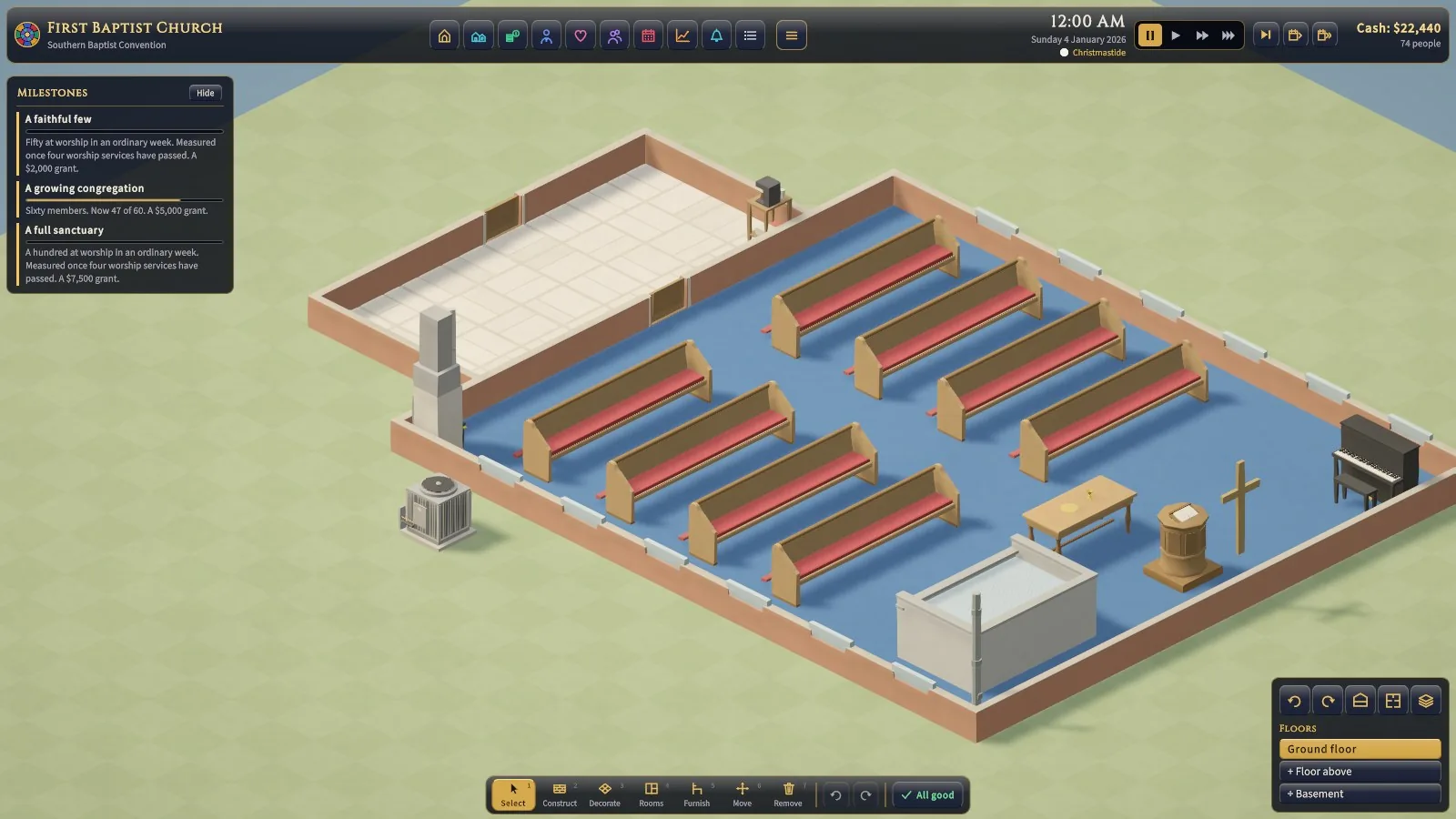
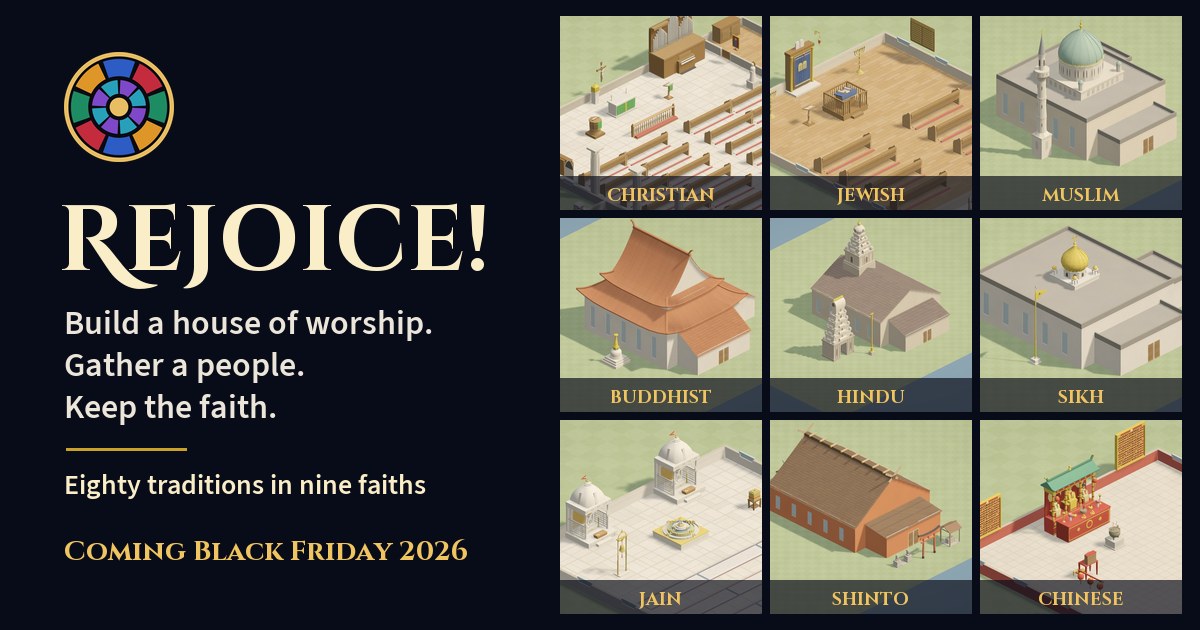
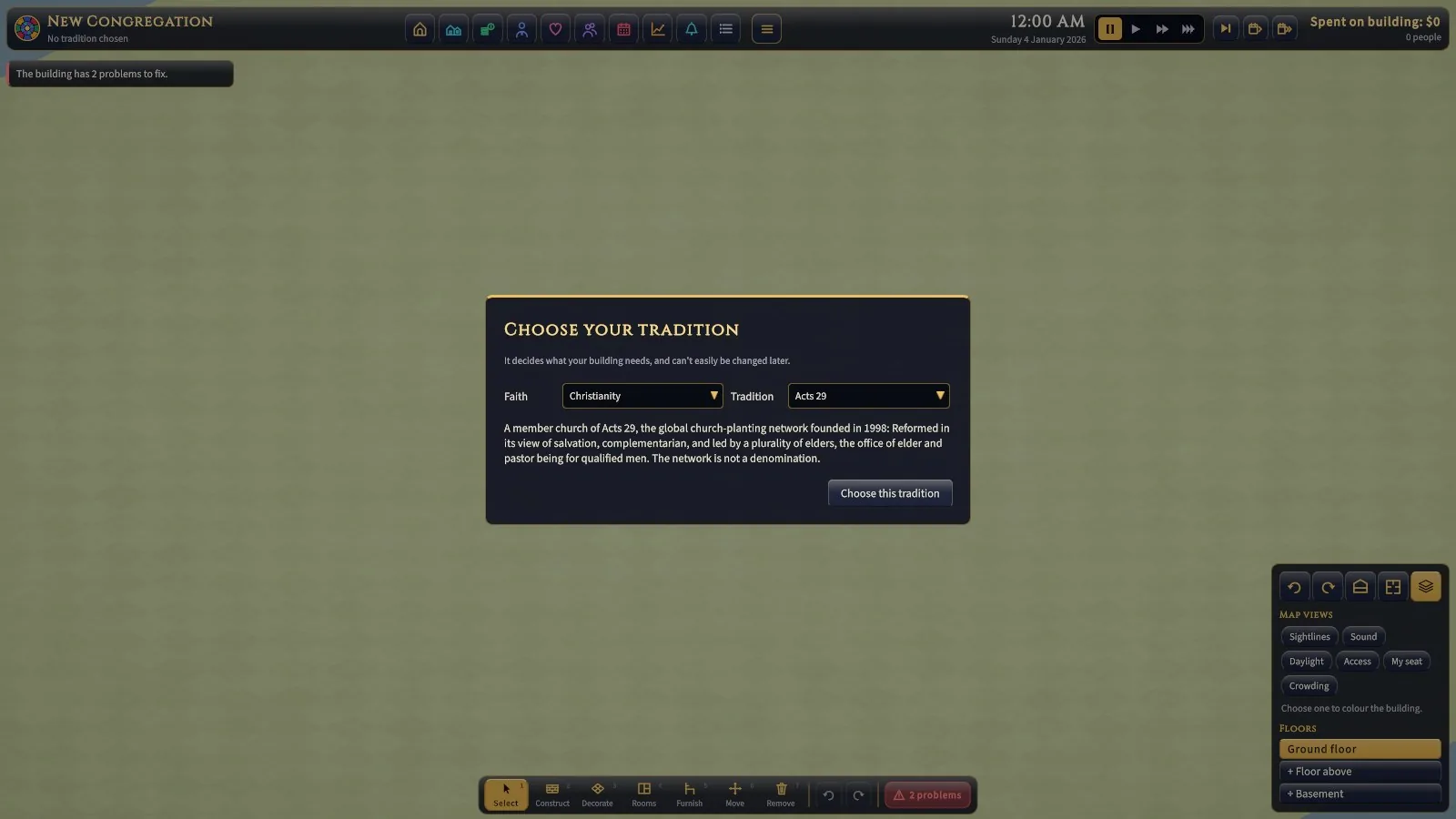
Choose a faith (Christianity, Judaism, Islam, Buddhism, Hinduism, Sikhism, Jainism, Shinto, or Chinese religion), then a tradition. Traditions aren't skins. Each is modelled from its own sources and described as it describes itself: what its worship centres on, its rites, who owns the building and who chooses the leader, how people belong, what they give, and what they expect of the building and each other. Every word the game uses comes from the tradition: parish or ward; mandir or gurdwara; rabbi, imam, or granthi; sermon, d'var Torah, khutbah, dharma talk, or katha.

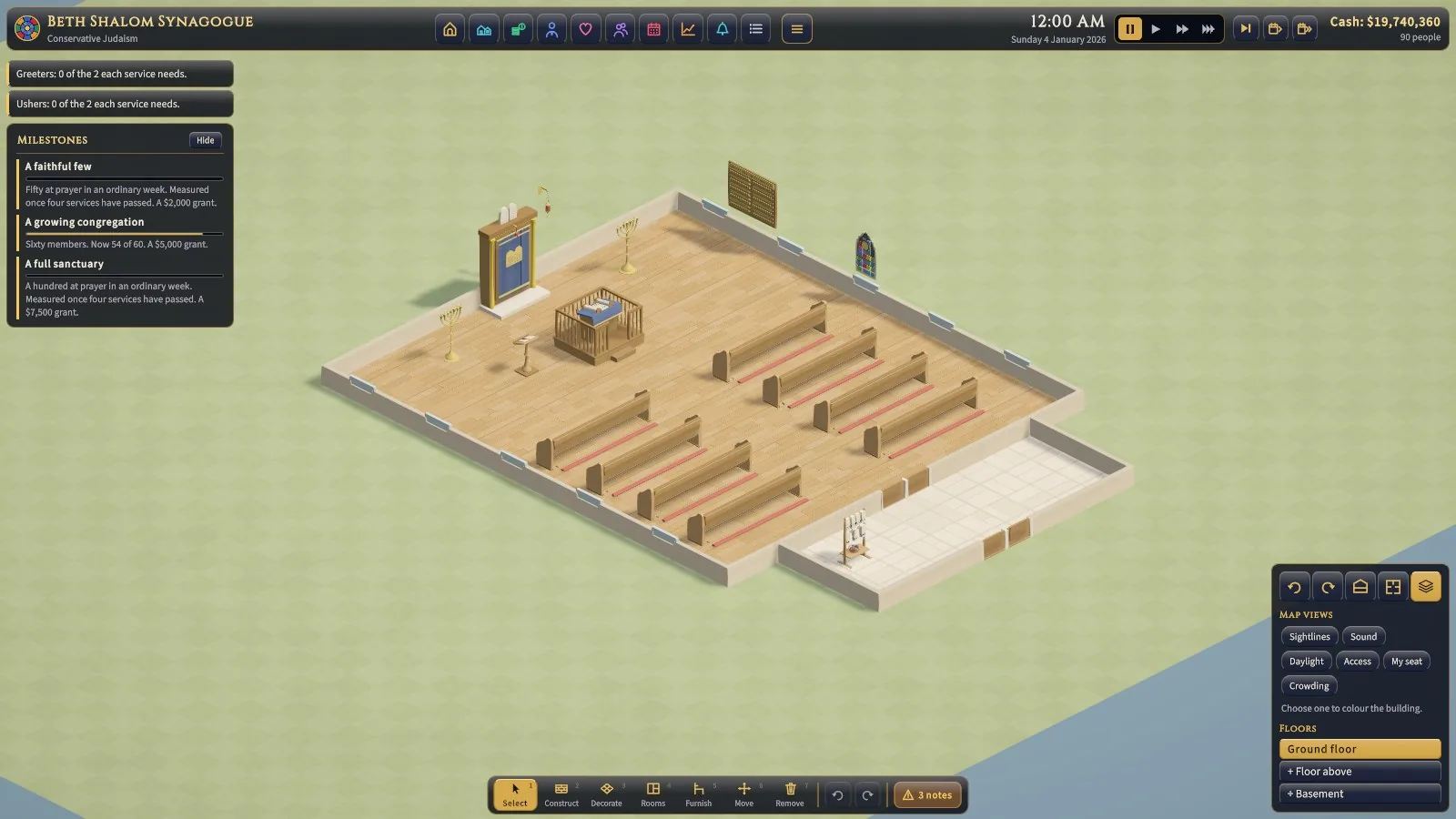
  • A synagogue faces east to an ark and a bimah, and, in most movements, can't read the Torah without a minyan of ten.
  • A mosque turns to the qibla, prays on carpet rather than in pews, and needs somewhere to make wudu.
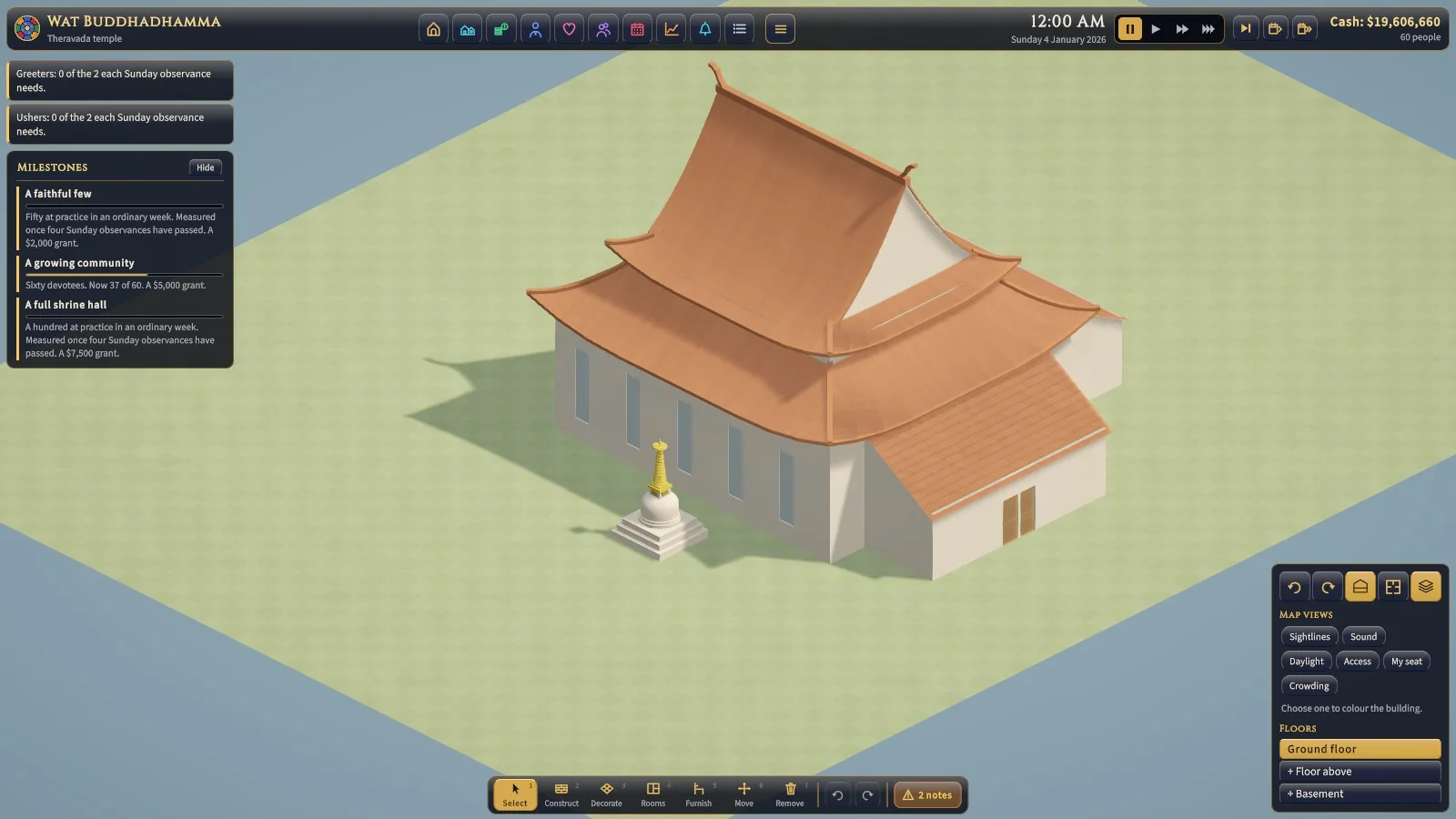
  • A Zen center sits on cushions at dawn and dusk; a Theravada temple houses monks and feeds them before noon.
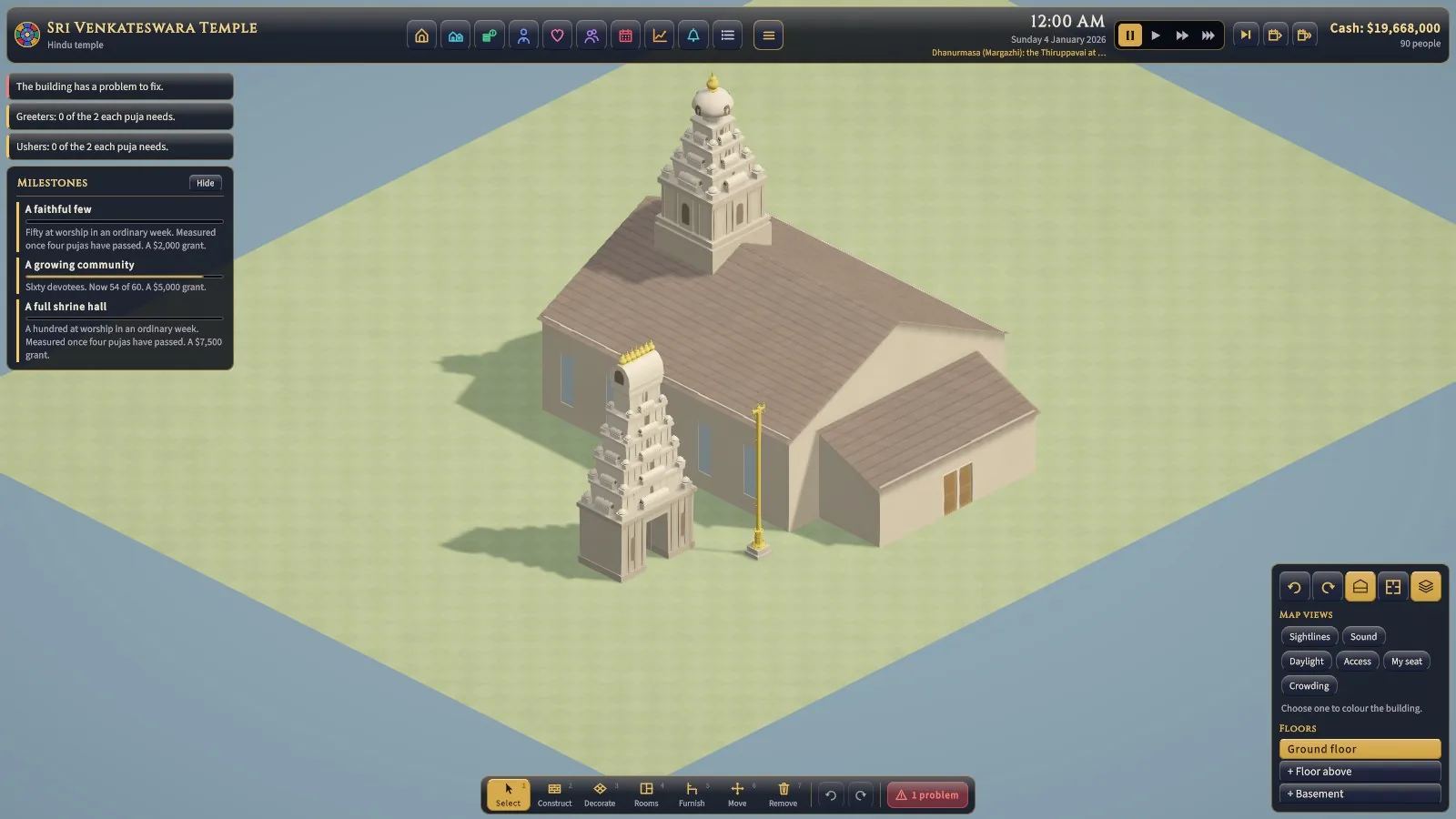
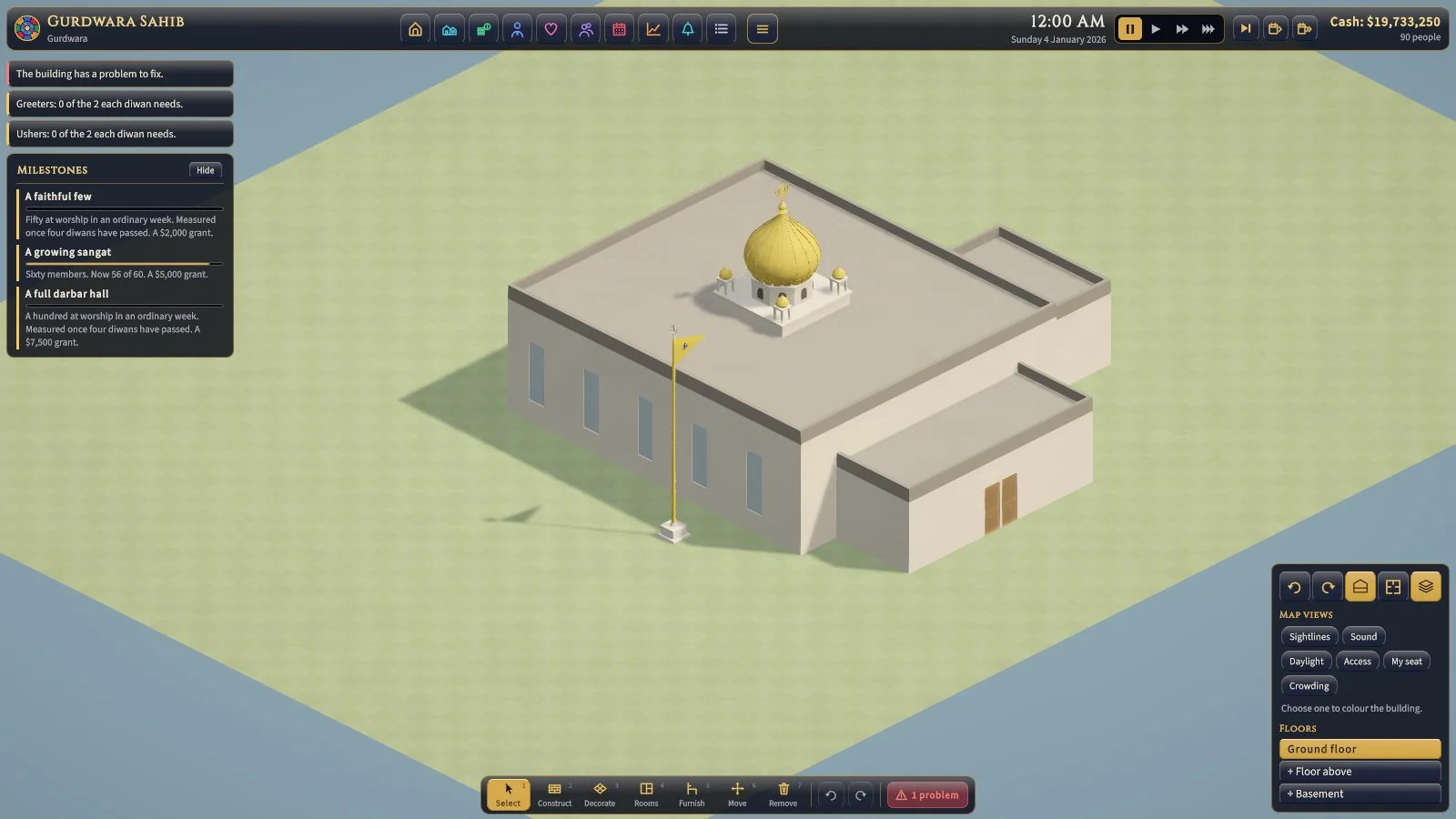
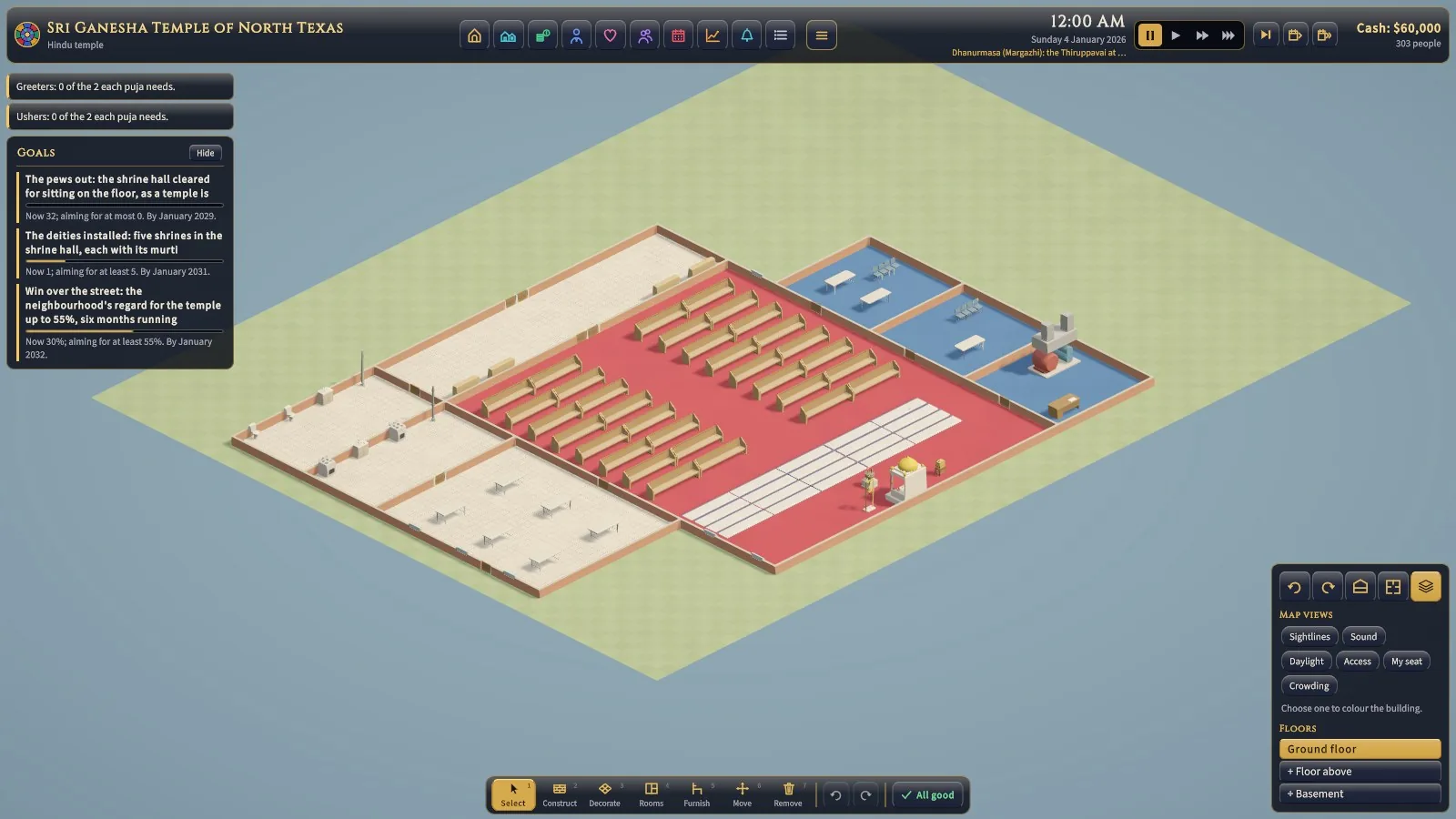
  • A Hindu temple opens at dawn for darshan before its murtis; a gurdwara serves langar, free to anyone, eaten sitting in rows on the floor.
  • A Jain center's members change into puja clothes to enter the shrine; a Shinto shrine and a Chinese temple welcome visitors one by one, and thousands at New Year.
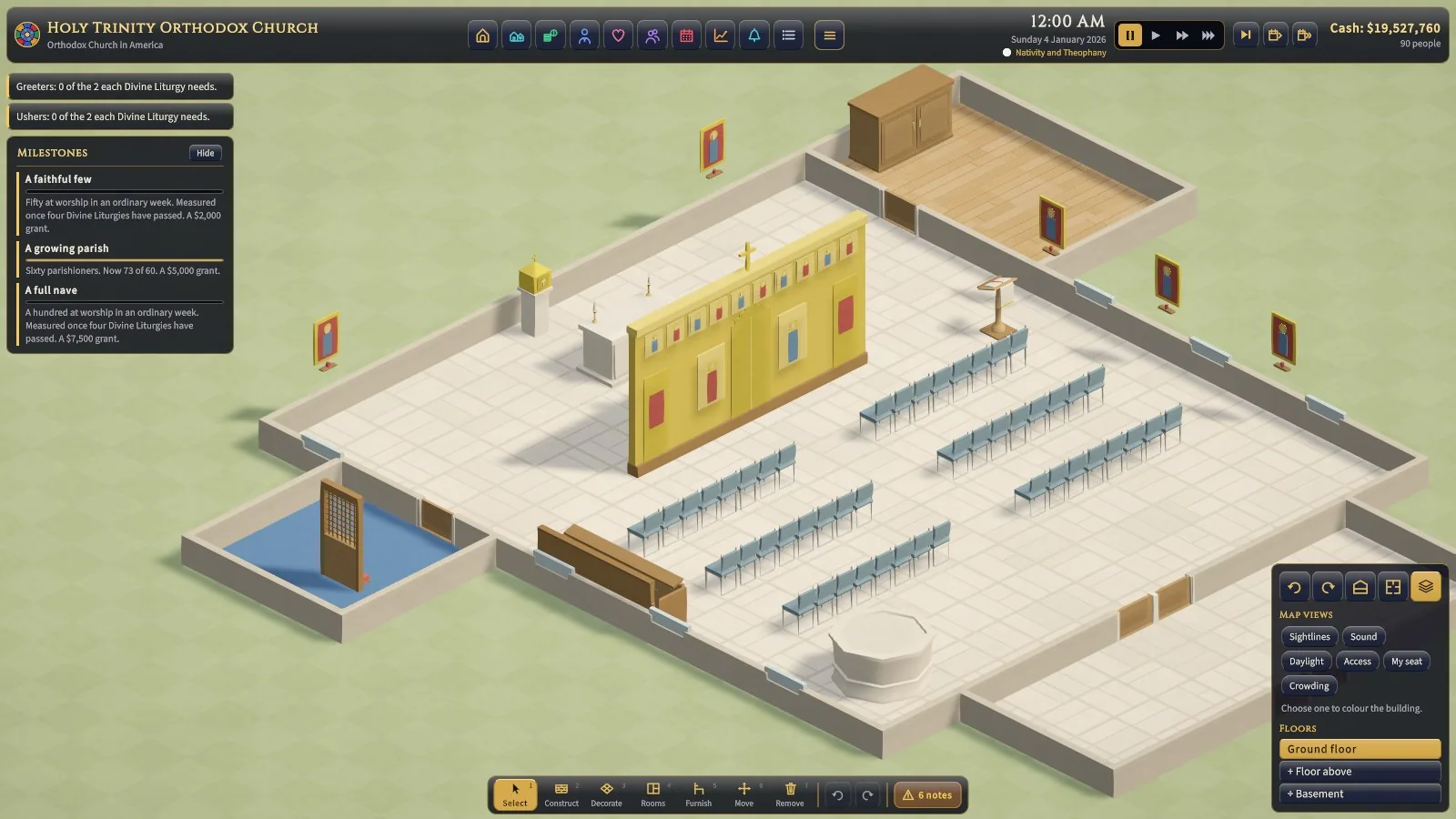
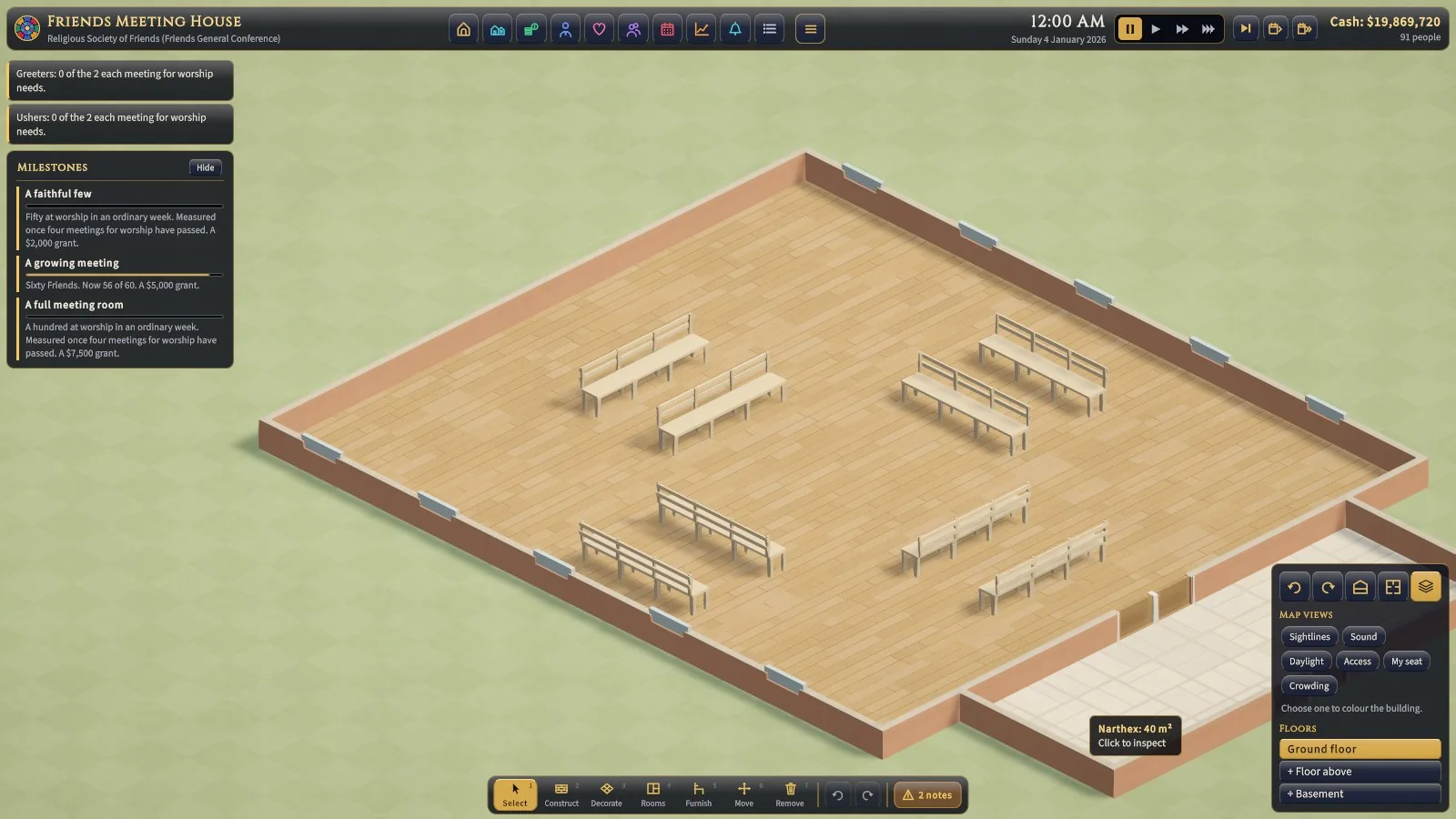
  • The Orthodox stand before an iconostasis; Quakers sit facing each other in silence; Baptists want a baptistry and a vote.

The week and the year

Every faith keeps its own time

Sunday, the Sabbath, Shabbat, or Jumu'ah. Shabbat runs from candle-lighting on Friday to nightfall on Saturday; the five daily prayers move with the sun where you've built, through the year; a Zen center sits at dawn and dusk. A gurdwara's diwan runs from morning into the afternoon, with langar after. A Hindu temple, a Shinto shrine, or a Chinese temple keeps open hours, and families and visitors come through them one by one. The big gatherings play out at a minute a second, and the daily ones pass quickly unless you choose to watch.

Fifty-three calendars set the year, by the moon and the sun: the Christian year in its colours, the Hebrew calendar's High Holy Days and festivals, Ramadan and the Eids by the Islamic months, Diwali and Navaratri by Hindu lunar days reckoned where you build, Vaisakhi and the gurpurabs, Paryushana, Lunar New Year and the Ghost Festival, Setsubun and the solar terms by the sun, and Obon, Vesak, and Tết. Weddings keep off the Sabbath, and in some Hindu and Jain traditions out of chaturmas and Paryushana; for Jews and most Muslims, a burial comes within a day or two.

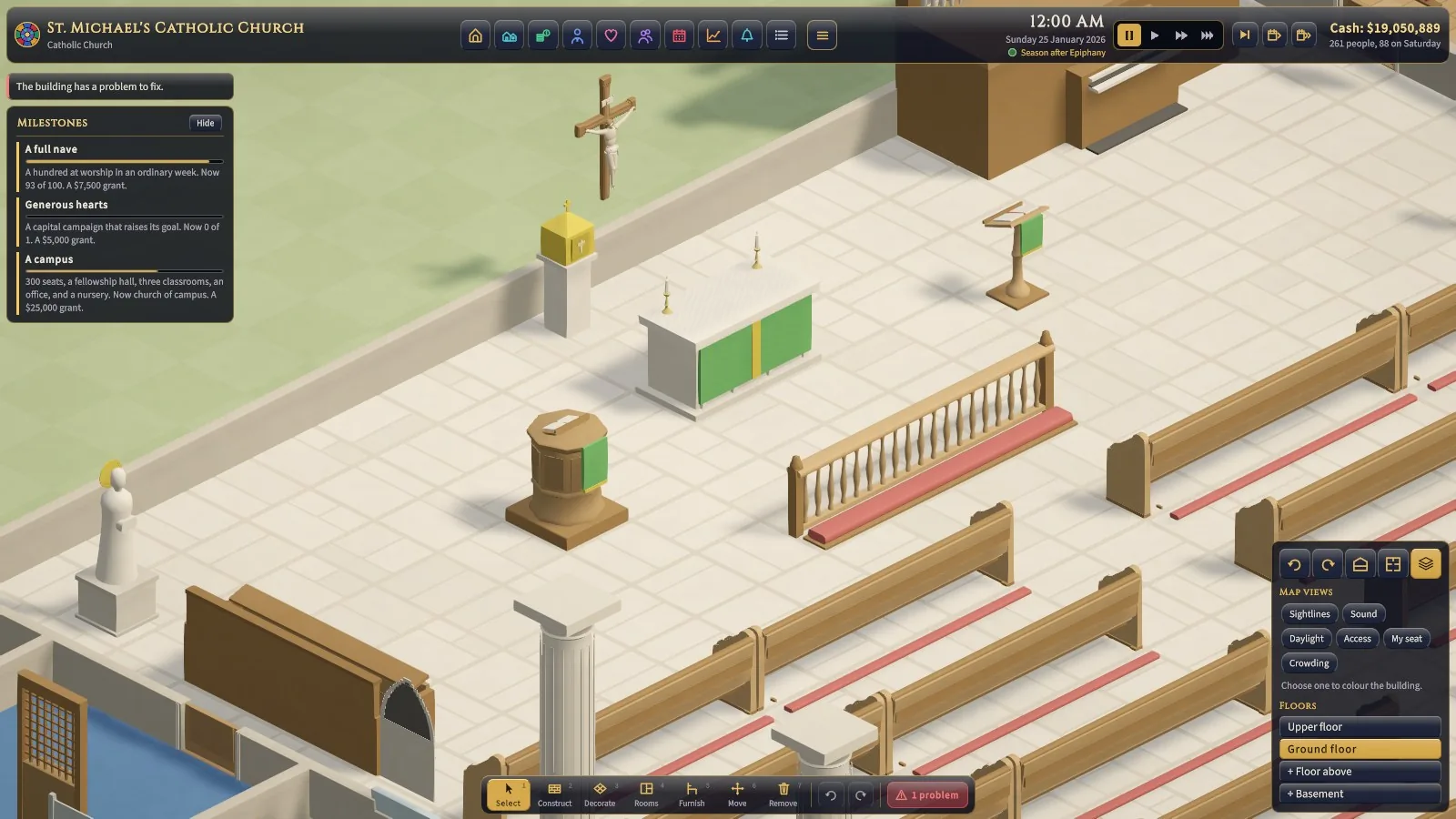
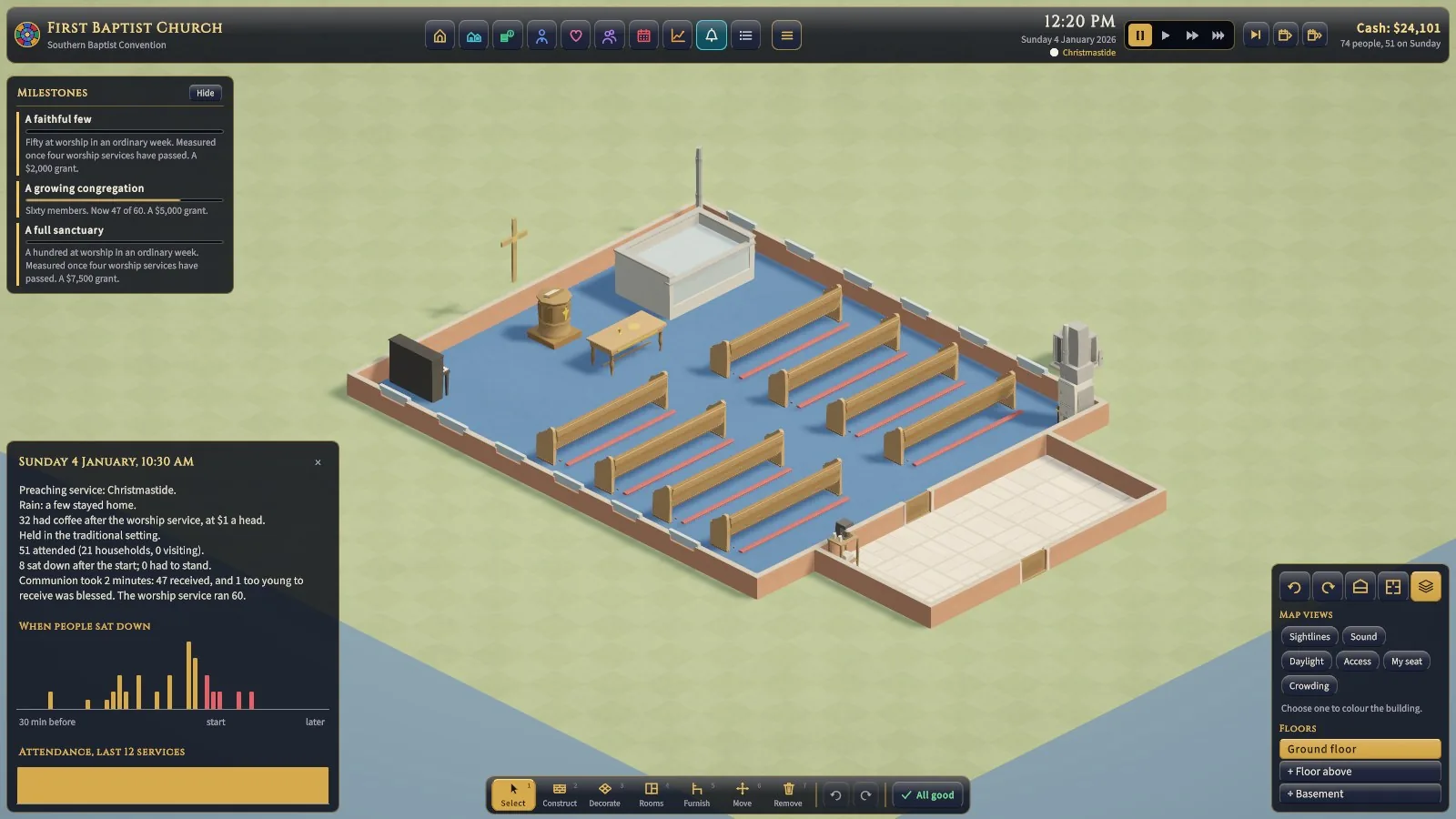
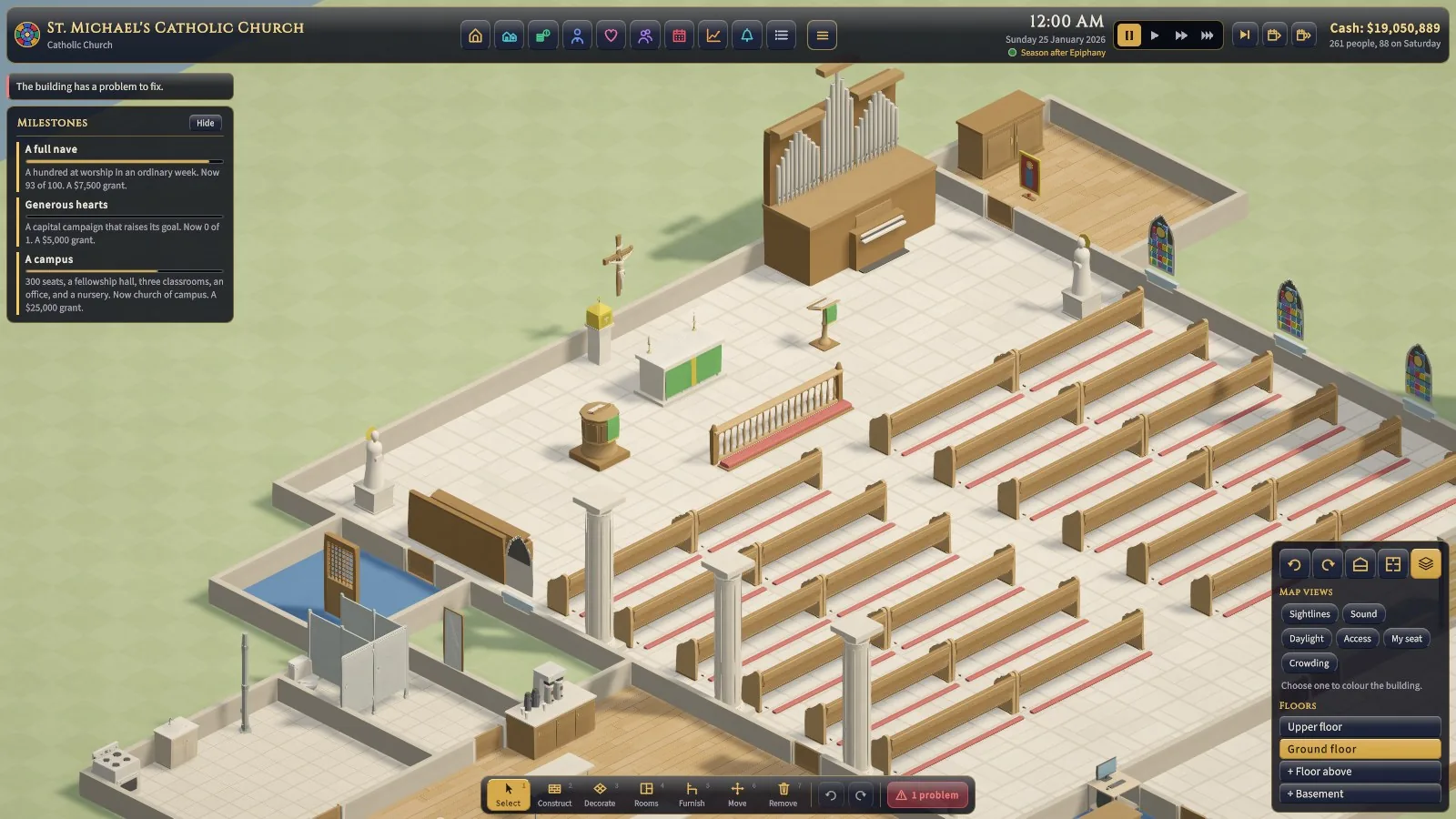
An altar and pulpit dressed in green for the season. A service's report beside the room it was held in.

A living congregation

Every person there has a story

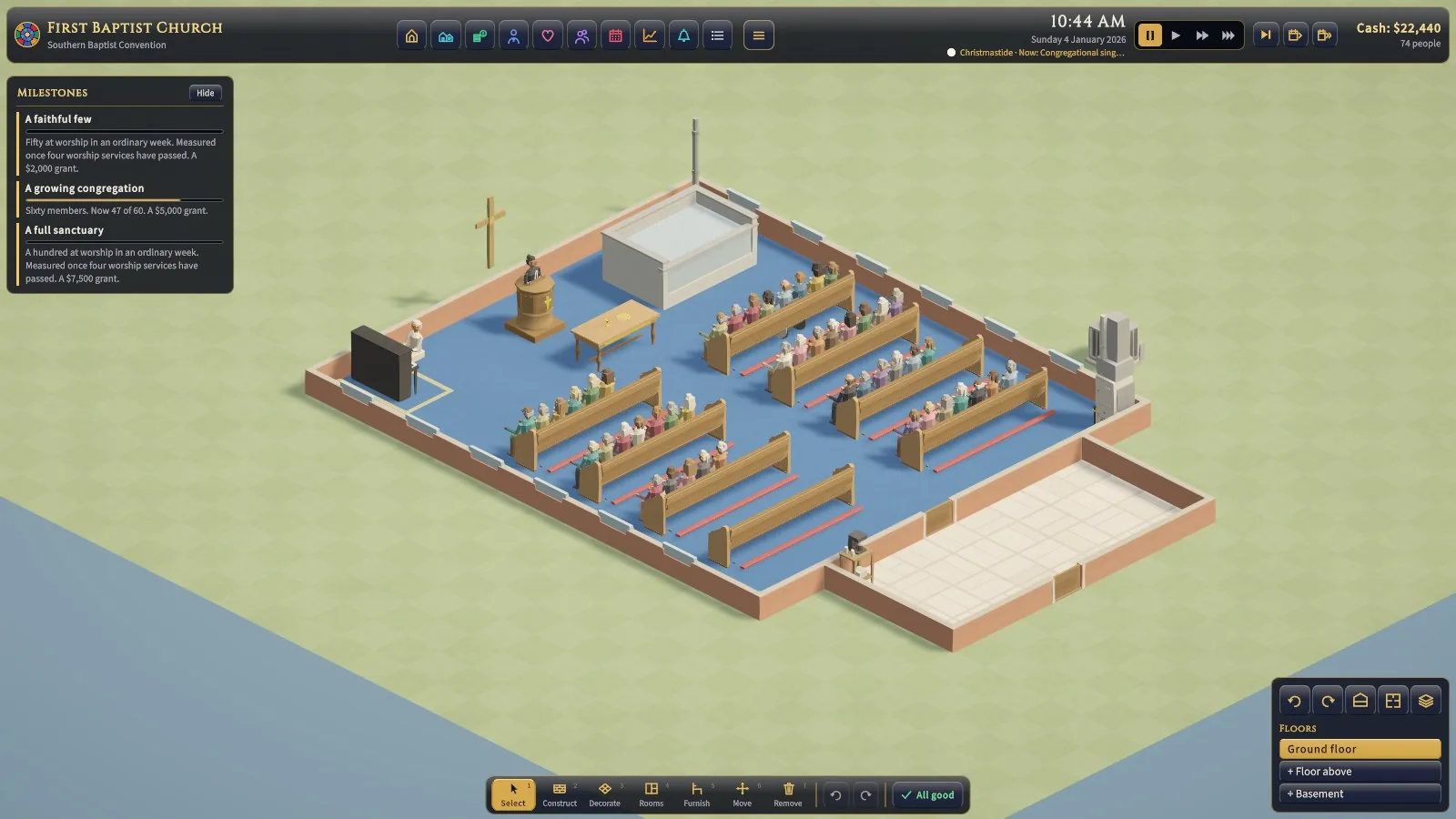
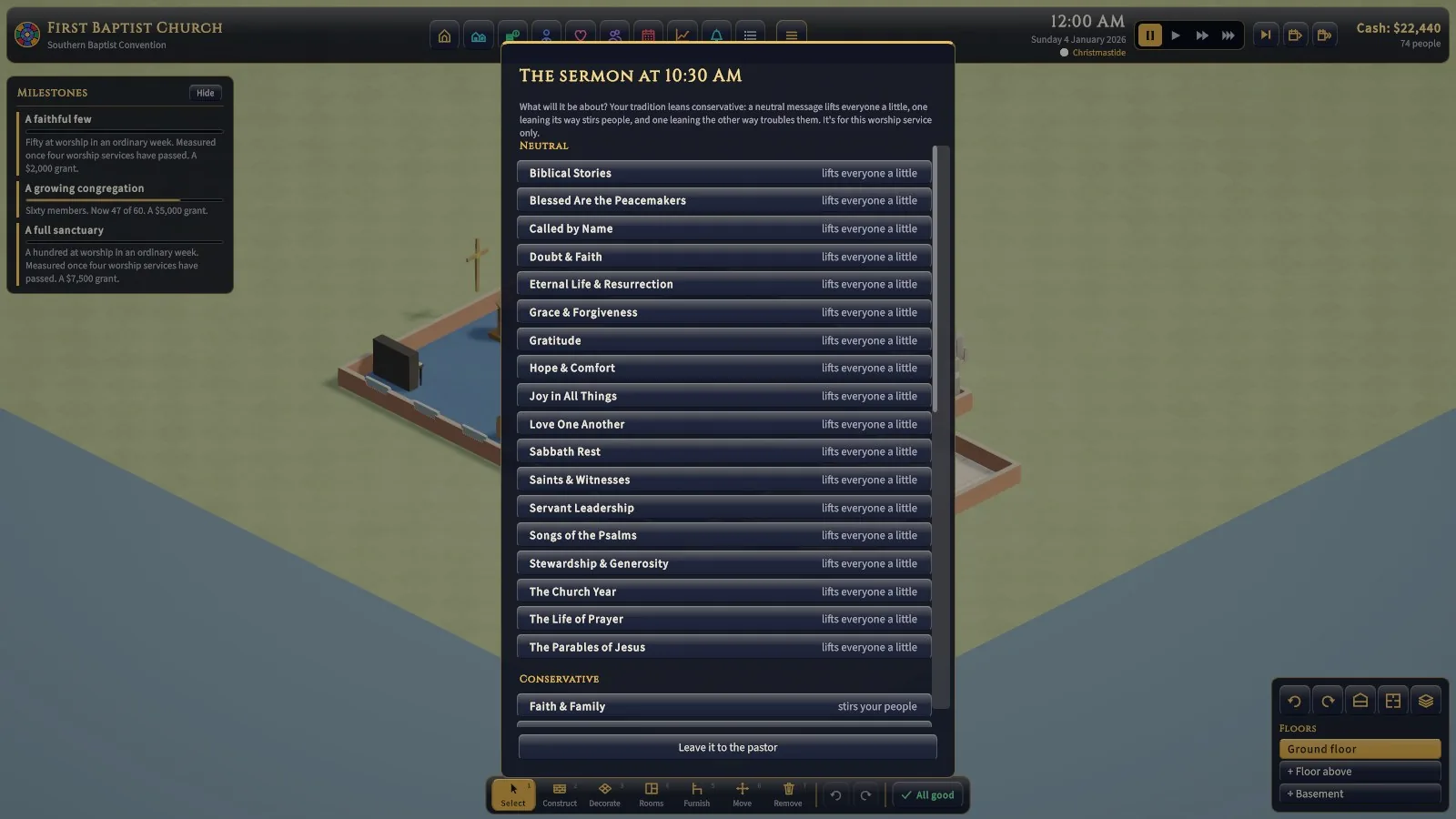
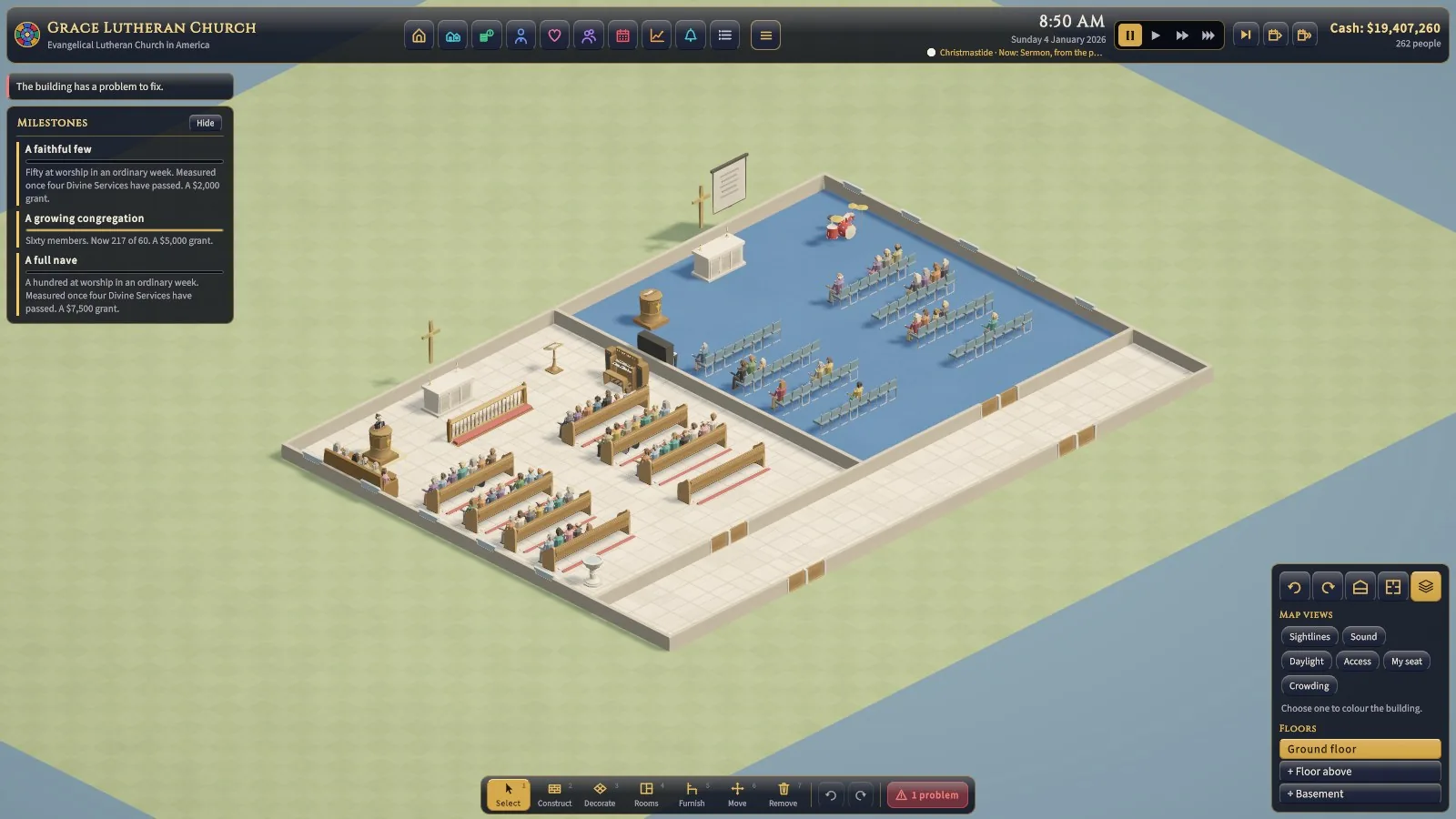
Households arrive, find a place in the pews, on the carpet, or on the floor, pray, sing or chant, and stay for the meal or don't. Each person has an age, health and mobility, a faith and a membership, a family name from the community's own heritage, and seventy-eight things that make them glad or sorry they came: the heating, the cushions, what was preached, the crowding, whether they could see the front, whether there was a minyan, whether there were enough cooks for the langar, whether anyone said hello.

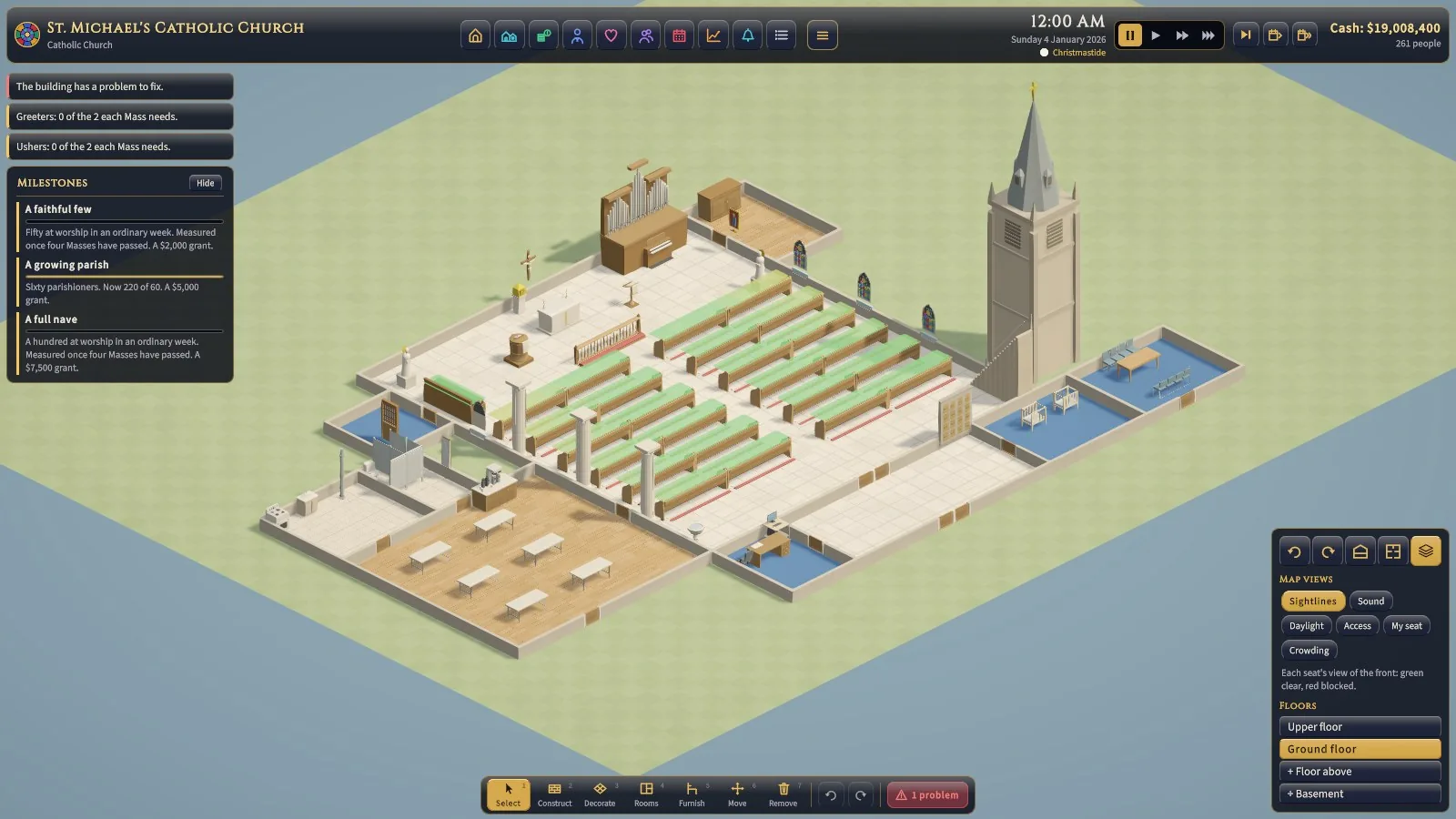
See it all in map views of sightlines, sound, daylight, access, and crowding.

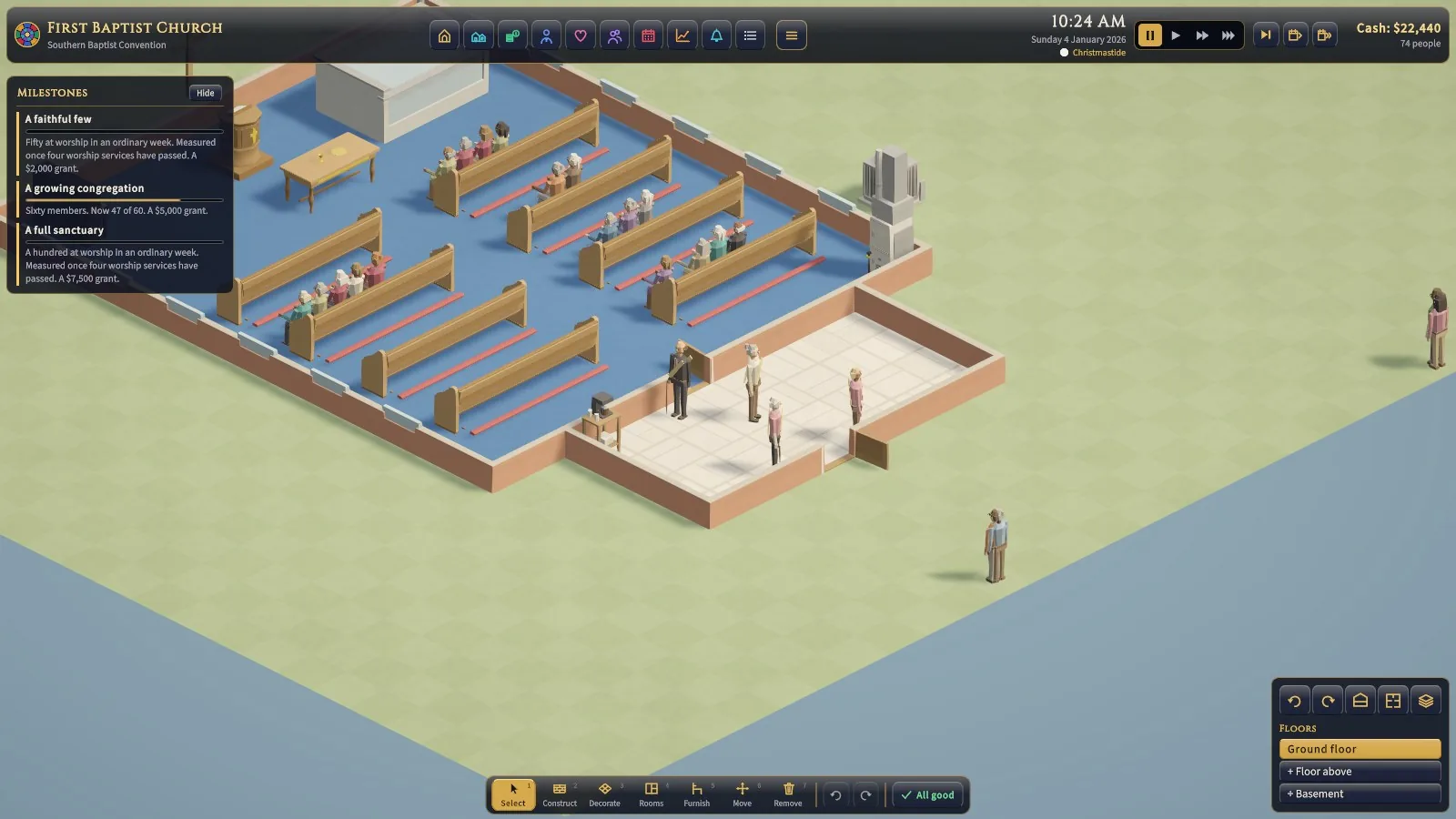
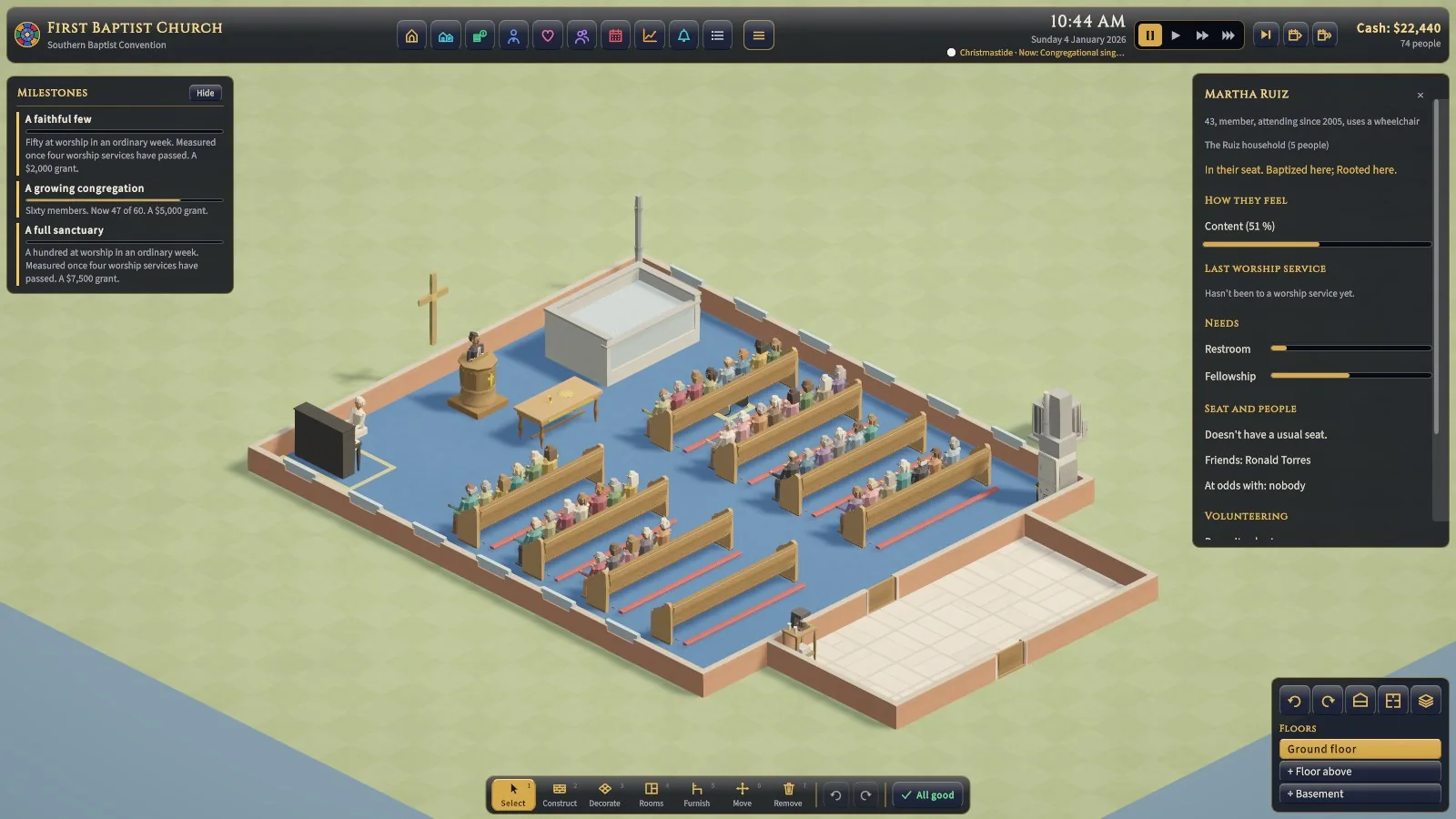
People walking into a church and finding their seats. A person's inspector listing what pleased and displeased them.

Money and upkeep

Faith is free. Heating isn't.

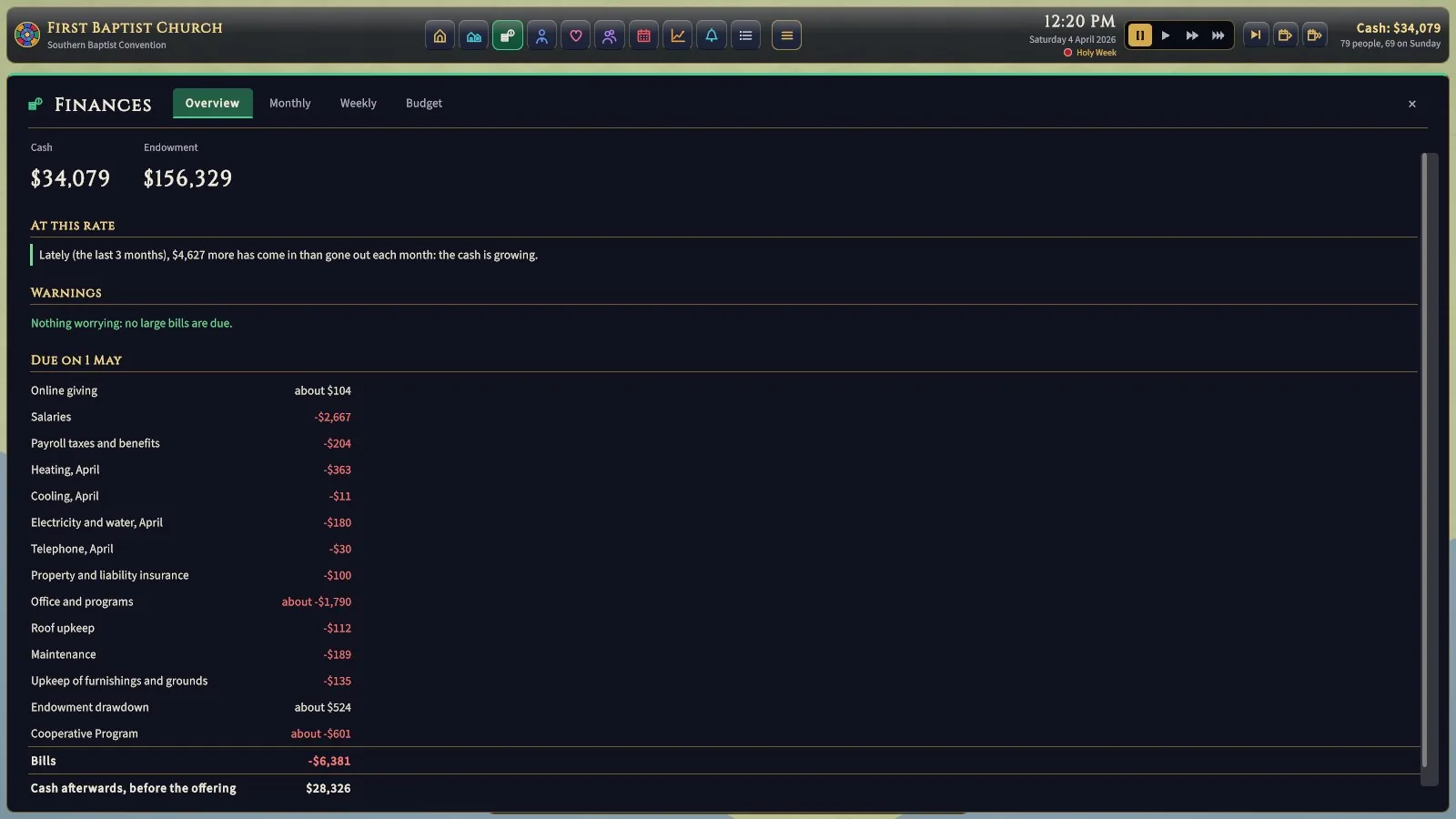
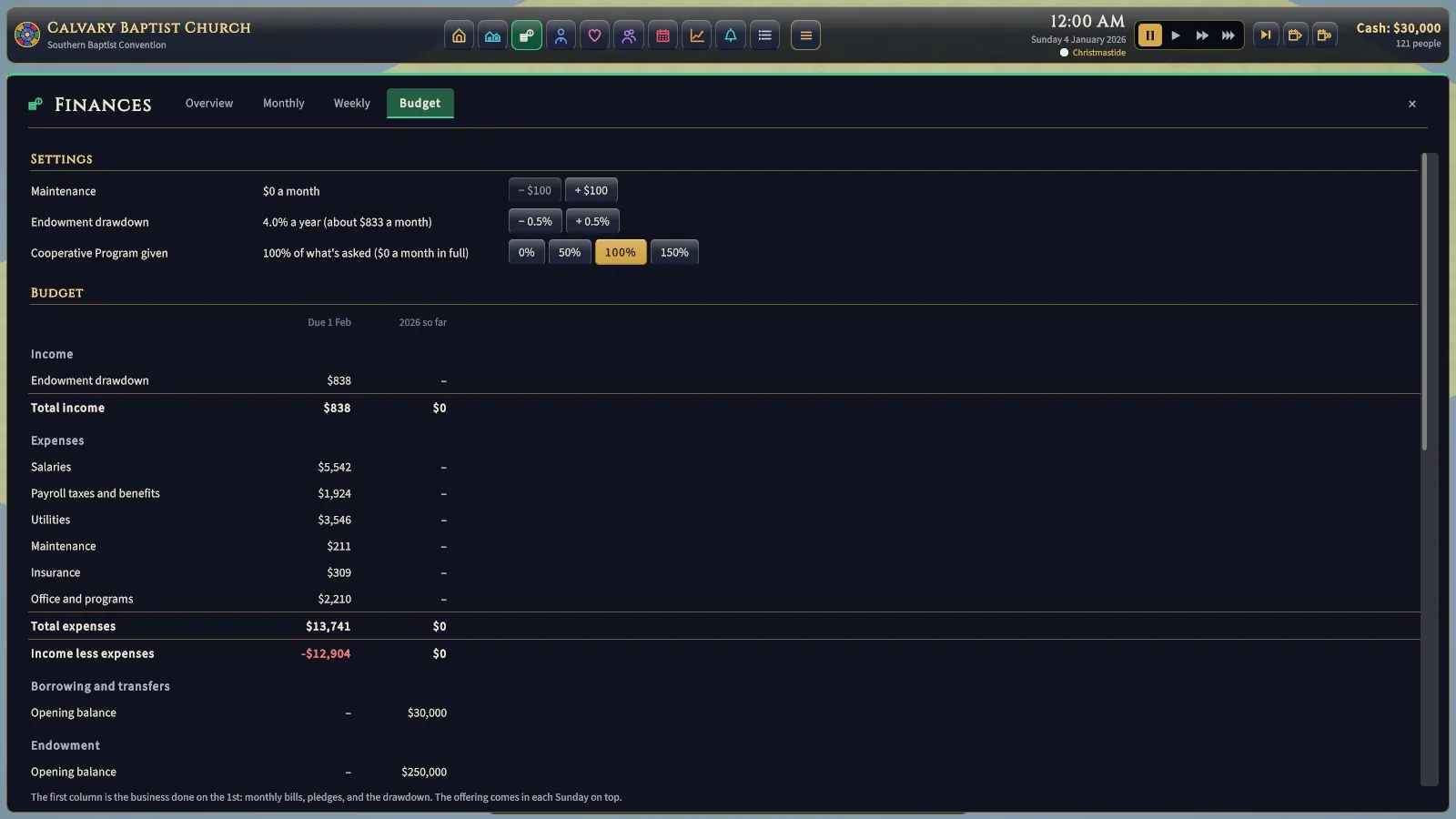
Each faith gives in its own way: the plate and pledges, a synagogue's dues and its High Holy Day seats, zakat in Ramadan passed straight on to those in need, dana at a temple, tithes sent up to the wider body. Families book pujas, blessings, and readings for a fee, at the temple or at home, when a priest is free; visitors buy amulets, and families renew their lamps each year; a family sponsors the week's langar; honours go to the highest bidder in a Jain center's boli. Against them, salaries, utilities, insurance, the mortgage (or Islamic financing where interest is forbidden), and a kosher, halal, or vegetarian kitchen. Set the budget, draw on the endowment, run a building campaign.

Everything wears: boilers fail in January, roofs leak, the old bus breaks down on the way to worship. Maintain it, or pay more later.

The finance screen's overview of income and expenses. A parish budget, income against expenses.
People to lead

Hire, recruit, and send them out

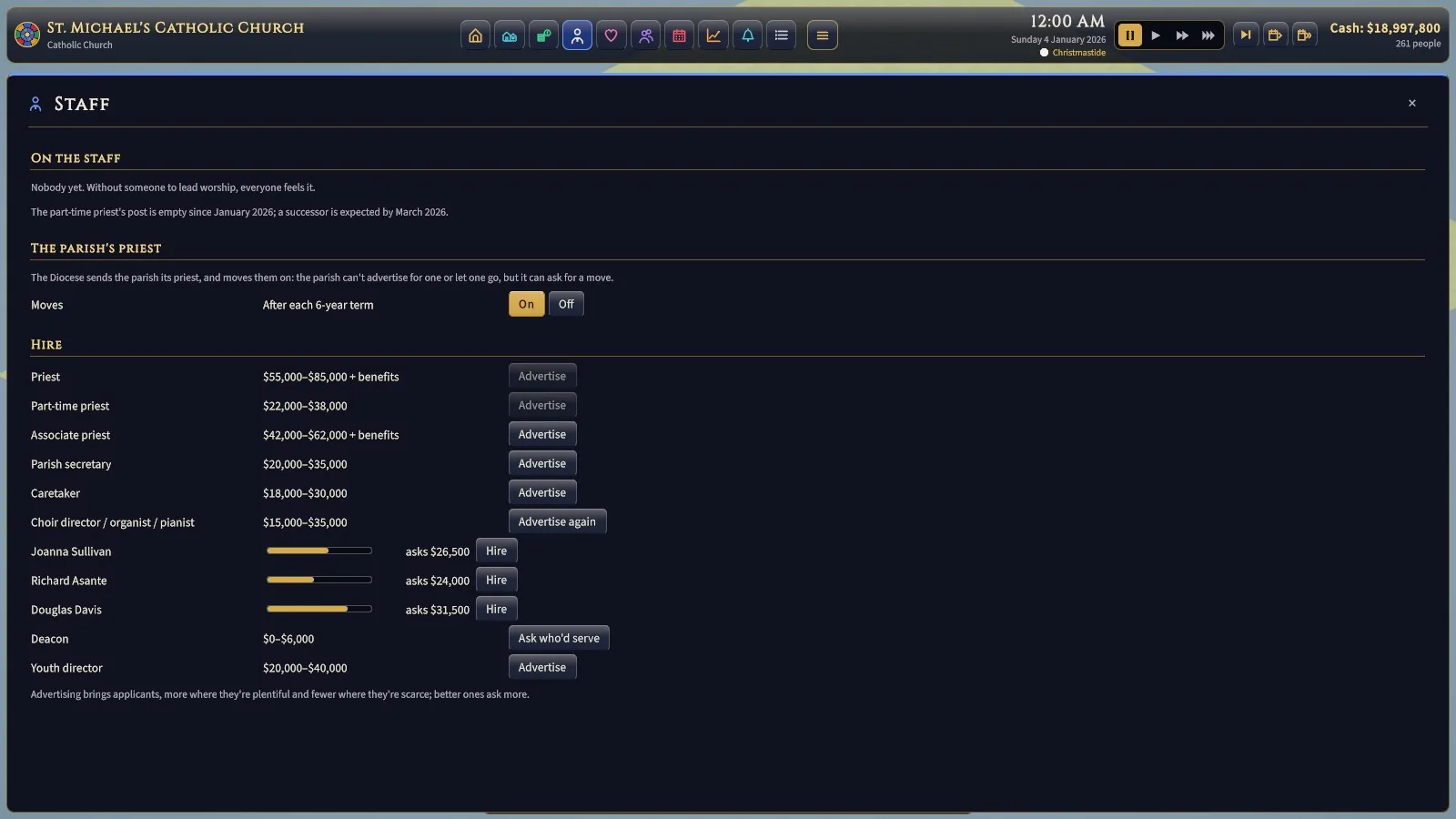
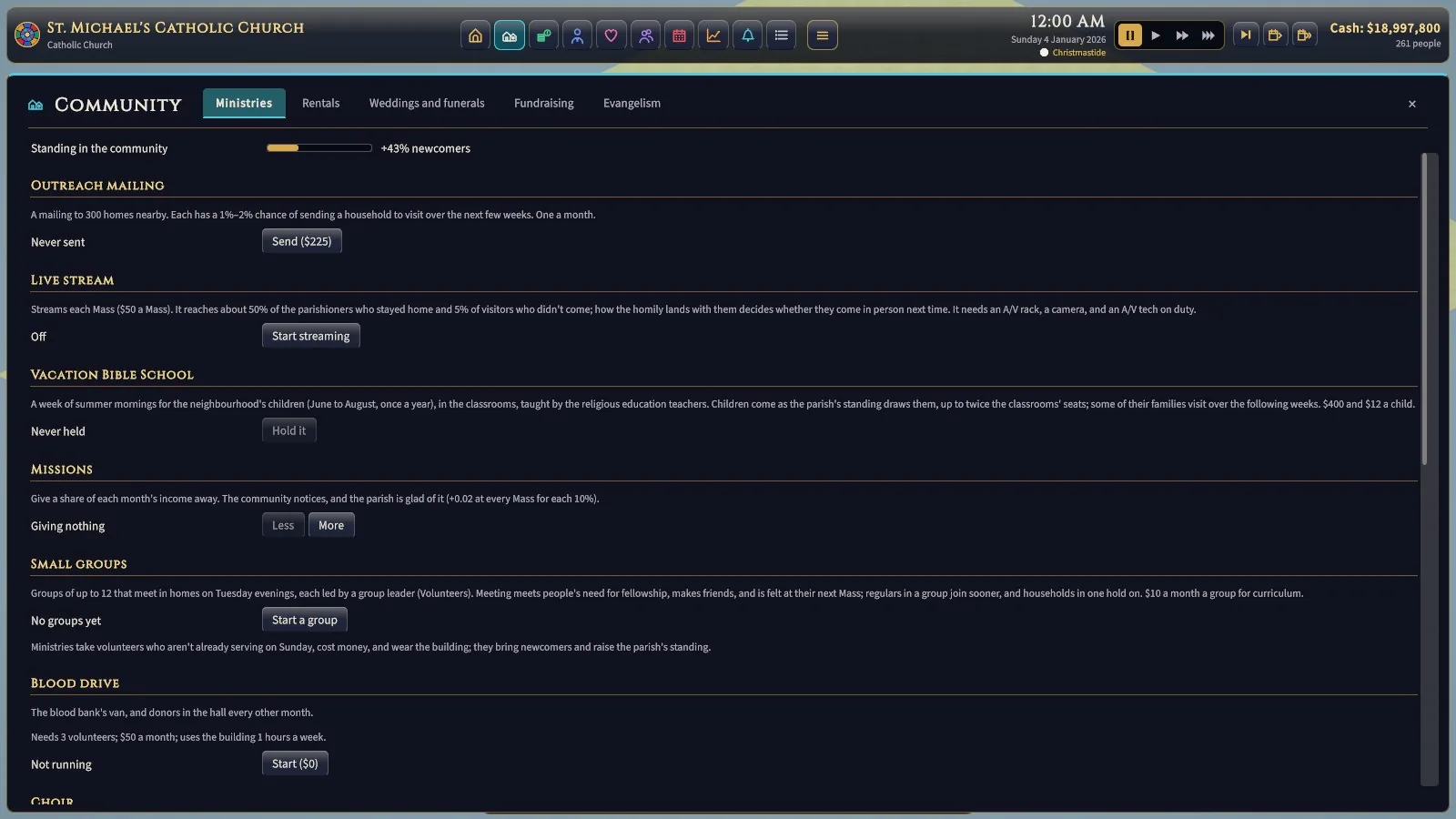
Call a pastor, a rabbi, or an imam, or welcome monks to live at the temple. Hire a cantor, a Qur'an teacher, a mashgiach for the kosher kitchen, a priest from India on a religious worker's visa, ragis to sing kirtan, a miko for the shrine, a secretary; recruit greeters, ushers, a choir, cooks for the langar, teachers for Sunday school, Hebrew school, Dharma School, or Bala Vihar, and drivers. Each faith has its own ministries, from a food pantry and a youth group to a chevra kadisha, a zakat committee, a sesshin, the families who take turns to feed the monks, gatka, taiko, and a lion dance troupe. Rent the hall to the scouts; send the van for those who can't drive and the bus round the neighbourhood.
The staff screen, with a post advertised. The community screen's ministries.

The challenge

Hard choices, and a congregation to keep

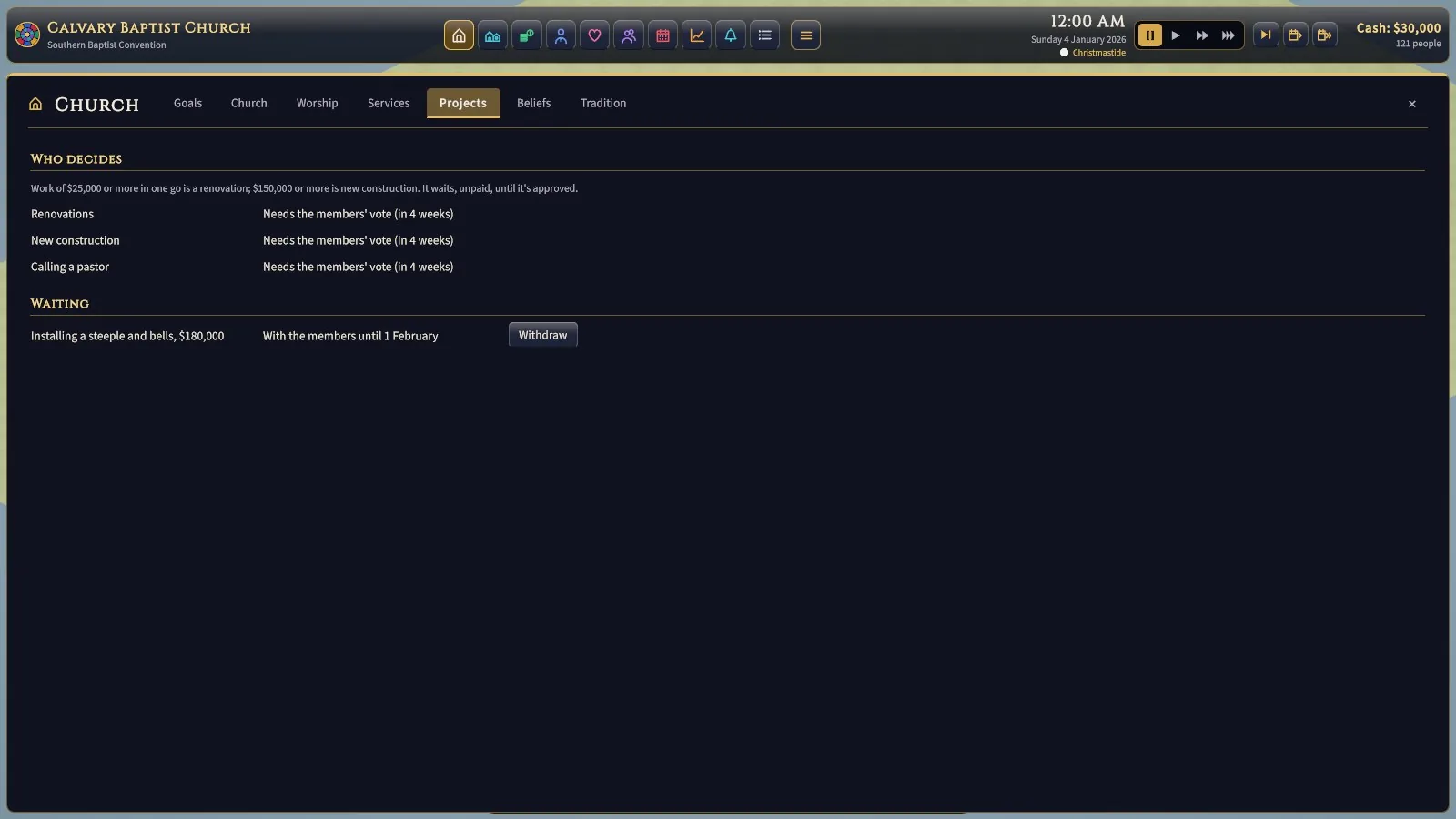
A brown stain spreads over the back pews after a week of rain. A wealthy member offers a gift, if it's spent on new carpet. Two volunteers fall out over the coffee rota. Some want the call to prayer given from the roof. The astronomers say Eid is on Tuesday; the moon-sighting committee says Wednesday. The temple's board and its abbot can't agree what the building fund is for. The priest's visa is running out. The losing slate takes the gurdwara's election to court. The neighbours complain of the smoke from the furnace where paper offerings are burnt. A hundred dilemmas, projects that need approving, and conflict that can split a congregation.

  • Revitalize a dying parish with a handful of faithful and a failing building.
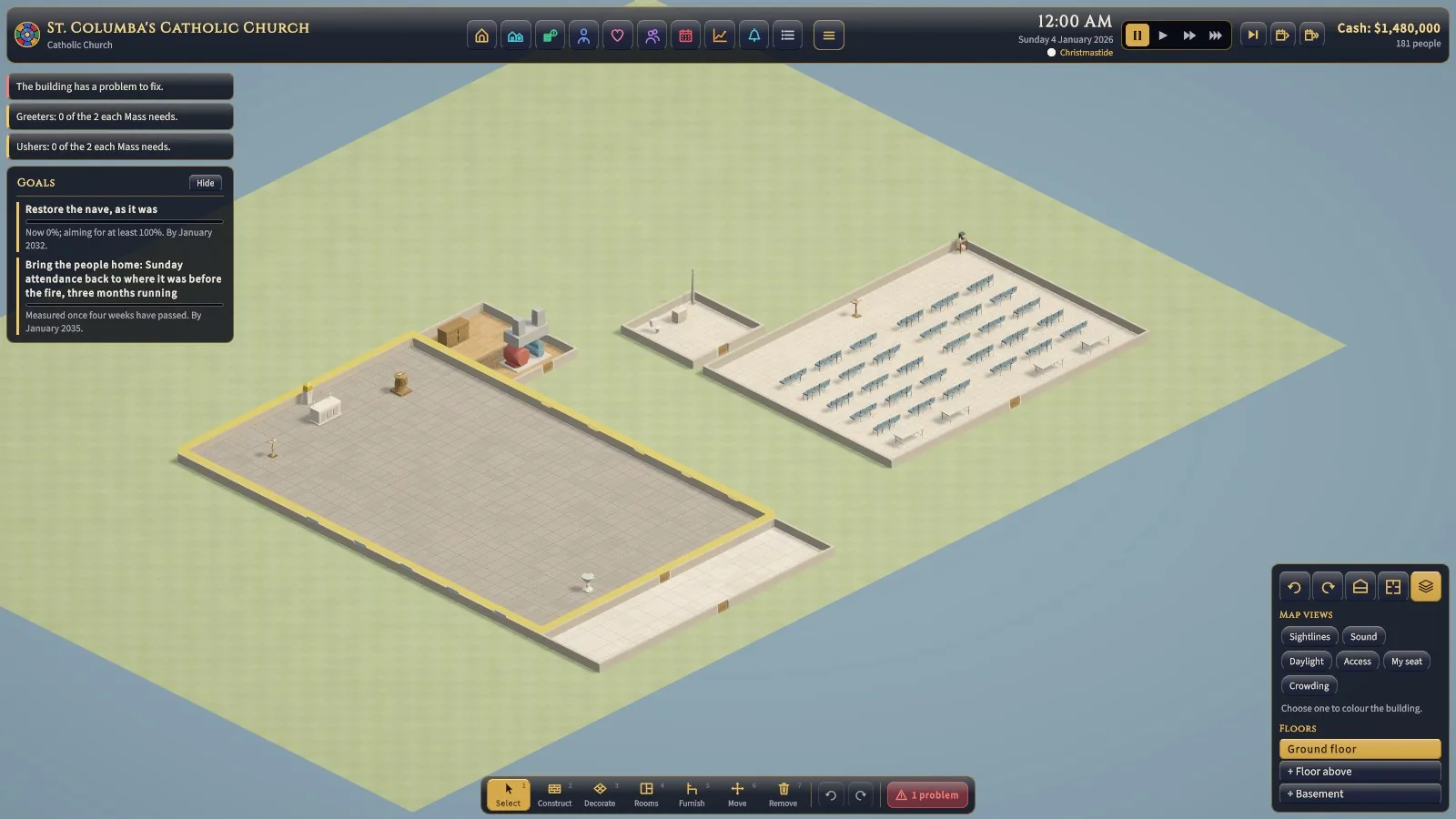
  • Restore a fire-damaged historic church, listed, stone by stone, while the parish worships in its hall.
  • Plant in a new suburb, from a rented storefront to a building of your own.
  • Build a cathedral across generations.
  • Turn a bought church into a mosque, with the mortgage still owing and the rows turned to the qibla.
  • Make one congregation of two synagogues that merged under one roof, grudges and all.
  • Rebuild a dharma center's trust after its teacher's fall.

Seventeen scenarios, from a storefront mosque and a temple in a house to a country church sharing its pastor, most of them playable in more than one tradition. Or play the sandbox with any of the eighty traditions, with milestones and grants to reach for.

A fire-damaged church, its burnt rooms marked. A proposal waiting for the parish's approval.

The numbers

Every service, every class, every ride, week by week

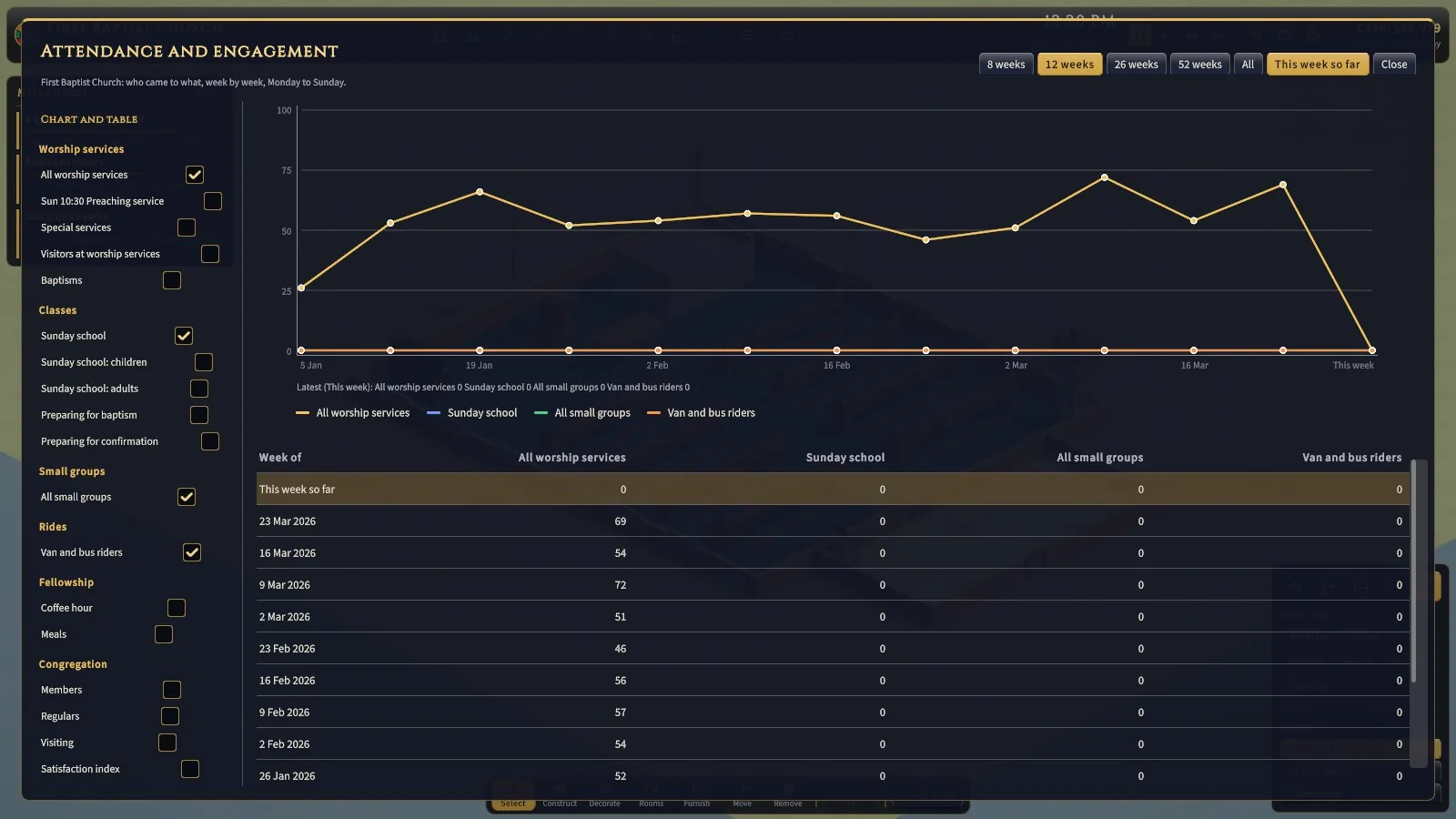
Ten years of weekly reports: each service on its own, Sunday school and confirmation classes, every small group and ministry, van and bus riders, members, regulars, and how content they are. Chart what you choose; read the figures beneath.

The full-screen attendance report, a line chart above a table of weekly figures.

Come early

Rejoice! launches exclusively on Steam on Black Friday, for Windows, Mac and Linux.

  1. Black Friday
    27 November 2026, launch day

    $9.99

    One day only

  2. Launch price
    28 November 2026 through Martin Luther King Jr. Day, 18 January 2027

    $19.99

    Through the winter

  3. Then
    From 19 January 2027

    $24.99

    The regular price

Sign up to test before launch

Questions

When does it come out?

Black Friday, 27 November 2026, exclusively on Steam, for Windows, macOS, and Linux.

How much is it?

$9.99 on launch day; $19.99 from the day after through Martin Luther King Jr. Day (18 January 2027); $24.99 after that.

Do I have to be religious to play?

No. Rejoice! is a management sim: the traditions are systems that change how a house of worship works (its building, its week, its money, its governance, what its people expect), not a message. It doesn't tell you what to believe, and no faith or tradition is the "right" one.

Which traditions are in it?

Eighty, in nine faiths. Christianity (forty-four): the Catholic, Orthodox, and Coptic churches, Lutherans, Episcopalians and Anglicans, Methodists, Presbyterians, Baptists, Pentecostals, Quakers, Mennonites, Adventists, the Latter-day Saints and Community of Christ, Jehovah's Witnesses, Unitarian Universalists, and many more. Judaism: Reform, Conservative, Modern Orthodox, Reconstructionist, and Chabad-Lubavitch. Islam: a Sunni Islamic center, a Twelver Shia Islamic center, the community of Imam W. Deen Mohammed, the Ahmadiyya Muslim Community, and the Nation of Islam. Buddhism: the Buddhist Churches of America (Jodo Shinshu), Soka Gakkai International-USA, a Soto Zen center, a Theravada temple, a Tibetan Buddhist dharma center, a Vietnamese Buddhist temple, and a Chinese Buddhist temple. Hinduism (ten): a Hindu community temple, an Indo-Caribbean mandir, BAPS Swaminarayan Sanstha, the International Swaminarayan Satsang Organisation, ISKCON, the Arya Samaj, a Vedanta Society, a Chinmaya Mission center, Self-Realization Fellowship, and a Sathya Sai Center. Sikhism: a gurdwara. Jainism: a Jain center and Jain Vishva Bharati. Shinto: a Shinto shrine, Konko Churches of North America, and Tenrikyo. Chinese religion: a Chinese folk temple, a Daoist temple, and Yiguandao (I-Kuan Tao). The guide lists them all, with what each needs.

How do you treat each faith?

As it describes itself. Every tradition is modelled from its own sources (its governing documents, its own descriptions of its worship and practice) and placed where it places itself: the Latter-day Saints and Community of Christ among the Christian traditions, the Ahmadiyya and the Nation of Islam among the Muslim ones. Where a body describes itself as standing apart, the game says so: Konko and Tenrikyo sit under Shinto, and Self-Realization Fellowship and the Sathya Sai Organization among the Hindu traditions, each with a note on how it describes itself. Each is a careful draft until people from it have reviewed it. If something's wrong about yours, please tell us at hello@tinderboxlabs.com.

Five prayers a day: doesn't that slow the game down?

No. Every daily prayer and minyan, and every hour a temple or a shrine stands open to visitors, is simulated, but only the main gatherings (Sunday worship, Shabbat, Jumu'ah, a gurdwara's diwan) play out at a minute a second; the rest pass quickly. If you'd like to watch every one, there's a setting for that.

Is there a goal, or is it a sandbox?

Both. Seventeen scenarios each set a challenge (revive a dying parish, restore a burnt church, turn a church into a mosque, keep a synagogue going into its second century, rebuild a dharma center after its teacher's fall); the sandbox takes any of the eighty traditions, with milestones and grants to reach for, and a year in review every January.

How deep does it go?

Deep enough to need a guide of its own. Every person is simulated, every service and every daily prayer is reported, and the numbers are all there to read. Read the Complete Guide.

Can I play it before launch?

We're looking for testers. Sign up here.

Press kit

Title
Rejoice!
Developer
Tinderbox Labs
Genre
Management simulation, building
Traditions
Eighty, in nine faiths: Christianity, Judaism, Islam, Buddhism, Hinduism, Sikhism, Jainism, Shinto, Chinese religion
Release
Black Friday, 27 November 2026
Platforms
Windows, macOS, Linux
Store
Steam (exclusive)
Price
$9.99 on Black Friday; $19.99 through 18 January 2027; $24.99 thereafter
Contact
hello@tinderboxlabs.com

Rejoice! is made by Tinderbox Labs, an independent studio. Say hello at hello@tinderboxlabs.com.